Difficulty adjustment on Bitcoin (BTC) mining is a protocol feature created by Satoshi Nakamoto that serves to keep an average interval of 10 minutes between every new block that is discovered by Bitcoin miners, filled with transactions, and then added to the blockchain. This adjustment directly impacts mining profitability, as increased difficulty also means increased costs for the activity.
With a sustained increase in mining difficulty over time, Bitcoin miners are working ‘underwater,’ as the average cost to mine one single BTC has been superior to the average price of 1 BTC in the spot market year-over-year since August 2022.
The average mining cost is calculated by Cambridge University and plotted in a chart by MacroMicro. On August 8, it registered an average cost of $34,835 per mined BTC, against a spot price of $29,902 on August 9 — accounting for a loss of $4,933 per unit of the leading cryptocurrency produced coins.
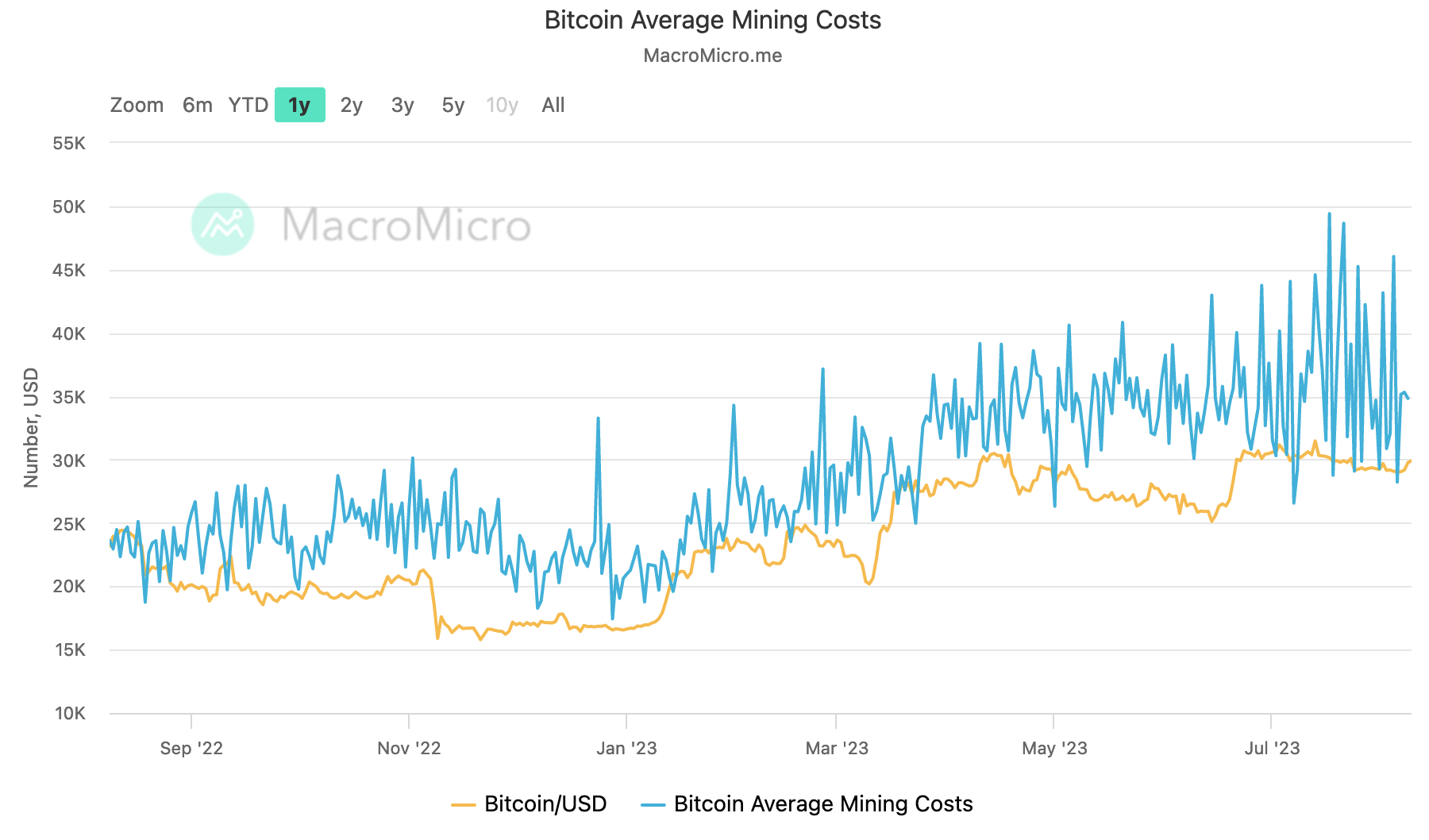
The highest average cost registered in the 1-year period was $49,415 on July 17, versus a price of $30,145/BTC on the same day, for a loss of around $19,270 per mined BTC.
Except for a few single-day deviations on the chart, Bitcoin miners were mostly mining underwater, according to the presented data. This makes mining businesses hedge their position with financial products such as energy futures contracts.
The entities that suffer the most are small and medium Bitcoin miners who can’t keep a profitable activity, losing market share and hashrate share for bigger miners — in a sort of economy of scale dynamic.
The most recent difficulty adjustment comes amid an energy crisis in Texas, one of the most prominent hubs for Bitcoin mining in the world, as reported by CBS News. Making energy even costier than before.
Bitcoin mining difficulty adjusted to 52.39 trillion
The block height 802368 was confirmed on August 9 with a positive adjustment of 0.10% on mining difficulty. It now requires 52.39 trillion hashes to a block to be considered valid.
On June 11 (block 798336), the difficulty was adjusted to an all-time high of 53.91 trillion (+6.45%), followed by a retrace on July 26 (block 800352) to 52.33 trillion hashes (-2.94%), which still holds this metric above historical data.
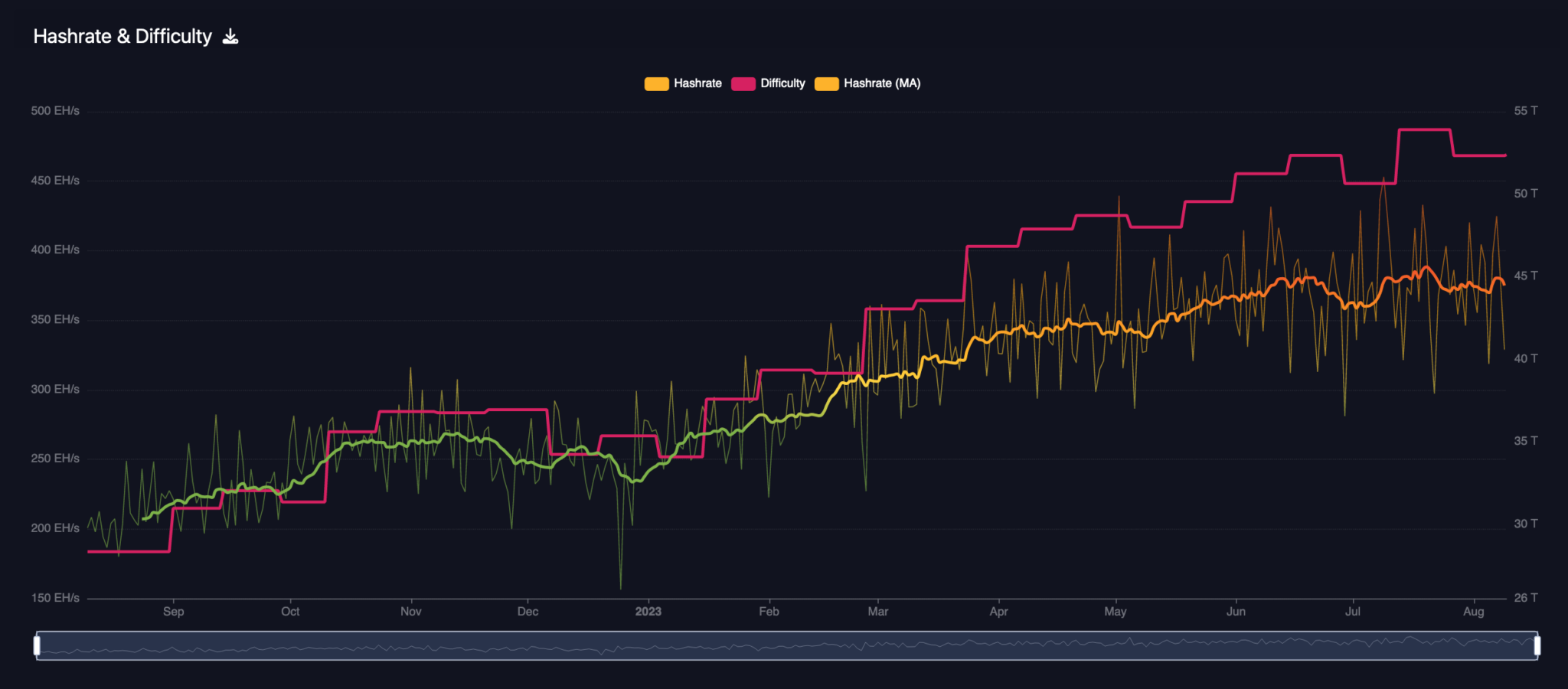
Difficulty adjustments are directly correlated with hashrate dynamics. The more proof-of-work (PoW) that is being computed by Bitcoin miners — measured by hashrate — the higher the chances that one of these miners will find a valid block in an interval lower than 10 minutes. Also valid for the opposite direction, when less hashrate on the network also means longer times between blocks.
What is the mining difficulty and how does it work
Mining through the proof-of-work system was the method chosen to secure the Bitcoin network and distribute new BTC to entities providing work and resources to the activity.
To guarantee a programmed distribution up to the maximum limit of 21 million, guaranteeing a controlled inflation of the BTC circulating supply, the Bitcoin protocol uses algorithms that help to keep the creation of a new block (with the corresponding payment of its reward) every about 10 minutes.
This algorithm works by adjusting mining difficulty. Evaluating the frequency of discovering new blocks over the last 2,015 blocks — about two weeks, assuming 10 minutes per block.
If the last 2,015 blocks are being mined in an interval greater than the desired 10 minutes, the mining difficulty needs to decrease, making it easier to mine more blocks in a shorter amount of time. The reverse is also correct: increasing the mining difficulty if the last 2,015 blocks have been discovered in an interval of less than 10 minutes between each block.
Although the adjustment is proportional to the computational power being used in the network, it cannot exceed four times the previous value. In case, the mining difficulty adjustment always needs to be less than 300%, in a raise; or less than 75%, in a reduction.
The mining difficulty is affected by including or removing the number of “zeros” that must go to the left of the other random characters.