Close Menu
  • Latest News
    • Market
    • Altcoins
    • Legal and Regulatory
  • Tech
    • Blockchain
    • Security and Privacy
  • Web 3
    • Web3 News
    • NFTs
    • Gaming
  • Learn
    • Education
    • Investments
    • Staking
    • Wallets and Exchanges
  • ICOs
  • Mining
  • Crypto Tools
    • Exchange Tool
  • Shop
What's Hot

Mapping LEO crypto’s path to $9.55 – But ONE hurdle remains

August 17, 2026

Crypto investors are looking past market-cap rankings and back to fundamentals

August 17, 2026

Two Tax Models Are on the Table, and €21,100 Separates Them

August 17, 2026
Facebook X (Twitter) Instagram
  • Contact
  • Privacy Policy
  • Terms & Conditions
Facebook X (Twitter) Instagram
CryptoPulseDaily.com
  • Latest News
    • Market
    • Altcoins
    • Legal and Regulatory
  • Tech
    • Blockchain
    • Security and Privacy
  • Web 3
    • Web3 News
    • NFTs
    • Gaming
  • Learn
    • Education
    • Investments
    • Staking
    • Wallets and Exchanges
  • ICOs
  • Mining
  • Crypto Tools
    • Exchange Tool
  • Shop
CryptoPulseDaily.com
Home»Mining»Bitcoin transaction fees surge to make up 75% of miner revenue post-halving
Mining

Bitcoin transaction fees surge to make up 75% of miner revenue post-halving

April 23, 2024No Comments4 Mins Read
Share
Facebook Twitter LinkedIn Pinterest Email

Bitcoin’s fourth halving introduced a long-term and a short-term shift in miner revenue composition as it reduced the amount of BTC rewarded to miners for each mined block by 50% — directly impacting miner incentives and, by extension, the broader Bitcoin economy.

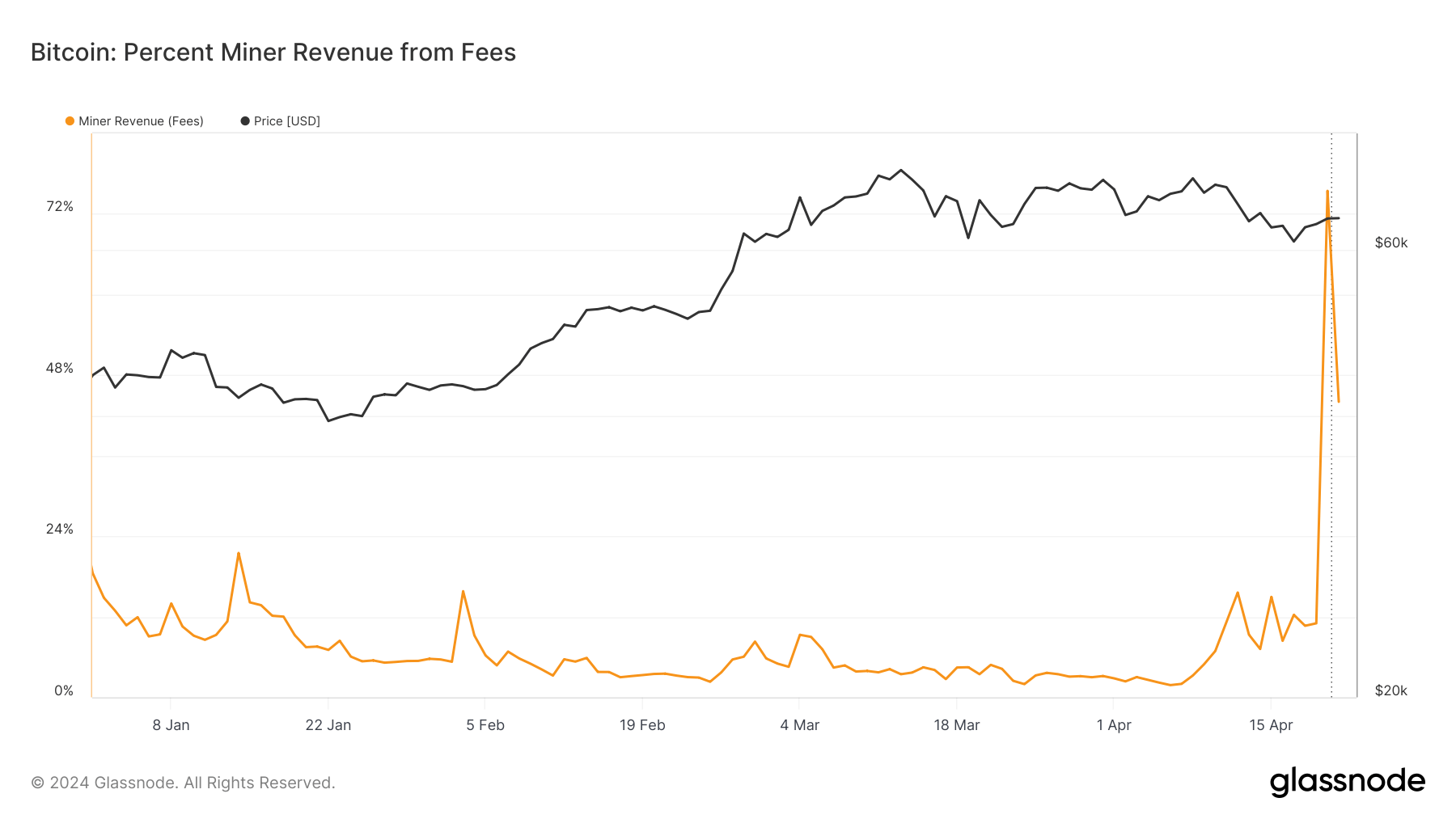
On April 19, just before the halving, transaction fees constituted 11% of total miner revenue, a figure that has been relatively stable throughout the year. However, the halving event on April 20 caused a substantial change, with transaction fees skyrocketing to over 75% of miner revenue.

Graph showing the percent of miner revenue coming from transaction fees from Jan. 1 to April 21, 2024 (Source: Glassnode)

The surge in fees can be attributed to a combination of factors. Firstly, a significant part of the market might have raced to settle their transactions before the halving, which has driven up transaction fees.

Secondly, there seemed to be a growing demand for transactions, and users wanted to be included in the halving block itself. Most of this demand could be attributed to Ordinals, as inscriptions on the coveted block 840,000 could be worth more on the secondary market.

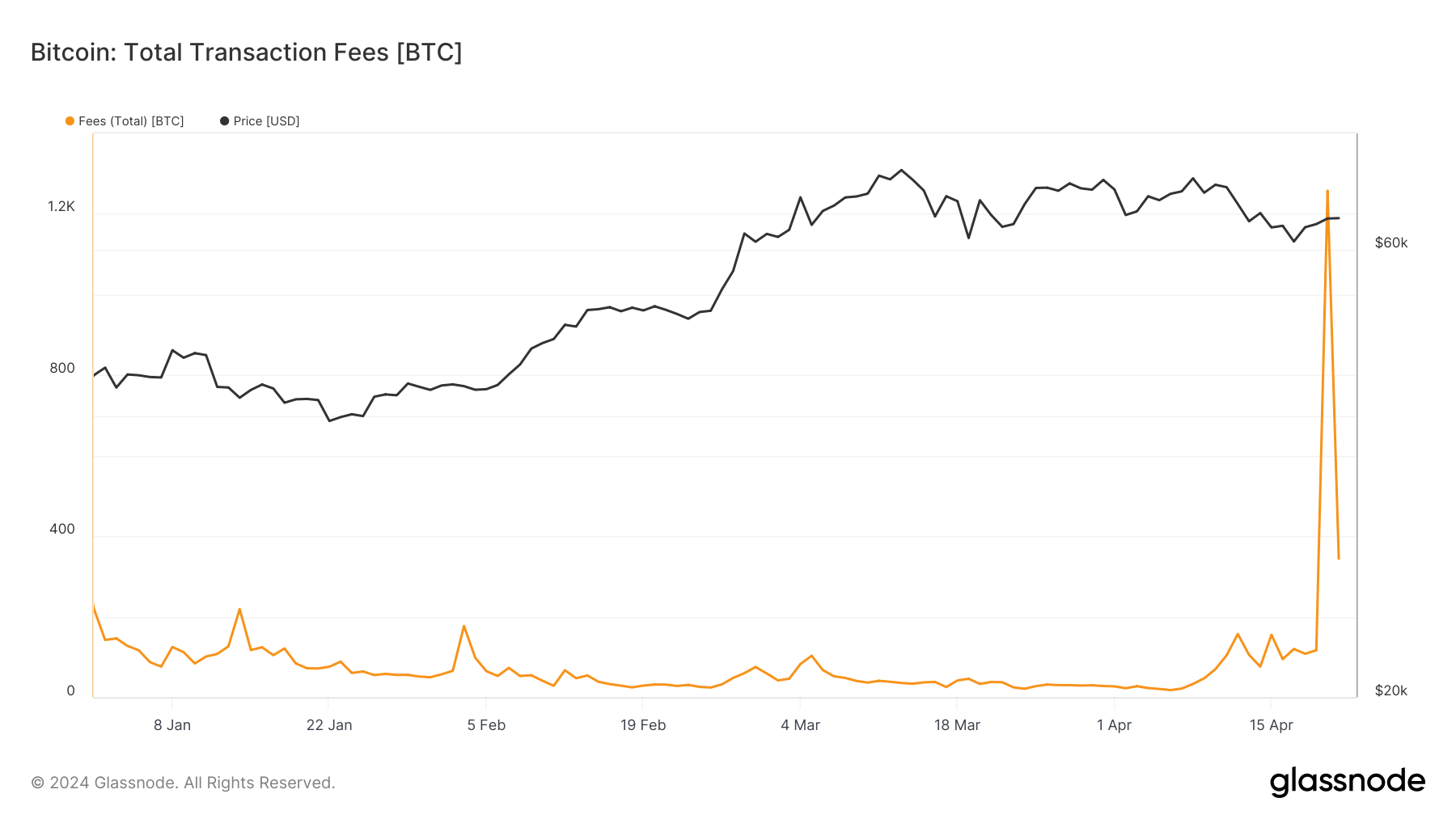
This demand for limited block space drove transaction fees to historic highs, which paid 1,257 BTC to miners on the day of the halving. On April 19, the day before the halving, the total fees paid to miners were 116 BTC, showing just how dramatic the escalation in transaction cost was.

The subsequent drop to 344 BTC in fees on April 21, while still significantly higher than pre-halving levels, shows the market normalized and began to adjust to the new mining economics.
bitcoin mining fees total ytd
Graph showing the total amount of transaction fees paid to miners from Jan. 1 to April 21, 2024 (Source: Glassnode)

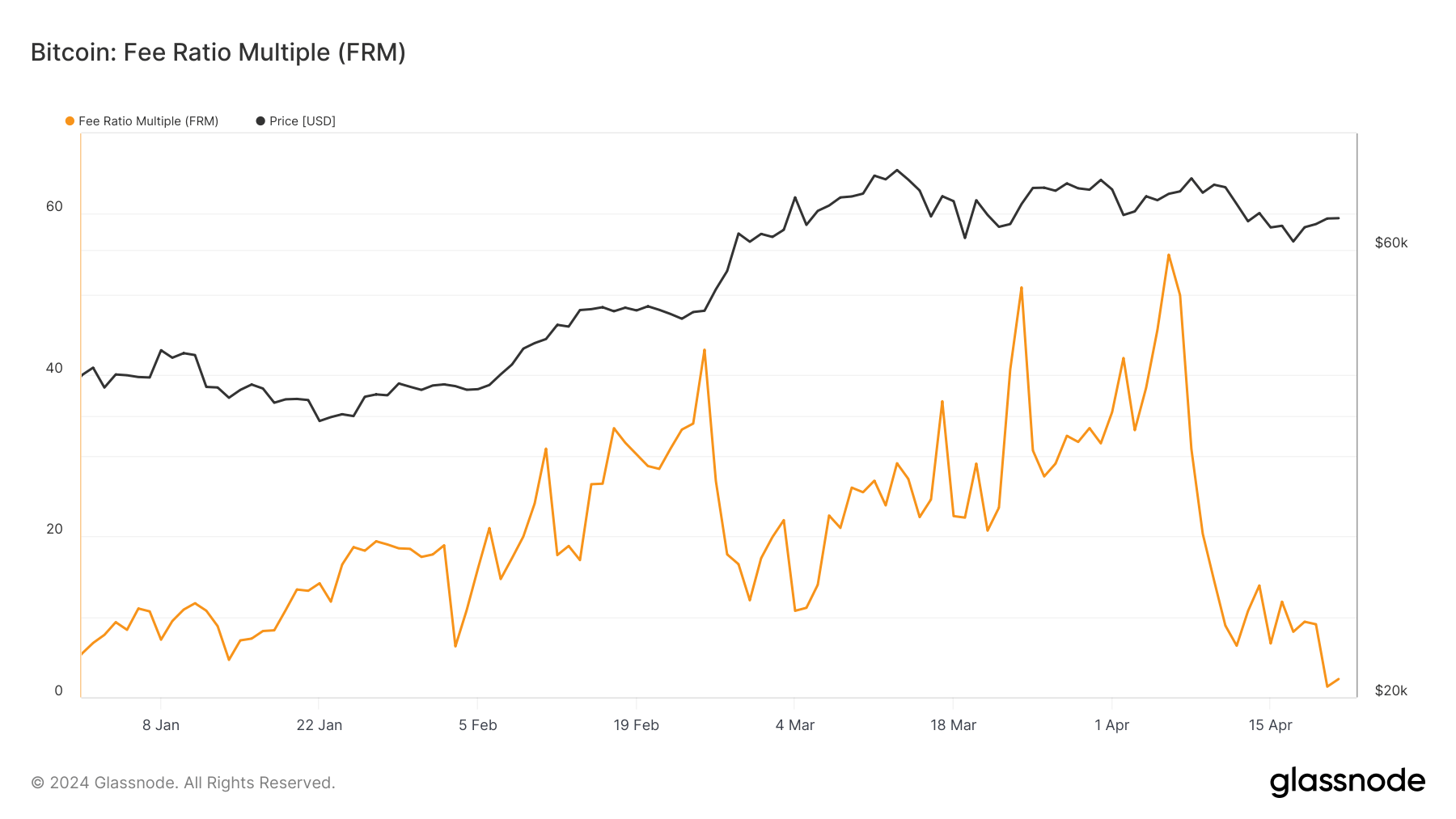
The Fee Ratio Multiple (FRM) clearly shows the impact of these heightened fees. The metric is used to evaluate the economic security of a blockchain, particularly as it transitions from block reward-based miner compensation to one predominated by transaction fees. The FRM is calculated by dividing the total miner revenue, consisting of block rewards and transaction fees, with the transaction fees.

See also  Secures 200 MW for Bitcoin Mining

This metric helps assess how much of the mining income is derived from transaction fees rather than block rewards, offering insights into the blockchain’s sustainability once block rewards are no longer a significant factor.

On April 19, the day before the halving, the FRM stood at 9.01. It indicates that the total miner revenue was approximately nine times the amount earned from transaction fees alone, with the majority of miner income still heavily reliant on block rewards.

As the block reward was reduced in half and the transaction fees increased, the FRM dropped to 1.325, showing just how dramatic the shift towards reliance on fees was. With the block reward reduced, transaction fees comprised a much larger proportion of the total miner revenue, decreasing the FRM value.
btc frm ytd
Graph showing the fee ratio multiple (FRM) from Jan. 1 to April 21, 2024 (Source: Glassnode)

A lower FRM value implies that the blockchain is moving closer to a state where it could theoretically sustain itself predominantly on transaction fees. This is crucial for its long-term security and viability as block rewards continue to halve until they cease.

However, this could negatively affect a large part of the network. As transaction fees begin to constitute a larger portion of miner revenue, the cost to users may increase, potentially affecting how transactions are prioritized and impacting user behavior. This could lead to even higher fee spikes during peak demand.

The post Bitcoin transaction fees surge to make up 75% of miner revenue post-halving appeared first on CryptoSlate.

Source link

Bitcoin Fees Miner PostHalving revenue surge transaction
Share. Facebook Twitter Pinterest LinkedIn Tumblr Email

Related Posts

What the CLARITY Act Actually Does for Bitcoin

August 16, 2026

Cboe pushes for 3x Bitcoin and Ethereum ETFs after 2x crypto funds suffer losses of up to 96%

August 16, 2026

Texas refuses to sell as its $10 million Bitcoin bet sinks to $6.6 million

August 16, 2026

Bitcoin price enters ‘fire sale’ zone – Is the BTC bottom near?

August 16, 2026
Add A Comment
Leave A Reply Cancel Reply

Top Posts

Band Protocol pioneers Oracle-Stellar Smart Contract integration

March 10, 2024

Indonesia to conduct blockchain trials for public services

October 14, 2023

Blast network’s layer 2 project falls prey to 500 ETH rug pull

February 26, 2024

Subscribe to Updates

Get the latest creative news From Crypto Daily Pulse directly in your Inbox!

Our mission is to develop a community of people who try to make financially sound decisions. The website strives to educate individuals in making wise choices about Crypto, ICOs, Web3, Blockchain and more.

We're social. Connect with us:

Facebook X (Twitter) Instagram Pinterest YouTube
Top Insights

Mapping LEO crypto’s path to $9.55 – But ONE hurdle remains

August 17, 2026

Crypto investors are looking past market-cap rankings and back to fundamentals

August 17, 2026

Two Tax Models Are on the Table, and €21,100 Separates Them

August 17, 2026
Get Informed

Subscribe to Updates

Get the latest creative news From Crypto Daily Pulse directly in your Inbox!

  • Contact
  • Privacy Policy
  • Terms & Conditions
© 2026 Crypto Pulse Daily - All rights reserved.

Type above and press Enter to search. Press Esc to cancel.

Cleantalk Pixel
  • bitcoinBitcoin(BTC)$63,324.000.50%
  • ethereumEthereum(ETH)$1,901.191.20%
  • tetherTether(USDT)$1.000.00%
  • binancecoinBNB(BNB)$604.26-0.30%
  • usd-coinUSDC(USDC)$1.000.00%
  • rippleXRP(XRP)$1.000.20%
  • solanaSolana(SOL)$75.440.10%
  • tronTRON(TRX)$0.3319860.40%
  • Figure HelocFigure Heloc(FIGR_HELOC)$1.00-0.50%
  • HyperliquidHyperliquid(HYPE)$58.903.30%