Close Menu
  • Latest News
    • Market
    • Altcoins
    • Legal and Regulatory
  • Tech
    • Blockchain
    • Security and Privacy
  • Web 3
    • Web3 News
    • NFTs
    • Gaming
  • Learn
    • Education
    • Investments
    • Staking
    • Wallets and Exchanges
  • ICOs
  • Mining
  • Crypto Tools
    • Exchange Tool
  • Shop
What's Hot

What Changes Will a 200 Millisecond Interval Make? Here Are the Details

October 13, 2026

MEXC Brings AI, TradFi and the Future of Trading to Life at TOKEN2049 Singapore

October 13, 2026

Coinbase’s Texas move gets a shareholder suit dismissed over Delaware-era claims

October 13, 2026
Facebook X (Twitter) Instagram
  • Contact
  • Privacy Policy
  • Terms & Conditions
Facebook X (Twitter) Instagram
CryptoPulseDaily.com
  • Latest News
    • Market
    • Altcoins
    • Legal and Regulatory
  • Tech
    • Blockchain
    • Security and Privacy
  • Web 3
    • Web3 News
    • NFTs
    • Gaming
  • Learn
    • Education
    • Investments
    • Staking
    • Wallets and Exchanges
  • ICOs
  • Mining
  • Crypto Tools
    • Exchange Tool
  • Shop
CryptoPulseDaily.com
Home»Security and Privacy»$10 test, then $30,750 loss
$10 test, then $30,750 loss
Security and Privacy

$10 test, then $30,750 loss

October 12, 2026No Comments3 Mins Read
Share
Facebook Twitter LinkedIn Pinterest Email

Lookalike payment addresses targeted nearly 4.5 million Solana wallets over 11 months, according to blockchain-data firm Bitquery’s Oct. 9, 2026 findings. The findings show why a successful small test transfer can still precede a much larger payment to a scammer.

The technique, known as address poisoning, plants a misleading entry in a wallet’s payment history. A tiny incoming transfer puts the sender’s lookalike address near a legitimate payment. If the user later copies that address, they can send money to the wrong recipient.

Related Reading

Ethereum metrics hit record high because of cheap gas fees – because of this massive scam

A Solana test transfer can reach the wrong address

Bitquery describes a Nov. 17, 2025 case in which a wallet first paid $10 in USDT to its Gate.io deposit address. A lookalike sent dust 12 seconds later. The wallet then sent a second $10 test to the fake, followed by 30,749.80 USDT to that same address.
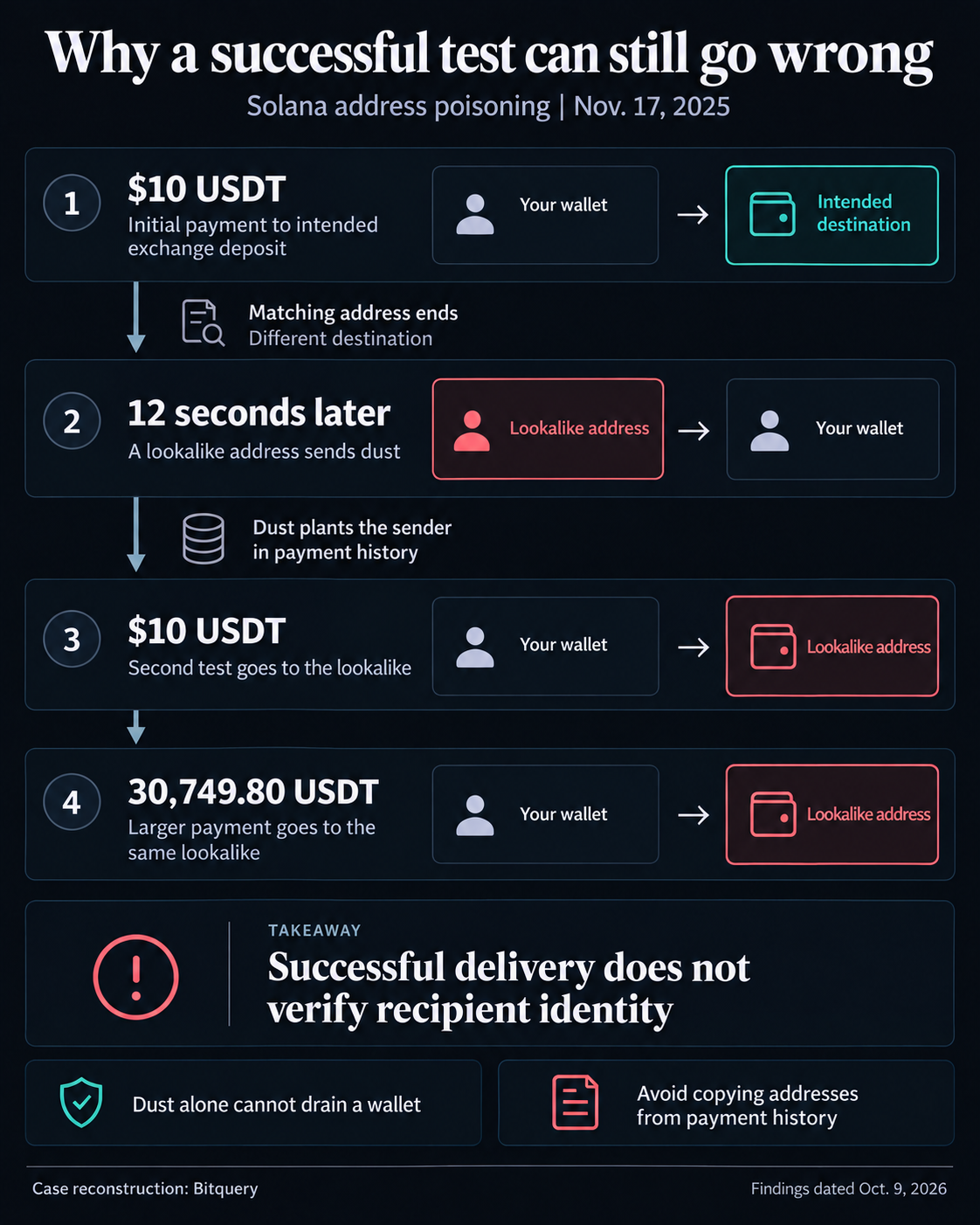
Bitquery’s November 17, 2025 Solana case: an initial $10 USDT exchange payment was followed by dust from a lookalike, then a $10 test and 30,749.80 USDT payment to that lookalike. Successful delivery does not verify recipient identity.Bitquery’s November 17, 2025 Solana case: an initial $10 USDT exchange payment was followed by dust from a lookalike, then a $10 test and 30,749.80 USDT payment to that lookalike. Successful delivery does not verify recipient identity.

The implication is that a successful test confirms delivery to the selected address, but cannot establish who controls it. If the destination was copied incorrectly, repeating the payment repeats the mistake.

The Catalyst

Daily Newsletter

Know what’s moving crypto.

Start with the stories that matter. Get the context behind the headlines and a clear view of what to watch next.

Related Reading

Crypto phishing scam nets $129 million in USDT then funds mysteriously return

Receiving dust does not itself drain a wallet in this mechanism. The loss occurs when its owner subsequently authorizes a payment to the lookalike.

Bitquery counted 4,497,798 targeted wallets from Oct. 30, 2025, through Oct. 7, 2026. Its rule required a same-day payment of at least $1 in SOL, USDC or USDT, followed by dust or a fake stablecoin token from a different address matching at least three characters at each end of the payee.

See also  AvaCloud helps Citi test a unique application

The loss analysis used a smaller subset: approximately 3.0 million wallets poisoned through July 9, 2026. Of those, 1,104 made qualifying payments totaling $940,106. The wider targeting count does not mean 4.5 million wallets lost money.

Related Reading

Polygon’s 8 million USDT0 holders face scrutiny as 58% of growth matches scam patterns

The loss total is a floor. It counts payments of at least $1 within 90 days of the first dust. Beyond that window, a payment could qualify if more dust arrived that day. Wallets poisoned after July 9 and payments outside those rules were excluded. Bitquery also removed likely existing relationships, such as pairs with earlier payments or repayments; some genuine thefts may have been excluded.

Phantom’s address-poisoning guidance advises avoiding addresses copied from transaction history and verifying the address before sending.

Its receiving-payment instructions separate the checks: first confirm the exact recipient address and network, then look up the transaction status on an explorer. Phantom also says it cannot recover tokens sent to the wrong address.

Source link

Loss Test
Share. Facebook Twitter Pinterest LinkedIn Tumblr Email

Related Posts

Cryptobilis Founder Reveals Company Was Sold Months Before Exploit

October 13, 2026

Who Pays and Who Gains as Ledger Drama Fuels Multisig Adoption

October 12, 2026

Sleuth ZachXBT Blasts Ripple’s Cheap $250K Payout for 18T XRP Bug

October 12, 2026

Ledger wallet implant reveals Genuine Check’s limits

October 12, 2026
Add A Comment
Leave A Reply Cancel Reply

Top Posts

Russia’s Crypto Mining ‘Legalization’ Bills Could Be Approved ‘This Week’

July 25, 2024

David Schwartz to Unveil Blockchain Interop Plans at ETH Denver

January 29, 2024

Blockchain really is better than middlemen

March 15, 2024

Subscribe to Updates

Get the latest creative news From Crypto Daily Pulse directly in your Inbox!

Our mission is to develop a community of people who try to make financially sound decisions. The website strives to educate individuals in making wise choices about Crypto, ICOs, Web3, Blockchain and more.

We're social. Connect with us:

Facebook X (Twitter) Instagram Pinterest YouTube
Top Insights

What Changes Will a 200 Millisecond Interval Make? Here Are the Details

October 13, 2026

MEXC Brings AI, TradFi and the Future of Trading to Life at TOKEN2049 Singapore

October 13, 2026

Coinbase’s Texas move gets a shareholder suit dismissed over Delaware-era claims

October 13, 2026
Get Informed

Subscribe to Updates

Get the latest creative news From Crypto Daily Pulse directly in your Inbox!

  • Contact
  • Privacy Policy
  • Terms & Conditions
© 2026 Crypto Pulse Daily - All rights reserved.

Type above and press Enter to search. Press Esc to cancel.

Cleantalk Pixel
  • bitcoinBitcoin(BTC)$83,661.00-0.33%
  • ethereumEthereum(ETH)$2,531.32-1.25%
  • tetherTether(USDT)$1.000.00%
  • binancecoinBNB(BNB)$745.12-1.17%
  • rippleXRP(XRP)$1.38-2.46%
  • usd-coinUSDC(USDC)$1.000.01%
  • solanaSolana(SOL)$108.57-3.38%
  • tronTRON(TRX)$0.330108-0.63%
  • Figure HelocFigure Heloc(FIGR_HELOC)$1.060.00%
  • zcashZcash(ZEC)$1,217.59-8.12%