The question of age has been recurring when holding public office. Especially in the context of the digital age and technological breakthroughs.
The cryptocurrency industry is a stark testament to this phenomenon. And one cannot help but wonder whether members of the United States Congress who are over 80 years old are in a position to understand and regulate this market.
The Octogenarian US Congress Members
The seasoned politicians over 80 years old include names like Senator Charles Grassley (R-IA) and Dianne Feinstein (D-CA), both aged 89. Additionally, stalwarts like House Speaker Nancy Pelosi (D-CA) and Senate Minority Leader Mitch McConnell (R-KY) make the cut.
Here is the full list of the oldest US Congress members at the vanguard of crypto regulation:
- Charles Grassley (R-IA) is 89 years old.
- Dianne Feinstein (D-CA) is 89 years old.
- Grace Napolitano (D-CA) is 86 years old.
- Bill Pascrell Jr. (D-NJ) is 86 years old
- Eleanor Norton (D-DC) is 85 years old.
- Harold Rogers (R-KY) is 85 years old.
- Maxine Waters (D-CA) is 84 years old.
- Steny Hoyer (D-MD) is 84 years old.
- James Clyburn (D-SC) is 83 years old.
- Nancy Pelosi (D-CA) is 83 years old.
- Bernie Sanders (I-VT) is 81 years old.
- Danny Davis (D-IL) is 81 years old.
- John Carter (R-TX) is 81 years old.
- Mitch McConnell (R-KY) is 81 years old.
- Anna Eshoo (D-CA) is 80 years old.
- Fredrica Wilson (D-FL) is 80 years old.
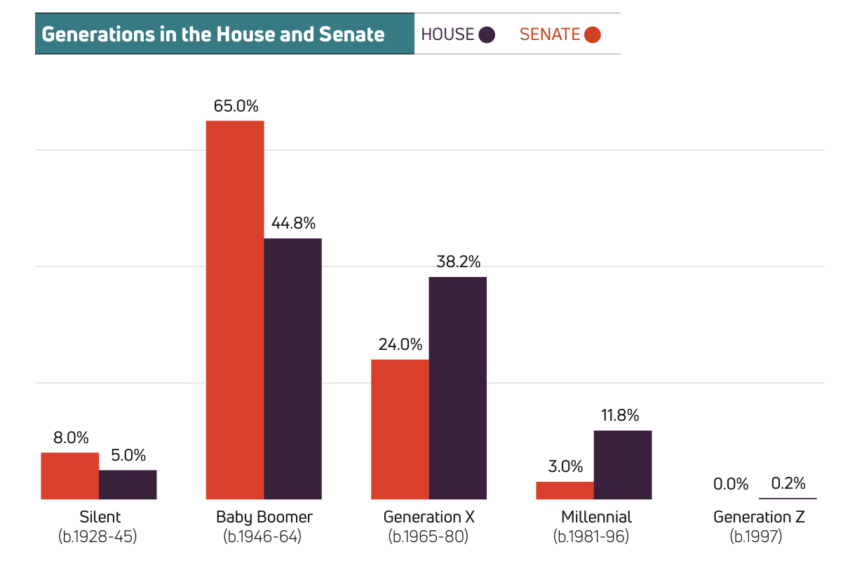
US Congress Members by Generations. Source: FiscalNote
The fact that these Congress members are of advanced age is not inherently problematic. Indeed, experience, wisdom, and a lifetime of public service offer invaluable insights into governance.
However, the rapid evolution of technology, especially in areas like crypto, challenges even the brightest and most contemporary minds.
“As a whole, Congress is far too old. Young people deserve a voice in government as much as any American. We need representatives in government who understand what it is like to grow up in Generation Z,” said Jack Lobel, a press secretary for Voters of Tomorrow.
Read more: This Congressman Wants to End America’s War on Crypto
The Complexity of Regulating Crypto
The current Congress members’ complexity in regulating crypto lies in multiple facets, such as technical intricacies, economic implications, and regulatory challenges.
- Technical Intricacies: At its core, cryptos operate on blockchain technology. Understanding the decentralized nature of blockchains, cryptographic hashes, and public and private keys requires significant technical knowledge. Hence, this could be an important barrier for individuals who did not grow up in the digital age or did not adapt to its changes.
- Economic Implications: Cryptocurrencies reshape how one views currencies, assets, and commodities. Consequently, the volatility of crypto, the speculative nature of investments, and their implications for national and global economies are matters of considerable debate.
- Regulatory Challenges: The decentralized and often anonymous nature of crypto makes them resistant to traditional regulatory approaches. Therefore, drafting effective laws requires understanding the mechanics of cryptos and the ethos driving their adoption.
Considering these complexities, one might wonder if it is plausible for the octogenarians of Congress to draft and vote on effective cryptocurrency-related legislation.
Read more: Regulating Crypto: What Are the Benefits and Drawbacks?
Some critics argue that this age group may not fully grasp the intricacies. Therefore, they rely heavily on advisers and industry experts, which could lead to regulations that might be ineffective or even detrimental.
US Congress Crypto Regulation Initiatives
Despite the age issue, the 118th Congress witnessed a whirlwind of activity centered around crypto legislation from July 26 to July 28. This initiative aimed to lay the groundwork for defining digital assets, determining their regulatory bodies, and understanding the nuances of crypto’s inclusion under the Bank Secrecy Act (BSA).
The cornerstone of these discussions was the division of the Securities and Exchange Commission (SEC) and the Commodity Futures Trading Commission’s (CFTC) jurisdictions. The contention arises because of the lack of clear guidance on classifying a token as a security or a commodity.
While the SEC has largely viewed all digital assets barring Bitcoin, as securities, Senators like Cynthia Lummis (R-WY) and Kirsten Gillibrand (D-NY) beg to differ.
“Companies like Kraken and Coinbase have gone to the SEC and asked them to be clear and lay out the regulatory requirements that the SEC believes should apply to them. And they’re frustrated because they feel like they were trying to comply, but instead some of them got enforcement actions slapped on them,” said Lummis.
Read more: The Full List of Cryptos Named Securities in SEC Lawsuits Against Binance and Coinbase
Still, Representative French Hill (R-AR) is fighting to bring digital commodities under the Commodities Exchange Act. His “FIT for the 21st Century Act” is an example that has seen a rapid move through the House Committees.
Besides regulatory classifications, stablecoin legislation has garnered significant attention. With the total stablecoin market capitalization exceeding $125 billion, Patrick McHenry (R-NC) released a discussion draft to focus on stablecoin regulation.
America’s War on Crypto
While figures like Elizabeth Warren (D-MA) remain skeptical of crypto, associating it primarily with illicit activities, the industry is responsible for addressing these concerns.
Read more: Senator Elizabeth Warren Wants to Form an Anti-Crypto Army
Interestingly, Congress appears to be making strides toward crypto regulation. The Blockchain Regulatory Clarity Act and the Financial Technology Protection Act address cryptocurrency’s legitimacy and compliance with the BSA.
Quoting Congressman Tom Emmer (R-MN), there is a pressing need to bring “clarity where none exists.” And while the path to such clarity remains convoluted, one hopes that the combined expertise of Congress, regardless of age, can lead the United States to a promising crypto future.
Still, the question remains: Does age represent a number, or does it indicate a potential gap in understanding cryptocurrencies?