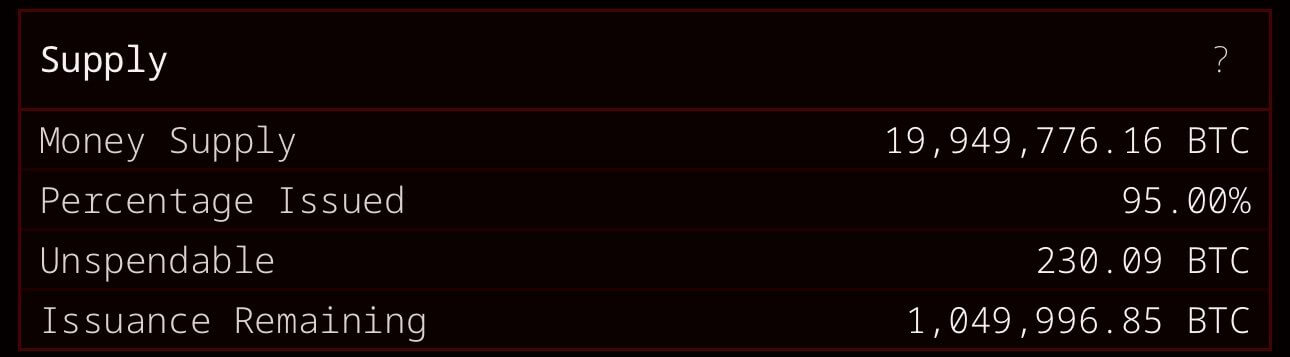
Bitcoin crossed a watershed moment in its monetary history on Nov. 17, surpassing 19.95 million mined coins and pushing the network past 95% of its immutable 21 million supply cap. This leaves the network with less than 1.05 million BTC to mine over the next 115 years.
On the surface, the milestone appears to be a victory lap for the digital asset as it represents a validation of the scarcity narrative that has driven its adoption by Wall Street giants and sovereign balance sheets alike.
Yet, for the industrial operators responsible for securing the blockchain, the celebration is muted.
In reality, the crossing of the 95% threshold marks the beginning of Bitcoin’s most capital-intensive and operationally unforgiving phase: the “5% Era.”
Bitcoin’s mathematics of the long tail
Bitcoin’s issuance schedule is not a linear progression but a geometric decay, governed by the “halving” event. This is a hard-coded event that reduces block rewards by 50% every 210,000 blocks, or approximately every four years.
When the network launched in 2009, miners could extract 50 BTC every ten minutes. Today, following the April 2024 halving, that reward stands at just 3.125 BTC. This decay function means that while the network is nearing its supply ceiling in terms of quantity, it is only at the midpoint in terms of time.
The final 5% of supply will be stretched across a century-long timeline, with the very last partial bitcoin not expected to be mined until the year 2140.
For macro investors, this trajectory is the core investment thesis. Bitcoin is transitioning from a youthful, high-inflation asset into a mature commodity with an inflation rate destined to drop below that of gold and, eventually, near zero.
This programmatic scarcity is precisely what fueled the approval of spot ETFs and the entry of institutional capital.
However, for miners whose business models were built during an era of abundant subsidies, this transition represents a looming revenue cliff. The era of “easy money” mining is mathematically over.
The miner’s paradox
The economic strain of this transition is not a theoretical future problem; it is visible in today’s on-chain data. The “5% Era” is beginning under arguably the most difficult market conditions in the network’s history.
Hashprice, which is the industry standard metric for tracking miner revenue per unit of hashrate, plummeted to $38.82 per petahash per second (PH/s) per day last week.
This represents a 12-month low and a severe contraction from the $80-$100 levels seen during previous bull market cycles.

The collapse in revenue is driven by a “Miner’s Paradox”:
- Price Weakness: With Bitcoin trading below $90,000, the fiat value of the 3.125 BTC block reward is insufficient to cover the operational expenditure (OpEx) of older fleets.
- Record Difficulty: Despite falling revenue, the network hashrate has not capitulated. It remains elevated near 1.1 zettahash per second (ZH/s).
Typically, when revenue drops, inefficient miners unplug, difficulty adjusts downward, and margins recover for the survivors.
That mechanism appears broken in the short term. Miners, flush with capital raised during previous quarters or locked into long-term hosting contracts, are keeping machines running at a loss or breakeven.
On-chain data reveals the damage: the industry recently earned a weekly average of just over $37 million per day, a sharp decline from the $40 million-plus daily averages seen months prior.

As a result, the sector is currently caught in a vice where revenues are falling while the difficulty of extraction rises, a dynamic that invariably leads to consolidation.
The pivot to AI
Facing this structural margin compression, the mining industry is fracturing into two distinct camps: the “Pure Plays” who are doubling down on Bitcoin efficiency, and the “Hybrid Operators” who are fleeing the sector entirely for a more lucrative market in Artificial Intelligence.
The logic is strictly improved unit economics. The same power capacity and cooling infrastructure used to mine Bitcoin can, with hardware adjustments, be used to power High-Performance Computing (HPC) and AI model training.
Currently, the arbitrage is massive because AI compute can yield exponentially higher revenue per megawatt-hour than Bitcoin mining.
In 2024, VanEck analysts quantified this opportunity, projecting that Bitcoin miners could unlock up to $38 billion in incremental annual revenue by diverting just 20% of their power capacity toward AI and HPC workloads.

The market is already witnessing this capital flight. Bitfarms, a name once synonymous with aggressive Bitcoin hashrate expansion, signaled a distinct shift with its recent announcement to wind down specific crypto operations in favor of AI compute.
Meanwhile, other operators across Texas and the Nordics, including Coreweave and Hive Digital, are also retrofitting facilities to capitalize on the AI boom.
This shift signals a broader transformation. The Bitcoin miners of the future may not be “miners” at all, but massive, hybrid energy-compute conglomerates where Bitcoin mining is merely a secondary revenue stream used to monetize excess power when AI demand dips.
This diversification may save the companies, but it raises questions about the long-term distribution of hashrate dedicated solely to securing the Bitcoin ledger.
The fee market
If the block subsidy is destined to vanish and miners are pivoting to AI, what will secure the Bitcoin network in 2030, 2040, or 2100?
Satoshi Nakamoto’s design posits that as the subsidy disappears, it will be replaced by transaction fees (the “service charge”). In this theory, demand for blockspace, driven by high-value settlements and financial applications, will become robust enough to compensate miners for maintaining the network.
However, the “5% Era” will test this thesis.
Currently, the fee market is volatile and unreliable. While the introduction of “Inscriptions” and “Runes” (protocols that allow data to be inscribed on satoshis) created brief spikes in fee revenue, the baseline demand for blockspace often remains too low to sustain the current hashrate without subsidies.
So, if Bitcoin’s price does not double every four years to offset the halving, transaction fees must rise to fill the void.
However, if they do not, Ethereum researcher Justin Drake has argued that the network’s security budget, which is the total amount of money allocated to protect the chain from attacks, will shrink.
In that scenario, Drake said this could have a “systemic effect” on the emerging industry and “the fallout could take the entire crypto ecosystem with it.”
Miners face “Bitcoin’s most difficult phase”
Considering the above, the 95% supply milestone is less a finish line and more of a starting gun for Bitcoin’s most challenging phase.
The “free ride” of high inflation is over. For the first 16 years, miners were subsidized by the protocol to build out infrastructure.
Now, that subsidy is evaporating. The market structure is shifting from a gold rush, where anyone with a pickaxe could profit, to a brutal commodity market defined by economies of scale, energy arbitrage, and balance sheet efficiency.
Still, Bitcoin’s long-term vision remains intact. Its design ensures that scarcity compounds while monetary inflation trends toward zero.
However, the burden of enforcing that scarcity now falls heavily on the miners.
So, as the rewards for securing the network dwindle toward zero over the next 115 years, the mining industry will likely experience a washout of unprecedented scale.
Essentially, the operators who survive the “5% Era” will not only be miners, but also energy merchants and computing giants. Their struggle to extract the final million coins will shape not only the price of the asset but also the geopolitical reality of the network itself.