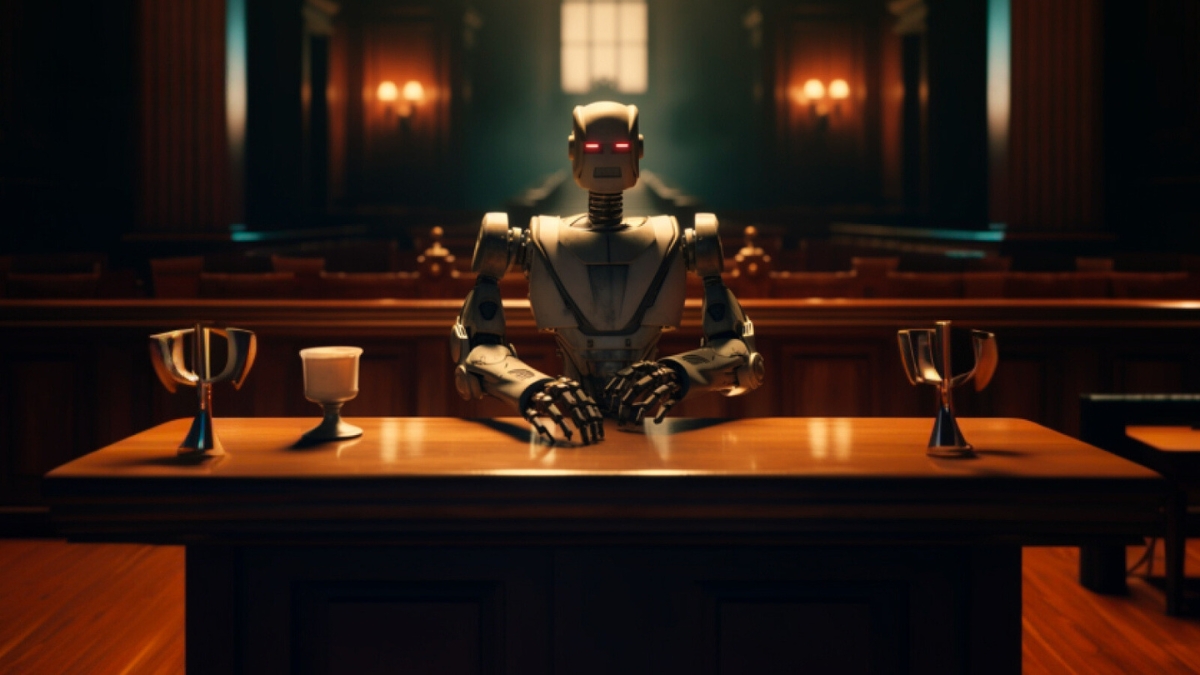
For the U.S. Copyright Office (USCO), an AI-generated work does not satisfy the “authorship” requirement of the U.S. Copyright Act.
Last week, a U.S. federal court upheld a previous decision made by the U.S. Copyright Office to rightfully deny copyright protection for any submitted generative AI works in the United States.
Since the beginning of 2023, almost a dozen copyright or similarly related lawsuits have been filed against AI platform services that center around whether or not AI-generated works satisfy the “authorship” element. The majority of what we’ve seen to date has been concerns surrounding training data and the relationship between the data sets it analyzes and the outputs it generates.
IP Watchdog’s Franklin Graves listed nine cases that currently focus on these issues, ranging from Getty Images (US) and Stability AI to OpenAI, Meta, and Alphabet.
Earlier this month, The New York Times updated its Terms of Service to restrict its content from being used to train any machine learning system or AI algorithm.
Unfortunately, a good chunk of the material that OpenAI uses in its training datasets comes from previously established copyrighted works – without consent, credit, and compensating the author.
Dr. Stephen Thaler’s Battle With the USCO
Last week’s Order from the Court stems from Dr. Thaler’s initial June 2022 complaint against the USCO, where he argues that an AI-generated work should be afforded copyright protection.
The work in question is an AI-generated work called “A Recent Entrance to Paradise,” which was the output of Dr. Thaler’s AI system, “Creativity Machine.”
In January, he filed a motion for summary judgment, arguing that pursuant to the U.S. Copyright Act, an individual should be allowed to register for copyright protection in a creative work that is generated by artificial intelligence.
In his motion for summary judgment, Dr. Thaler asked for the U.S. District Court to issue an order that would require the USCO to set aside the Review Board’s February 2022 decision upholding the USCO’s previous stances in denying copyright registration for his work – and instead, reexamine his initial copyright registration application for the work.
He put forth four arguments to support his position:
- The plain language of the U.S. Copyright Act as it currently reads, allows for copyright protection of AI-generated works similar to protections granted to non-human entities and corporations, satisfying the “authorship” requirement.
- Since the U.S. Supreme Court’s (SCOTUS) decision in the 1800 case of Burrow-Giles Lithographic Co. v. Sarony, which the Review Board stated in its opinion letter, there is a lack of knowledge and subsequently, a lack of case law that supports the USCO’s position.
- The courts should apply the Turing Test, which was developed in 1950 by Alan Turing, whereby the courts should work to answer the question of “whether a machine can make something indistinguishable from a person for purposes of copyright protection?” To support this, he referenced two cases from the Ninth Circuit – a case involving a book partially created by spiritual beings (Urantia Foundation v. Maaherra) and the monkey selfie case (Naruto v. Slater).
- The AI-generated work could be classified as a “work-for-hire.” He emphasized that while an AI is not an “employee” or an “independent contractor” under the doctrine in terms of having the ability to execute a contract, AI “functionally behaves” and as such, should be granted a similar status.
The USCO didn’t bite on any of the arguments, filing its motion for summary judgment that, if granted, would automatically dismiss the case with respect to the specific issues presented, in favor of the USCO.
Dr. Thaler filed his response in March, arguing that due to our technological advances, the current provisions of both the U.S. Copyright Act and the U.S. Constitution should be interpreted with outside materials, including anything prior to its legislation that can better speak to the issue at hand. He specifically points out that “this is perhaps the paradigmatic case of technological evolution” that requires this type of statutory interpretation.
Where We Are Right Now
The biggest concern right now, which IPWatchdog recognizes, is that the USCO currently relies on an “honor system” for disclosing whether a work was generated by an AI software or a similarly related algorithm.
This was something Dr. Thaler highlighted in his initial complaint – if he had submitted the same AI-generated work, listing his company as the author, the USCO would never have known and most likely have granted his company copyright protection. However, the Review Board does have criminal penalties for anyone who “knowingly makes a false representation of a material fact” in their copyright registration application.
The reality is we are watching the formation of legal precedent surrounding copyright protection (and patent protection) for AI-generated works and the relationship between the materials its datasets are trained on and the outputs these machines and algorithms are spitting out.
Graves, who went deeper into the way forward, laid out his question on where we are on this “creation-generation spectrum” that draws the line between whether a work is eligible for copyright registration or not.
And that brings us further down the rabbit hole of the conundrum we currently are facing with digital art and NFTs right now.