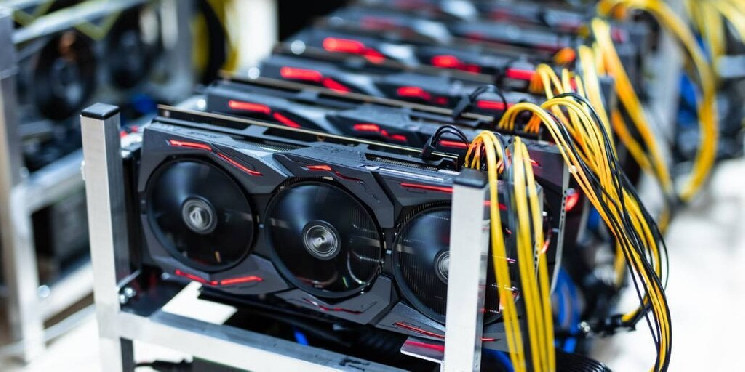
In the midst of shrinking revenues and rising operational costs, industry experts tell Decrypt that Bitcoin miners are continuing to invest in new, specialized hardware, displaying strong confidence in the future of the leading crypto network despite short-term struggles.
According to a Glassnode report released this week, Bitcoin’s hash rate—an essential measure of mining activity—remains near all-time highs, just 1% shy, even though revenues have plummeted.
The mining industry is currently facing a double challenge: increasing mining difficulty and declining transaction fee revenue. As the hash rate rises, so does the difficulty of mining and earning a BTC block reward, thus pushing production costs higher.
This, combined with cooling demand for high-fee transactions like those from Runes tokens and the NFT-like Ordinals, has squeezed miners’ profitability in recent months. Still, miners continue to invest in new ASIC hardware, in part due to the need to stay competitive in an environment where older machines are rapidly becoming obsolete.
One major factor driving this trend is improved energy efficiency in modern ASIC equipment, which helps miners manage operating costs.
Speaking with Decrypt, Illia Otychenko, lead analyst at crypto exchange CEX.IO, said that the energy efficiency of dedicated Bitcoin mining hardware “more than doubled” from 2018 to 2023, “significantly reducing the energy consumption per coin produced.”
This advancement allows miners to mitigate rising electricity costs and mining difficulty, keeping profitability intact even amid unfavorable market conditions.
While the price of Bitcoin remains relatively strong, transaction fee pressure has eased, further squeezing miners’ profits. With transaction fee revenue now a small fraction of what it once was, miners are leaning more heavily on block subsidies to sustain operations.
Interestingly, miners are now shifting their strategies in response to this revenue squeeze.
Historically, they sold the bulk of their mined Bitcoin to cover operational costs, but the report highlights that many are now retaining a portion of their mined supply in treasury reserves. Marathon Digital, for example, announced in July that it would adopt a “full HODL” strategy, saying it would no longer sell mined BTC. In fact, it has bought more from the market, as well.
Jeffrey Hu, head of investment research at HashKey Capital, sees this as a sign of confidence in Bitcoin’s long-term value.
“Miners retaining a portion of their mined supply suggests they are banking on future price appreciation,” Hu told Decrypt. “It’s a sign of confidence and could reduce selling pressure in the market, potentially supporting prices.”
However, Hu also cautions that this strategy comes with risks, particularly if miners are forced to sell reserves during downturns, which could exacerbate sell pressure.
Ryan Lee, chief analyst at Bitget Research, attributed the reasons behind the rising hash rate partly to the reintroduction of older mining rigs, which are becoming profitable again with Bitcoin’s price gains over the past year.
“Older machines are being brought back into operation as Bitcoin’s price makes previously unprofitable hardware viable. This, combined with new investments in more efficient machines, is driving the total hash rate higher,” says Lee.
He also points to recent regulatory support in regions like Russia, along with positive signals from figures like former President Donald Trump, who has come out in support of Bitcoin and the crypto industry amid his latest run to return to the White House. Such shifts have bolstered the hash rate by reducing market uncertainty, Hu noted.
While these factors help offset some of the revenue challenges, experts agree that miners need to explore alternative revenue streams to ensure long-term profitability. When Decrypt surveyed the mining landscape at Bitcoin 2024 in July, there was a sense that firms were weathering an “identity crisis” of sorts—but it’s one that could ultimately help them in the long run.
Livepeer co-founder and CEO Doug Petkanics suggested that Bitcoin miners are well-positioned to diversify into AI computing, which demands vast amounts of compute power.
“The demand for AI compute power is growing exponentially. With their existing energy and cooling infrastructure, miners could tap into this market by adding GPUs and providing a new revenue stream,” said Petkanics.
Diversification could be key to surviving the increasingly competitive landscape of the mining industry. Firms like Core Scientific and Bitdeer are among those who are providing computing power for AI needs to shore up potential shortcomings with their Bitcoin business.
Otychenko predicts further consolidation, with capital-rich miners outlasting smaller operations.
CleanSpark’s acquisition of GRIID for $155 million in June this year, is a prime example, boosting its hosting capacity as part of its growth strategy. Similarly, Bitfarms recently acquired Stronghold Digital Mining, while Riot Platforms has acquired a 19% stake in Bitfarms to influence its direction.
Companies like Marathon Digital also see future acquisition opportunities to secure low-cost energy and scalable infrastructure.
“We may see further mergers and acquisitions as larger miners absorb struggling competitors to expand their market share,” he notes. For those unable to adapt, the rising operational costs may prove unsustainable, leading to a shake-up in the industry.
Hu also points to the possibility of new financing products designed to protect miners from market volatility, as well as innovative ways for mining pools to generate additional revenue, such as merged mining for new layer-2 solutions on Bitcoin.
“The mining industry might also grow in regions like the Middle East, where natural resources and a rapidly growing crypto business present new opportunities,” he adds.
However, even with diversification, miners’ profitability remains heavily reliant on block rewards, which currently account for over 90% of their revenue.
“Transaction fees only become significant during fee spikes, as we saw with Runes and Ordinals, but such events are temporary,” Otychenko said. “Block rewards are still the main revenue driver.”
Lee echoed this sentiment, warning that miners will eventually need to rely more on transaction fees as block rewards diminish with each halving cycle. He predicted that Bitcoin’s price could surge during the next bull cycle, potentially reaching $150,000.
This would attract more retail participation in mining, as smaller players enter the market by purchasing older, more affordable machines.
“While larger miners may shift toward asset management,” Lee said, “retail miners could generate consistent cash flow if Bitcoin’s price continues to rise.”
Edited by Andrew Hayward and Ryan Ozawa