
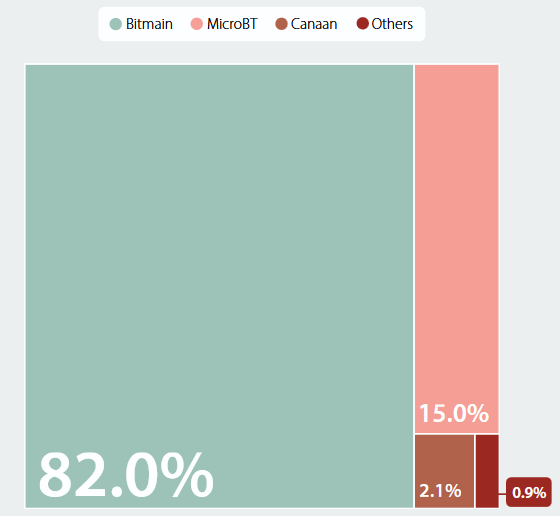
Cambridge describes this hardware market as highly oligopolistic. Such concentration means that if something goes wrong with one manufacturer, then a large share of the network’s machines could be affected. For example, the outcome of a U.S. national security investigation into Bitmain remains unknown. Bloomberg reported in November 2025 that a Department of Homeland Security-led probe was examining whether Bitmain machines could be accessed remotely for spying or to disrupt the U.S. power grid. Bitmain has denied posing any risk to U.S. national security.
Also, Bitdeer, which was spun off from Bitmain in 2021, manufactures its chips at TSMC in Taiwan. Bitmain has reportedly used TSMC as well, while the foundry is already operating at full capacity due to the expansion of the AI industry.
Bitcoin Bears, AI Bulls
Efforts to diversify the bitcoin mining hardware market have stalled this year. Mining generated less revenue per unit of computing power than ever before, while large miners pivoted to AI data centers, reducing demand for bitcoin mining rigs. Meanwhile, chip factories themselves were overwhelmed with orders from the AI industry.
For example, the so-called hashprice, or how much a miner can expect to earn per unit of computing power per day, hit an all-time low in June. Publicly listed miners, as a group, also mined below cash breakeven in Q2. According to CoinShares, their average cash cost per bitcoin was about $75,500 in the second quarter, while $BTC ended the quarter at a price of $58,400.
When Will Bitdeer Resume Sales?
Meanwhile, with chip factories busy fulfilling AI-related orders, Bitdeer CEO Jihan Wu said in May 2026 that the company was prioritizing its own mining over rig sales, partly because of limited chip fabrication capacity. For Bitdeer, it makes more sense to keep scarce chips for its own mining operations and earn revenue from mining rather than sell the rigs.
“Right now, the bitcoin price is still in its bearish situation, and if we sell the mining rigs, we will have to sell it at a very bad price,” Wu said during an earnings call back then.
In Q3 2026, Bitdeer’s SEALMINER sales revenue fell 97% to $0.3 million, while its average self-mining hashrate increased.
Leo Li, Bitdeer’s U.S. sales director, told Bitcoin.com News that large-scale external sales of its SEALMINERs were currently on hold. The company was prioritizing the deployment of its mining rigs across its self-mining operations and co-mining partnerships.
“We believe this approach allows us to optimize capital allocation and capture greater long-term value from our proprietary mining technology,” Li said, adding that external sales might resume “based on market conditions, production capacity, and our broader business priorities.”
The U.S. sales director confirmed that the “vast majority” of Bitdeer’s active self-mining rigs were powered by SEALMINERs. TSMC remained its only foundry partner.
Pivoting to AI and Falling Sales
Meanwhile, Auradine was the main U.S.-designed alternative to Chinese mining machines. However, in March, the company renamed itself Velaura AI and refocused on AI chips. Chief Strategy Officer Sanjay Gupta told TheEnergyMag at the time that the company would work through its existing inventory, while increasingly using unsold units for its own mining at third-party facilities.
The oldest name in the business, Canaan, earned more from mining bitcoin itself than from selling machines in Q2, and expected hardware sales to decline further. They did in Q3: revenue from product sales dropped 65% from Q2 to $4.8 million, while mining revenue fell 46% to $9.5 million, mainly because Canaan operated fewer of its own machines. The company cited continued weak demand for mining equipment and intense pricing competition.
In its Q3 report, Canaan Chairman and CEO Nangeng Zhang said the company remained focused “on two complementary priorities”—expanding its access to cost-advantaged power resources for mining and compute infrastructure, while also maintaining its core mining hardware technology and bitcoin mining capabilities through “disciplined, commercially driven investment.”
Proto Customer and Bitcoin Deals
Jack Dorsey’s Block entered the Bitcoin mining hardware market in 2024 and launched its modular Proto rigs in 2025. However, its first and biggest named customer, Core Scientific, paid $42 million in 2026 to cancel the remainder of its order as it pivoted to AI data centers. Proto hardware is still reaching buyers, though. Bitcoin.com News reported in October that Bitcoin mining services provider Sazmining had launched an offering that allows individual investors to buy Proto hashboards. Buyers own the hashboards, while Sazmining handles operations and maintenance.
Meanwhile, the biggest name in the business, Bitmain, was also hit by the slump and cut prices to clear inventory in Dec. 2025. However, since at least Dec. 2024, Bitmain has allowed large miners to pay for machines by pledging bitcoin at a fixed price, with the option to buy the $BTC back later. Some of its largest disclosed deals were paid for this way, including American Bitcoin’s $314 million deal in 2025.
Bitmain has also had a U.S. production line since Dec. 2024 and announced plans for a larger U.S. site. Bitdeer is building a SEALMINER assembly facility in Nevada, while MicroBT has already begun U.S.-based manufacturing. MicroBT is also a private company and, like Bitmain, does not publish sales results. It continues to release new machines, with its latest model, the M7D, debuting in March this year.
More Open-Source
Therefore, the Bitcoin mining industry still depends mostly on chips designed by Chinese companies Bitmain and MicroBT, as well as Canaan, Singapore-based Bitdeer, and U.S.-based Proto. Meanwhile, even the growing solo mining market mostly runs on Bitmain’s chips.
Beyond these companies, a community-supported initiative called the 256 Foundation is working on alternatives. The public charity says its mission is to build open-source alternatives to every closed layer of the mining stack, including hashboards, control boards and firmware. However, its hashboard—the circuit board that carries the mining chips—uses Bitmain chips. Meanwhile, Proto donated 256,000 Intel mining chips to the foundation, but Intel stopped making these chips in 2023.
This is why Canaan’s decision to release open-source firmware for its Avalon Nano 3S, including the driver for its A3197S mining chip, is a big deal. With this move, Canaan is giving developers and users the ability to inspect, modify, and improve the software themselves without needing permission.
“In our view there’s no downside here for Canaan, only upside. Open firmware brings in developers, tinkerers, and home miners who want to understand and own their machines,” 256 Foundation said, urging other mining hardware makers to do the same.
A Temporary Phase With an Unknown End
All that said, the current situation, with fewer new hardware sellers remaining in the market, might still be temporary. If the price of bitcoin rallies and the AI pivot proves less profitable than expected, then mining could become more attractive again. Demand for rigs could also increase, potentially spurring competition among manufacturers.
Canaan has already said it expects revenue to rise to $18–22 million in Q4 from $14.5 million in Q3, although it did not specify how much would come from rig sales. Also, while there are fewer sellers, the machines actually running on the network are likely more varied than they were a few years ago. Bitdeer now mines mostly with its own chips, as does Velaura AI on a smaller scale, while the latter also sells its inventory.
Additionally, those looking to start mining bitcoin now can consider buying used rigs from miners pivoting to AI. While this does not diversify the hardware market itself, it at least gives prospective miners more purchasing options.
In either case, although the situation may be temporary, no one knows how long the current market oligopoly and its associated risks will last.


