Bitcoin’s hashrate has spent 316 days below its record as miners redirect power toward AI.
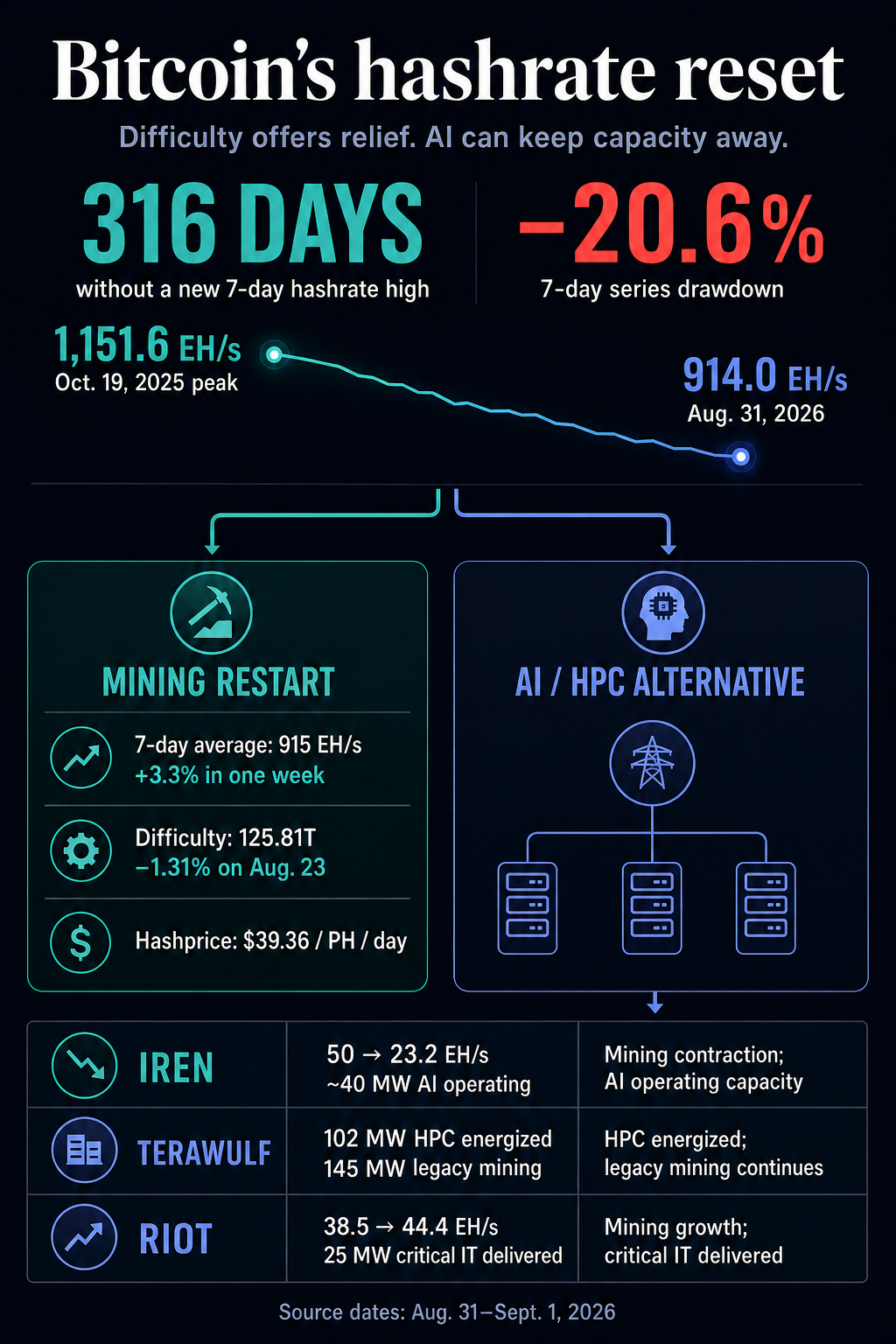
The seven-day network average stood near 914 exahashes per second on Aug. 31, about 20.6% below its October 2025 peak of 1,151.6 EH/s. The stretch without a new high is the longest in a decade, exceeding the previous 252-day maximum in the same Blockchain.com series.
The decline followed months of weak mining economics, summer power curtailments and a growing shift by some operators toward artificial intelligence and high-performance computing. Twenty One Capital CEO Raphael Zagury has described the episode as Bitcoin’s first sustained “economic hashrate bear market.”
That description has become more significant because Bitcoin itself has already delivered the kind of price recovery that historically helped revive mining.
BTC rallied 34.9% from late June through late August reaching as high as above $81,000, while network hashrate fell 10.1% over the same period, only the second such divergence since 2012.
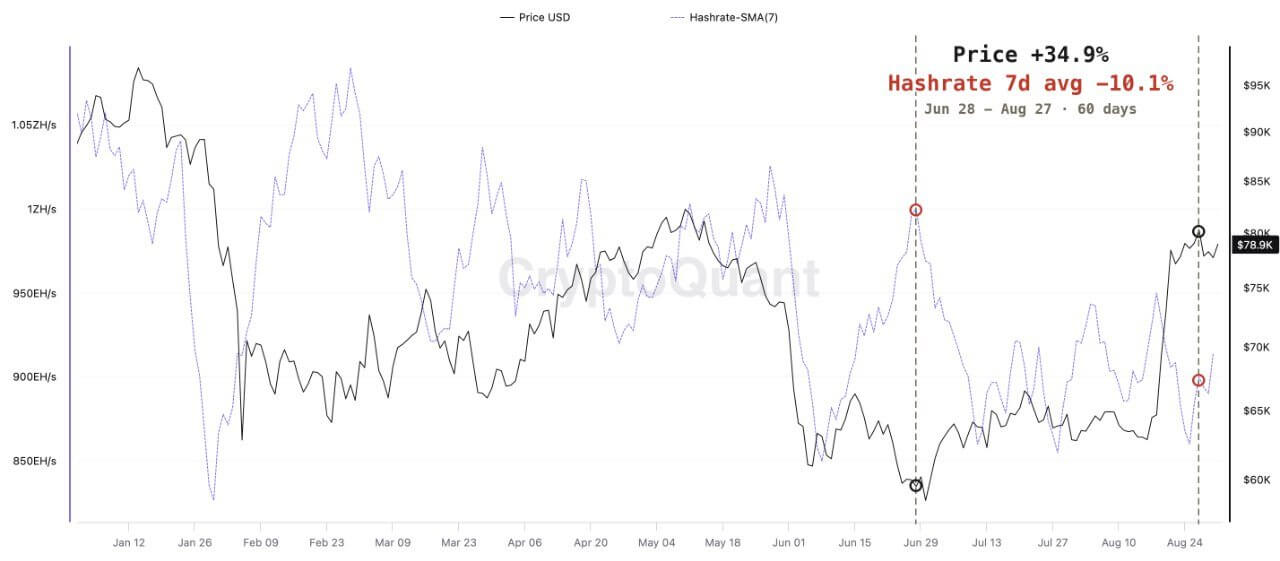
Higher Bitcoin prices increase the dollar value of block rewards and normally encourage miners to restart machines that became uneconomic during a downturn. This time, the response has been much weaker.
The difference is that some of the power and>estimated network hashrate at roughly 885 EH/s in the week through Aug. 11, while mining difficulty stood 18.3% below its November 2025 peak. That was the largest difficulty drawdown since China’s 2021 mining ban.
The Puell Multiple, which compares the dollar value of daily Bitcoin issuance with its one-year average, averaged about 0.73 over the preceding 30 days, placing it in the 16th percentile and pointing to unusually weak miner revenue conditions.
Those pressures forced marginal machines offline. Bitcoin then began doing what it was designed to do.
As hashrate falls, the protocol eventually reduces difficulty, allowing the remaining miners to compete for the same block subsidy with less computing power. Better margins can then entice idle capacity back.
However, signs of that rebound also emerged in August.
VanEck said the Aug. 8 difficulty adjustment rose 1%, the first upward move in the sequence it tracked, as hashrate recovered toward 925 EH/s. Difficulty later fell 1.31% on Aug. 23, providing another round of relief.
By Aug. 31, Hashrate Index put seven-day hashrate at 915 EH/s, up 3.3% from 886 EH/s a week earlier. Blocks were arriving every 9 minutes and 56 seconds, almost exactly on Bitcoin’s 10-minute target.
Hashprice had also improved to $39.36 per petahash per second per day, above its 30-day average of $34.63.
That combination of a roughly 35% Bitcoin rally, lower difficulty, and better hash price would normally make restarting machines increasingly attractive. Yet hashrate remains far below its record.
AI changes what happens after a miner switches off
For some operators, shutting down Bitcoin machines no longer means waiting for mining margins to recover.
IREN cut installed self-mining capacity from 50 EH/s in June 2025 to 23.2 EH/s by June 2026 as it decommissioned miners and redirected power and>reported 81 MW of critical-IT capacity at June 30 and 102 MW energized in July, alongside 145 MW of legacy Bitcoin mining capacity.
Riot Platforms highlighted how long those alternative commitments can last when it signed a roughly $9 billion, 20-year compute agreement with Anthropic in August.
That changes the economics of a mining recovery.
A machine taken offline because hashprice fell can be restarted when Bitcoin becomes more profitable. However, power committed to a long-duration AI customer cannot return nearly as quickly, even if Bitcoin rallies and difficulty falls.
Years spent building mining operations have made the sector particularly attractive to AI developers. Miners already control large power allocations, grid connections and data-center sites built to handle dense computing loads.
The hashrate downturn cannot be attributed entirely to that shift. Seasonal curtailments, particularly in Texas, reduced mining during periods of high electricity demand, while inefficient fleets were also shut down as margins deteriorated.
AI becomes important because it can determine what happens to that capacity afterward.
Better mining economics now have to compete with AI
The next phase of Bitcoin’s hashrate recovery will show how much capacity was merely idle and how much has effectively moved on.
Some miners are still expanding aggressively.
MARA reported 70.3 EH/s of energized hashrate as of June 30, while Bitdeer reached 76.7 EH/s of self-mining capacity in July. Riot increased deployed mining capacity to 44.4 EH/s from 38.5 EH/s even as it expanded into AI.
That leaves the industry split between operators still adding Bitcoin machines, those diverting infrastructure toward computing customers, and companies trying to pursue both.
Bitcoin’s own recovery mechanism remains intact. Difficulty continues to adjust, blocks are arriving near target and the recent rebound toward 915 EH/s shows that some hashpower is returning.
But the 316-day drought suggests the response has not yet been strong enough to restore the network’s late-2025 peak.
The question now is whether improving Bitcoin prices, hashprice and difficulty economics can pull enough idle machines back to end that drought.
If they cannot, the reason may increasingly lie outside Bitcoin itself: some of the infrastructure that once waited for the next mining recovery is now being paid to stay somewhere else.