

Bitcoin’s security-budget debate usually starts with one total: how much miners collect in transaction fees as the block subsidy shrinks.
A July 2026 NBER working paper by Fabian Schär, Dario Thürkauf, and David Yermack points to a second variable. Using data from 2017 through 2025, the authors report that larger fee differences between adjacent Bitcoin blocks are associated with more competing blocks at the same height and a longer wait for the next block.
The evidence is observational and identifies a network-level relationship, while miner intent and the cause of any individual block race remain unresolved. The finding still gives wallets, miners, and users a measurable signal: Bitcoin security incentives respond to how fees arrive from block to block, as well as how much the network pays over time.
Fee gaps create a different mining incentive
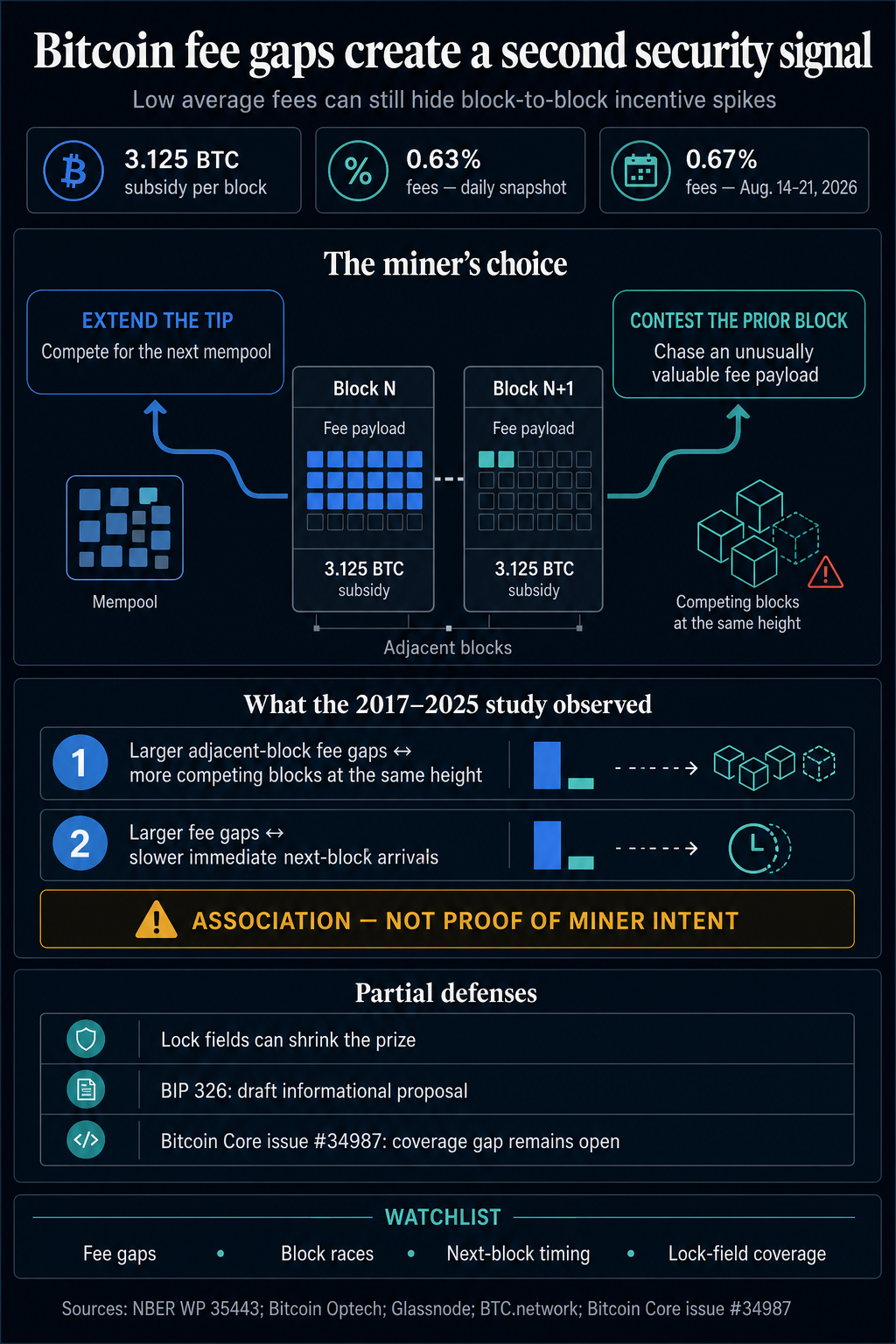
Bitcoin currently pays miners a fixed subsidy of 3.125 BTC for each block, plus the transaction fees included in that block. Successive subsidy reductions place more long-run weight on fees as a source of mining revenue.
As of Aug. 26, a daily Glassnode measure put transaction fees at about 0.70% of miner revenue. A BTC.network report covering Aug. 14 through Aug. 21 calculated a 0.67% share for the week. The two snapshots cover different periods, but each places fees below 1%.
Block-level data can show much sharper variation than those aggregate readings. An Aug. 26 Blockchain.com block snapshot showed 0.0077 BTC in fees in block 964,120 and 0.0536 BTC in block 964,121, an almost seven-fold change between adjacent blocks. The comparison illustrates how sharply fee rewards can vary from one block to the next, while the fee values alone leave miner behavior unresolved.
That prize shapes the choice described by Bitcoin Optech’s fee-sniping reference. A miner can extend the newest block and compete for the transactions currently waiting in the mempool. It can also attempt to recreate a valuable prior block, claim that block’s fees, and then extend the alternative chain.
The attempt begins behind the accepted tip, and its economic appeal rises when fees in the prior block greatly exceed the expected fees in a new tip-extending block. Hash-rate share, propagation, and other miners’ reactions affect the odds, so the incentive is probabilistic. Variable fees can change the payoff calculation even during periods when the network’s aggregate fee revenue is low.
The working paper tests whether that logic appears in historical network behavior. In a co-author explanation of the research, Thürkauf defines a block race as competing blocks at the same height. The authors associate larger adjacent-block fee gaps with more of those races.
They also report a lower probability that the next block appears in the first seconds after a large fee gap, a timing pattern consistent with some hash rate contesting the prior height. Since the analysis is observational, the result establishes an association at the network level and leaves individual miner motives unresolved.
That distinction shifts the measurement focus because monthly or annual fee totals describe Bitcoin’s overall security income, whereas adjacent-block fee gaps isolate brief periods when revisiting the prior height can carry a larger potential payoff.
| Signal | Security relevance | Interpretive limit |
|---|---|---|
| Fee gap between adjacent blocks | Approximates the extra prize in a valuable prior block | Miner intent remains unknown |
| Competing blocks at the same height | Shows that multiple versions briefly existed | Routine network behavior can also produce a race |
| Delay in the next block’s first seconds | Matches the timing window highlighted by the study | A single delay has multiple possible causes |
| Fee share of miner revenue | Measures aggregate reliance on transaction fees | Fee distribution remains outside the aggregate measure |
Bitcoin wallet protections shrink the prize unevenly
Bitcoin transactions can reduce the incentive to revisit a prior block through lock fields. A wallet can set a lock so the transaction first becomes mineable in the block after the current tip, which excludes it from a replacement of the current tip.
Widespread use changes the economics of fee sniping because a miner rebuilding the earlier height loses access to some of the newest pending transactions, lowering the revenue available in its alternative block. The protection shrinks the available prize and leaves reorganization attempts technically possible.
Bitcoin Optech’s technical overview says developers see current protections as incomplete. Their effectiveness depends on which wallets and transaction-creation systems set the relevant fields, how consistently they do so, and which transaction types they cover.
BIP 326 describes anti-fee-sniping behavior for Taproot transactions through nLockTime or nSequence. It remains a draft informational proposal, and wallets can adopt the approach gradually under existing consensus rules, leaving real-world coverage dependent on implementation choices.
An open Bitcoin Core issue from April 2026 documents one concrete inconsistency. The issue says the send RPC and GUI wallet flow set nLockTime near the current block height, whereas the createrawtransaction and walletcreatefundedpsbt paths default to zero. The proposed consistency change remains open.
The difference means Bitcoin Core’s anti-fee-sniping default is applied unevenly across transaction-creation paths. Estimating the network-wide effect would require data on how much transaction volume each path represents, which the issue does not provide.
Implementation coverage therefore belongs inside the security-budget discussion because a mitigation can be technically available while its network effect depends on the share of pending transactions that use it. Broader and more consistent lock-field behavior would reduce the fees available to a miner trying to rebuild the previous height.
Miners also face a coordination problem because the return from contesting a block depends partly on whether other miners extend the accepted tip. A broad migration toward protective transaction construction changes the available reward directly and can occur under existing consensus rules, avoiding a miner-coordination requirement.
Signals to watch before the next subsidy cut
The next subsidy reduction provides a useful monitoring horizon, though its security effects will depend on fee demand, fee distribution, miner behavior, propagation, and mitigation adoption.
Four signals provide a better view than aggregate revenue alone:
- Adjacent-block fee gaps. Persistent or extreme gaps mark the periods when a prior block carries the largest extra prize.
- Competing-block frequency. A change in same-height races shows shifting network behavior while leaving the cause open.
- Immediate next-block timing. The first seconds after a high-fee block are the interval highlighted by the study.
- Lock-field coverage. More consistent use across wallet and automated transaction-creation paths can reduce the revenue available in a rebuilt prior block.
Each signal captures a different part of the incentive because fee gaps describe the prize, block races and timing describe network outcomes, and lock-field use describes a defense.
Bitcoin’s fee market can produce occasional outlier blocks even while fees remain a small share of miner revenue. Those outliers deserve closer attention because mining incentives emerge in each block interval, while monthly revenue charts blur the short-lived extremes.





