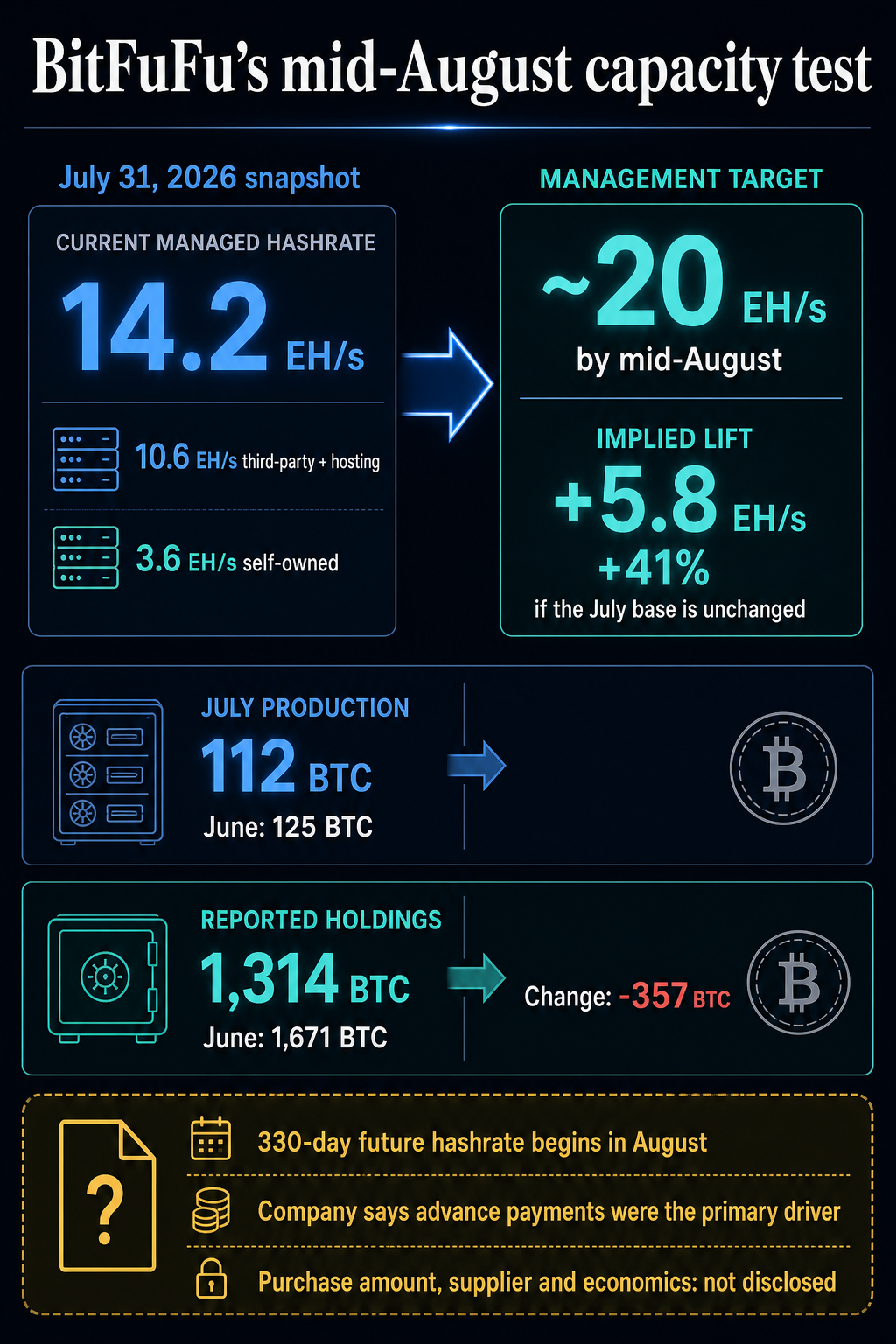
Bitcoin miner and cloud-mining provider BitFuFu said advance payments for 330 days of future hashrate were the primary reason its reported Bitcoin holdings fell by 357 BTC in July. At the same time, production and managed hashrate declined, leaving a clear operational checkpoint: whether the platform reaches approximately 20 EH/s by mid-August.
The company’s SEC-filed July operating update put holdings at 1,314 BTC on July 31, down from 1,671 BTC a month earlier. The reported balance excludes Bitcoin produced for cloud-mining customers. Total production fell to 112 BTC from 125 BTC, while average daily output slipped to 3.6 BTC from 4.2 BTC.

Total managed hashrate declined to 14.2 EH/s from 15.3 EH/s. Third-party suppliers and hosting customers contributed 10.6 EH/s, down from 11.8 EH/s, while self-owned hashrate rose to 3.6 EH/s from 3.5 EH/s.
Management expects capacity secured in June and July to restore total managed hashrate to about 20 EH/s by mid-August. From the July-end level, that guidance implies a 5.8 EH/s, or roughly 41%, increase if the base otherwise remains unchanged.
A separate June operating update disclosed 5.3 EH/s from suppliers for 270 days beginning in August. That block nearly matches the gap between 14.2 EH/s and 20 EH/s, but the July filing calls its 330-day capacity additional and does not disclose the new block’s EH/s contribution. The two updates therefore cannot be combined into a precise commissioning schedule.
The capacity purchase still lacks a price tag
The July filing does not disclose how much Bitcoin or money BitFuFu committed, identify the supplier, or provide pricing, energy costs, uptime requirements, or cancellation protections. It also does not provide a complete bridge between self-mining additions, sales or transfers, client receipts and advance payments. The 357 BTC decline therefore cannot safely be treated as either an open-market sale or the exact price of the capacity arrangement.
Those missing economics matter because BitFuFu said in its April update that it had declined to renew some third-party contracts when they would pressure margins. At the time, management said it would not pursue hashrate growth at the expense of unit economics. The July disclosure is not detailed enough to test the new purchase against that earlier standard.
A separate portion of the reserve remains encumbered. The July balance included an aggregate 44 BTC pledged for loans and miner-procurement payables, compared with 54 BTC in June, but the reason for the 10 BTC change and the current allocation are undisclosed. BitFuFu’s 2025 annual report describes historical collateral arrangements, but those year-end balances and terms cannot be mapped onto the July figure.

Reaching about 20 EH/s by mid-August would show that the planned capacity arrived on management’s timetable. It would not, by itself, establish that production has recovered, that the purchase meets BitFuFu’s earlier unit-economics standard or that further reserve use will not be required. Those questions depend on contract details and subsequent operating and treasury disclosures.