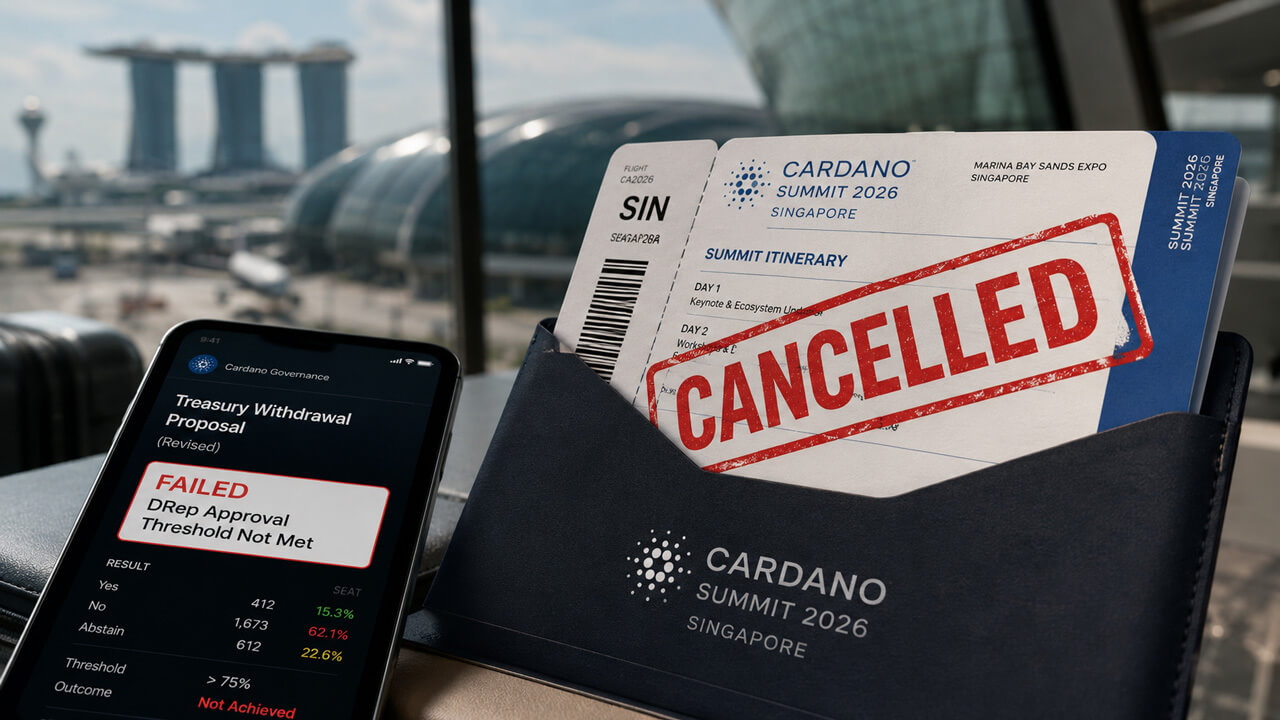
Cardano’s 2026 Summit in Singapore is off after the network’s treasury governance process failed to approve funding for it.
The official event page now says the Summit will not take place on Oct. 5-6 as previously announced. The cause is governance: Cardano Foundation said treasury-funded initiatives are subject to community vote, and the community decided not to proceed with the proposal.
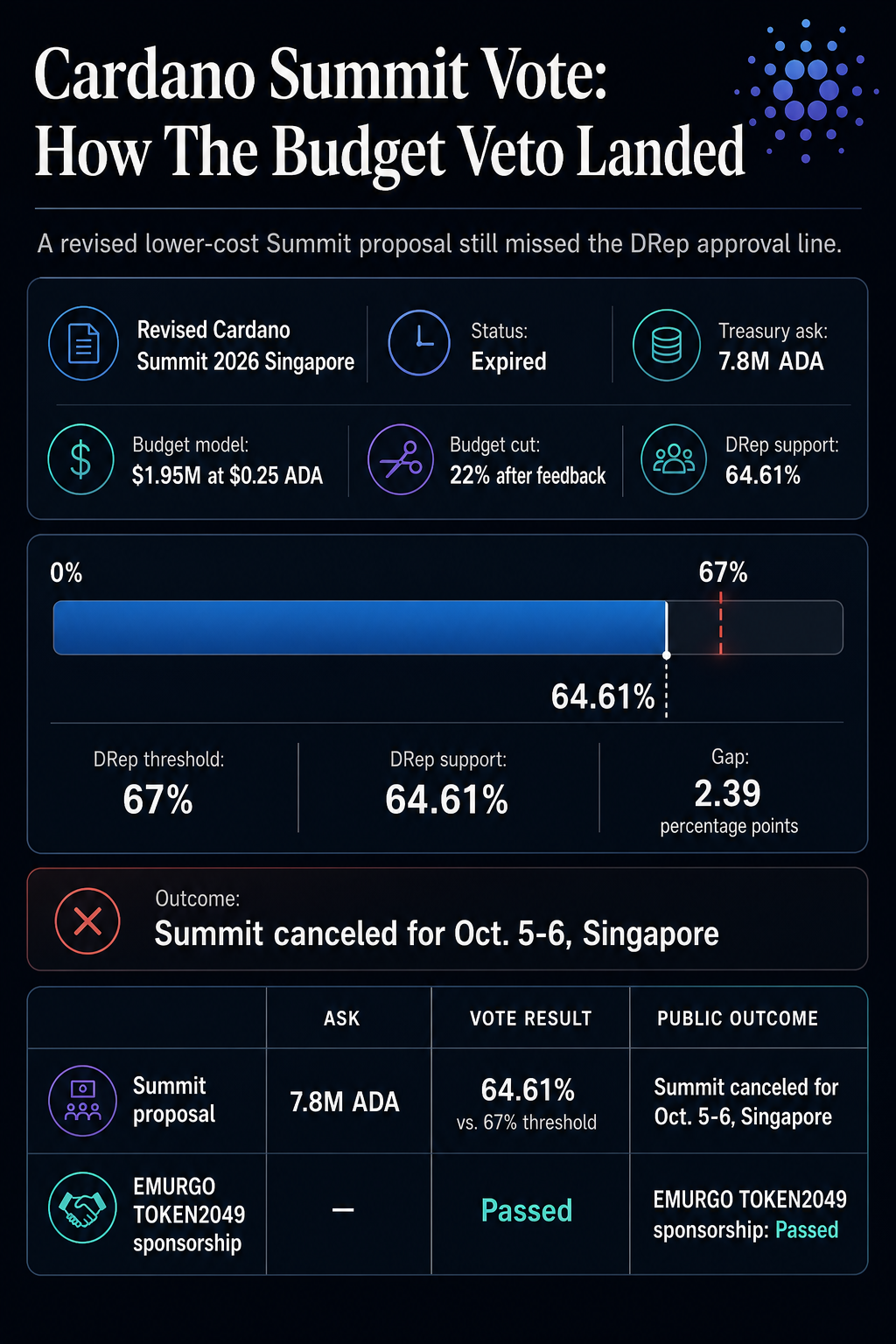
A governance abstraction has turned into a public budget veto. A revised 7.8 million ADA request from the Cardano Foundation, already cut from an earlier bundled proposal, expired below the Delegated Representative threshold.
The proposal recorded 64.61% DRep yes support against a 0.67 treasury-withdrawal threshold. A related Singapore presence still survived the vote, as EMURGO’s separate TOKEN2049 sponsorship proposal passed.
The result is more specific, and more revealing: DReps blocked the dedicated Summit while allowing a related Singapore sponsorship to continue.
A Budget Veto With A Calendar Attached
The revised governance action had a defined business and community scope. It asked for 7.8 million ADA, based on a $0.25 ADA assumption, to fund a $1.95 million Summit budget.
It described a two-day event in Singapore with one Ecosystem Day for builders, DReps, governance sessions, and workshops. That would be followed by an Industry Day aimed at enterprise, institutional, and regulatory audiences.
The Foundation had already revised the ask after community feedback. The proposal said the budget was reduced by 22%, or $550,000, and separated from EMURGO’s TOKEN2049 sponsorship.
It also increased the Foundation’s expected internal resource contribution to reduce external vendor costs. The proposal’s targets show the work the cancellation now affects.
The Summit was pitched as a funnel for 1,200 attendees, 250 enterprise marketing-qualified leads, and 50 strategic meetings within 45 days after the event.
Those numbers were proposal goals rather than delivered results. They positioned the Summit as both a community event and a business-development vehicle at the edge of Cardano’s wider Singapore conference push.
| Item | Funding Ask | Status | Signal |
|---|---|---|---|
| Revised Cardano Summit 2026 Singapore | 7.8 million ADA | Expired below DRep threshold | DReps blocked the dedicated event budget |
| EMURGO TOKEN2049 sponsorship | Separate sponsorship proposal | Passed | DReps distinguished the sponsorship from the Summit budget |
The threshold mechanics explain why a majority-support figure still failed. Cardano treasury withdrawals require Constitutional Committee and DRep approval, with DRep approval set at 0.67 and no stake pool operator threshold for that action type.
The same 67% DRep pass threshold also appears in GovTool’s treasury withdrawal documentation. That design gave DReps the power to stop the withdrawal even after 64.61% yes support.
A funding action can draw majority support and still expire when the required delegated-stake threshold sits above the final vote total.
For Cardano, that is the point of the system and the source of the problem. Treasury governance is supposed to impose discipline on spending.
It is supposed to make institutions justify requests, split bundled asks, respond to feedback, and accept a result when the threshold is missed. This vote shows that machinery working.
It also converts budget discipline into an operational outcome: the Summit disappeared from the 2026 calendar.

The Governance Win Comes With Coordination Risk
Cardano’s broader 2026 funding fight has already been building. Input Output had reduced its annual treasury funding request to $46.8 million as the ecosystem moved away from single-entity dominance and toward community-controlled funding approval.
A later vote brought DRep resistance, abstentions, and concern that proposals tied to Cardano’s technical roadmap were struggling around the same 67% approval area.

The Summit cancellation turns that funding tension into a calendar outcome ecosystem participants can see. The proposal itself targeted builders, governance participants, enterprise leads, and strategic meetings.
Those audiences can now observe a planned event being removed by the same treasury system that Cardano is asking them to trust.
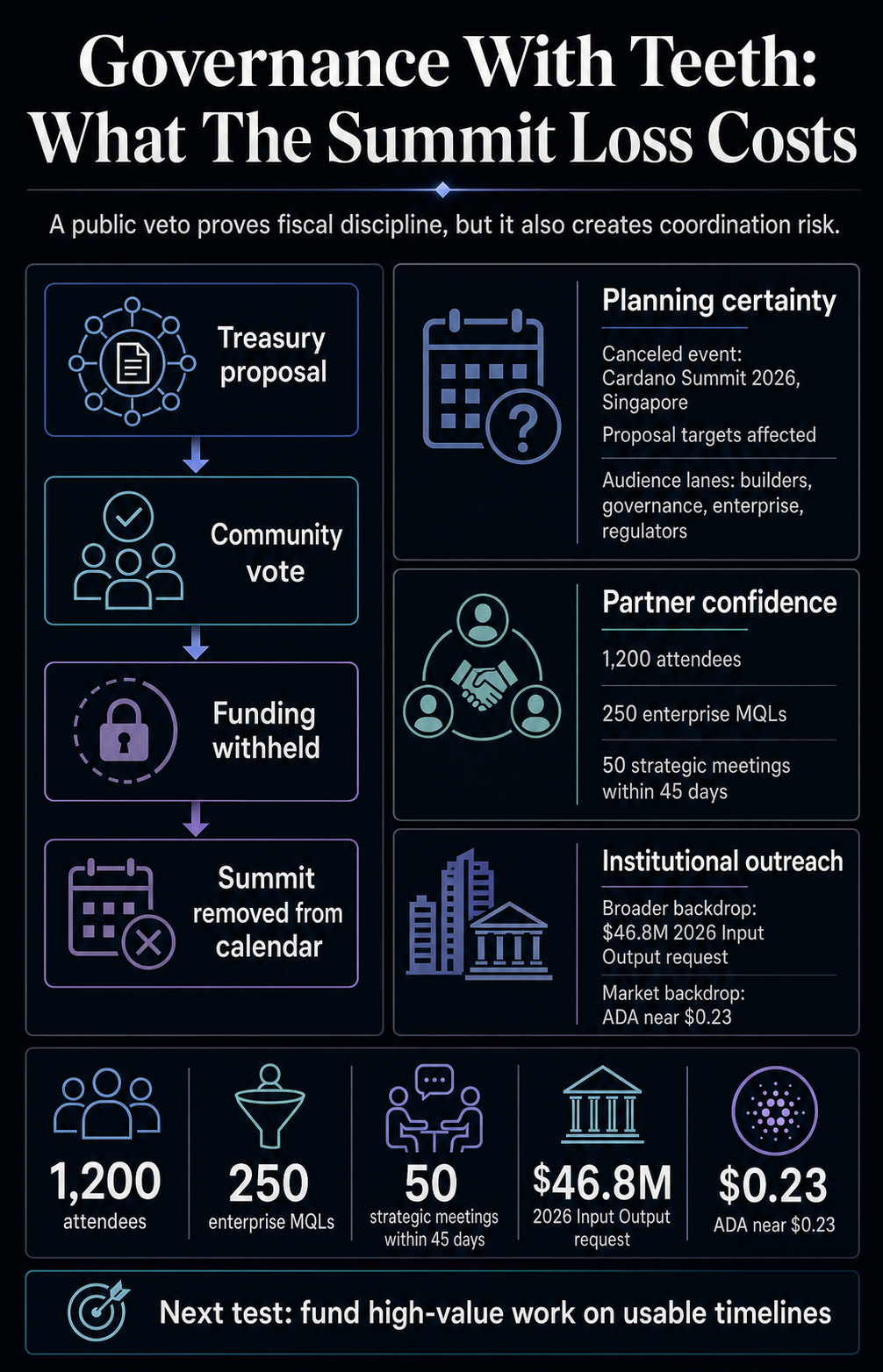 So it cuts both ways. On one side, it strengthens Cardano’s claim that on-chain governance has teeth.
The Foundation proposed, revised, and still had to accept that the treasury would withhold funding. The constraint is meaningful precisely because it applied to a request from one of the ecosystem’s central institutions.
On the other side, a governance system that can stop spending also has to prove it can fund high-value work on usable timelines.
If major initiatives repeatedly miss thresholds after late revisions, Cardano may gain budget discipline while losing execution speed. For events, that risk can appear as calendar uncertainty, weaker partner confidence, and fewer clear chances to use large industry gatherings as distribution moments.
The failed Summit vote also complicates Cardano’s institutional narrative. The revised proposal argued that Singapore would put Cardano in front of enterprise, financial, and regulatory audiences during TOKEN2049 week.
DReps could treat that strategic goal and the budget request as separate questions. Outside the governance process, the visible outcome is simpler: Cardano goes into 2026 without its dedicated Singapore Summit.
ADA’s market context gives the story a financial backdrop. On June 1, ADA traded near $0.23, a little more than 2% lower over 24 hours, with market capitalization around $8.4 billion and 24-hour volume around $360 million.
The vote shows how treasury scrutiny can shape the ecosystem’s public calendar as well as its balance sheet.
The next test is whether Cardano can turn this veto into a clearer funding process instead of another source of institutional drag. Future treasury proposals may face pressure to show tighter budgets, cleaner separation from adjacent sponsorships, and stronger evidence that spending creates measurable ecosystem value.
The Summit vote makes decentralization operational. DReps can now restrain core institutions in public.
The question is whether Cardano can pair that restraint with enough coordination to keep building, selling, and showing up where the next wave of users and institutions are making decisions.