
Close Menu
  • Latest News
    • Market
    • Altcoins
    • Legal and Regulatory
  • Tech
    • Blockchain
    • Security and Privacy
  • Web 3
    • Web3 News
    • NFTs
    • Gaming
  • Learn
    • Education
    • Investments
    • Staking
    • Wallets and Exchanges
  • ICOs
  • Mining
  • Crypto Tools
    • Exchange Tool
  • Shop
What's Hot

The next crypto recovery trade might be equities instead of tokens

June 28, 2026

Tokenization is becoming the financing layer for AI and robotics, Framework bets with $400 million fund

June 28, 2026

Fidelity rebuts claims Bitcoin becomes less secure after halvings

June 28, 2026
Facebook X (Twitter) Instagram
  • Contact
  • Privacy Policy
  • Terms & Conditions
Facebook X (Twitter) Instagram
CryptoPulseDaily.com
  • Latest News
    • Market
    • Altcoins
    • Legal and Regulatory
  • Tech
    • Blockchain
    • Security and Privacy
  • Web 3
    • Web3 News
    • NFTs
    • Gaming
  • Learn
    • Education
    • Investments
    • Staking
    • Wallets and Exchanges
  • ICOs
  • Mining
  • Crypto Tools
    • Exchange Tool
  • Shop
CryptoPulseDaily.com
Home»Mining»Fidelity rebuts claims Bitcoin becomes less secure after halvings
Mining

Fidelity rebuts claims Bitcoin becomes less secure after halvings

June 28, 2026No Comments3 Mins Read
Share
Facebook Twitter LinkedIn Pinterest Email

Fidelity Digital Assets has pushed back against concerns that Bitcoin’s long-term security will deteriorate as mining rewards decline, arguing in a new research report that the network’s economic incentives remain sufficient to secure the blockchain over time.

The report, authored by Fidelity research analyst Daniel Gray, reiterated the view that Bitcoin’s security depends on more than block rewards. Transaction fees, market incentives and other economic forces continue to encourage miners to secure the network and make sustained attacks prohibitively expensive, it said.

The findings challenge a longstanding criticism that each quadrennial halving weakens Bitcoin’s security by reducing the issuance of new coins. Critics argue that declining block rewards could eventually erode miners’ incentives unless transaction fees grow enough to offset the shortfall.

The issue has become one of the most closely watched long-term questions surrounding Bitcoin ($BTC), whose fixed supply schedule gradually reduces new issuance until block subsidies eventually disappear. Whether transaction fees and other incentives can sustain network security remains a central debate among developers and market participants.

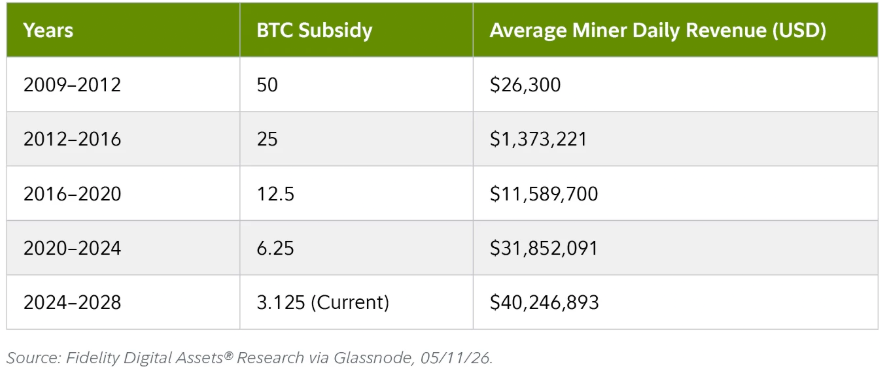
Since April 20, 2024, Bitcoin miners have received a subsidy of 3.125 $BTC for each block they mine, down from 6.25 $BTC during the previous halving cycle. However, Gray argued that lower issuance has not translated into weaker incentives for miners because Bitcoin’s rising price has more than offset the decline in block rewards.

He pointed to the growth in average daily miner revenue, which increased from roughly $26,300 during Bitcoin’s first halving cycle to more than $40.2 million today. “Despite declining issuance, miner incentives — and by extension, network security — historically strengthened alongside Bitcoin’s price,” Gray wrote.
See also  U.S.-Listed Bitcoin Miners Shed 25% of Their Market Cap in March: JPMorgan

Bitcoin’s average daily miner revenue has increased substantially across halving cycles. Source: Fidelity Digital Assets

Related: Nvidia’s $20 billion debt boom reinforces Bitcoin miners’ AI pivot

Public Bitcoin miners face mounting financial pressure

While Fidelity argues that Bitcoin’s long-term incentive structure remains intact, many publicly traded mining companies continue to face near-term financial pressure. Some industry analysts have described the current environment as one of the most challenging on record, citing lower mining rewards, rising costs and growing competition.

In response, several miners have diversified into artificial intelligence and high-performance computing, leveraging existing power infrastructure and data center assets to meet growing demand for AI workloads rather than relying solely on Bitcoin mining.

A recent report by VanEck estimated that publicly traded miners could require up to $50 billion in additional capital to fully transition to AI infrastructure, underscoring the scale and cost of the shift.
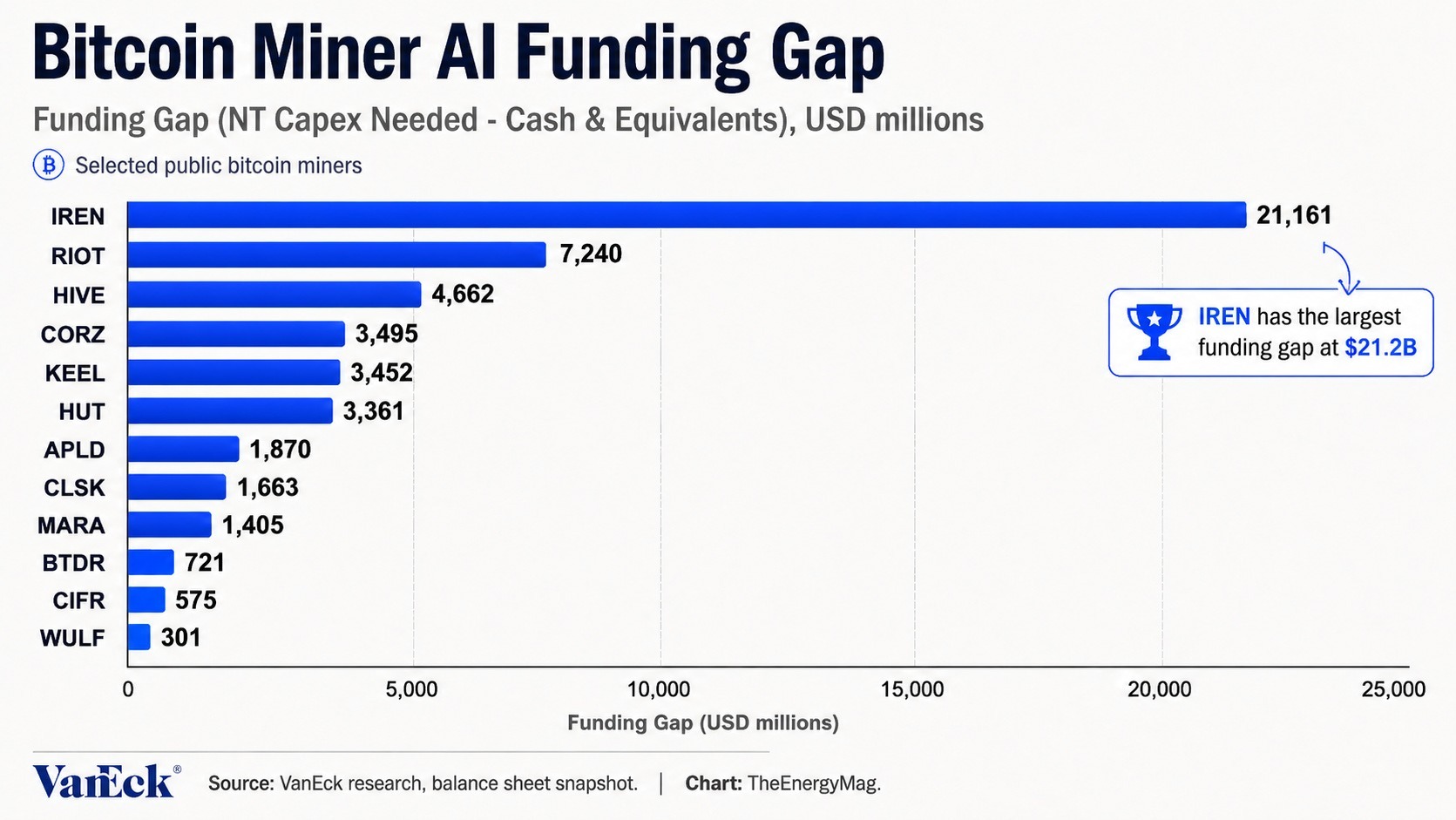
Public miners face a large funding gap in realizing their AI ambitions. Source: Miner Weekly

“A Bitcoin mine can run with relatively simple buildings, modular infrastructure and ASIC fleets that tolerate fast curtailment,” Blocksbridge Consulting wrote in a recent Miner Weekly publication. “AI and HPC facilities require higher standards for uptime, cooling, electrical redundancy, networking and customer support.”

Related: Crypto Biz: Is AI the exit strategy for miners?

Source link

Bitcoin claims Fidelity Halvings Rebuts Secure
Share. Facebook Twitter Pinterest LinkedIn Tumblr Email

Related Posts

FBI Sets Deadline for OneCoin Fraud Claims

June 28, 2026

Bitcoin under $60,000 on track for a rare back-to-back quarterly loss

June 28, 2026

Bitdeer Sells Entire Weekly Bitcoin Production, Now Holds Zero BTC

June 27, 2026

Miners Absorb 18% Hashprice Crash as Bitcoin Difficulty Jumps 7.15%

June 27, 2026
Add A Comment
Leave A Reply Cancel Reply

Top Posts

Ethereum Outperforms Bitcoin as Investors Focus on Altcoins

August 27, 2023

Sui Stablecoin Transfers Hit $65 Billion After Gasless Fee P

June 17, 2026

Pudgy Toys’ Nationwide Expansion: Now in 3,100 Walmart Stores

February 23, 2024

Subscribe to Updates

Get the latest creative news From Crypto Daily Pulse directly in your Inbox!

Our mission is to develop a community of people who try to make financially sound decisions. The website strives to educate individuals in making wise choices about Crypto, ICOs, Web3, Blockchain and more.

We're social. Connect with us:

Facebook X (Twitter) Instagram Pinterest YouTube
Top Insights

The next crypto recovery trade might be equities instead of tokens

June 28, 2026

Tokenization is becoming the financing layer for AI and robotics, Framework bets with $400 million fund

June 28, 2026

Fidelity rebuts claims Bitcoin becomes less secure after halvings

June 28, 2026
Get Informed

Subscribe to Updates

Get the latest creative news From Crypto Daily Pulse directly in your Inbox!

  • Contact
  • Privacy Policy
  • Terms & Conditions
© 2026 Crypto Pulse Daily - All rights reserved.

Type above and press Enter to search. Press Esc to cancel.

Cleantalk Pixel
  • bitcoinBitcoin(BTC)$59,666.00-1.58%
  • ethereumEthereum(ETH)$1,573.33-1.69%
  • tetherTether(USDT)$1.000.01%
  • binancecoinBNB(BNB)$552.59-2.14%
  • usd-coinUSDC(USDC)$1.000.00%
  • rippleXRP(XRP)$1.05-1.94%
  • solanaSolana(SOL)$71.68-1.29%
  • tronTRON(TRX)$0.3234370.92%
  • Figure HelocFigure Heloc(FIGR_HELOC)$1.041.53%
  • HyperliquidHyperliquid(HYPE)$62.78-1.93%