Close Menu
  • Latest News
    • Market
    • Altcoins
    • Legal and Regulatory
  • Tech
    • Blockchain
    • Security and Privacy
  • Web 3
    • Web3 News
    • NFTs
    • Gaming
  • Learn
    • Education
    • Investments
    • Staking
    • Wallets and Exchanges
  • ICOs
  • Mining
  • Crypto Tools
    • Exchange Tool
  • Shop
What's Hot

Decoding ETHGas’s 36% surge amid Ethereum’s network activity rebound

August 7, 2026

CleanSpark misses Wall Street revenue estimates as shares sink

August 7, 2026

Ethereum volume plunged 73% on Bullish, but a 72% spread jump saved its monthly bottom line

August 7, 2026
Facebook X (Twitter) Instagram
  • Contact
  • Privacy Policy
  • Terms & Conditions
Facebook X (Twitter) Instagram
CryptoPulseDaily.com
  • Latest News
    • Market
    • Altcoins
    • Legal and Regulatory
  • Tech
    • Blockchain
    • Security and Privacy
  • Web 3
    • Web3 News
    • NFTs
    • Gaming
  • Learn
    • Education
    • Investments
    • Staking
    • Wallets and Exchanges
  • ICOs
  • Mining
  • Crypto Tools
    • Exchange Tool
  • Shop
CryptoPulseDaily.com
Home»NFTs»Google Introduces Watermarks to ID AI-Generated Images
NFTs

Google Introduces Watermarks to ID AI-Generated Images

August 31, 2023No Comments3 Mins Read
Share
Facebook Twitter LinkedIn Pinterest Email

Google’s DeepMind and Google Cloud revealed a new tool that will help it to better identify when AI-generated images are being utilized, according to an August 29 blog post.

SynthID, which is currently in beta, is aimed at curbing the spread of misinformation by adding an invisible, permanent watermark to images to identify them as computer-generated. It is currently available to a limited number of Vertex AI customers who are using Imagen, one of Google’s text-to-image generators. 

This invisible watermark is embedded directly into the pixels of an image created by Imagen and remains intact even if the image undergoes modifications such as filters or color alterations.

Beyond just adding watermarks to images, SynthID employs a second approach where it can assess the likelihood of an image being created by Imagen. 

The AI tool provides three “confidence” levels for interpreting the results of digital watermark identification: 

  • “Detected” –  the image is likely generated by Imagen
  • “Not Detected” – the image is unlikely to be generated by Imagen
  • “Possibly detected” – the image could be generated by Imagen. Treat with caution.

In the blog post, Google mentioned that while the technology “isn’t perfect,” its internal tool testing has shown accuracy against common image manipulations. 
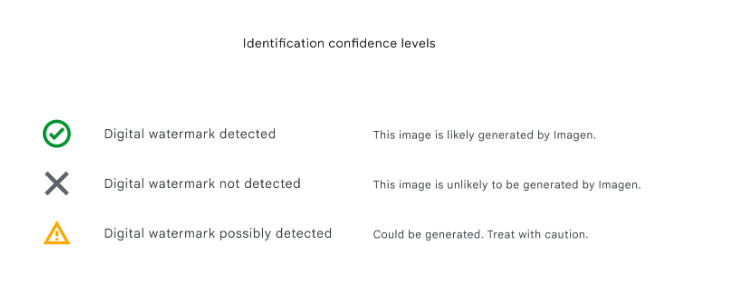
Photo Credit: Google DeepMind

Due to advancements in deepfake technology, tech companies are actively seeking ways to identify and flag manipulated content, especially when that content operates to disrupt the social norm and create panic – such as the fake image of the Pentagon being bombed. 

The EU, of course, is already working to implement technology through its EU Code of Practice on Disinformation that can recognize and label this type of content for users spanning Google, Meta, Microsoft, TikTok, and other social media platforms. The Code is the first self-regulatory piece of legislation intended to motivate companies to collaborate on solutions to combating misinformation. When it first was introduced in 2018, 21 companies had already agreed to commit to this Code.

See also  Netflix's $900k AI Salary, Meta Introduces New Tools, & More

While Google has taken its unique approach to addressing the challenge, a consortium called the Coalition for Content Provenance and Authenticity (C2PA), backed by Adobe, has been a leader in digital watermark efforts. Google previously introduced the “About this image” tool to offer users information about the origins of images found on its platform.

SynthID is just another next-gen method by which we are able to identify digital content, acting as a type of “upgrade” to how we identify a piece of content through its metadata. Since SynthID’s invisible watermark is embedded into an image’s pixels, it is compatible with these other image identification methods that are based on metadata and is still detectable even when that metadata is lost. 

However, with the rapid advancement of AI technology, it remains uncertain whether technical solutions like SynthID will be completely effective in addressing the growing challenge of misinformation. 

Editor’s note: This article was written by an nft now staff member in collaboration with OpenAI’s GPT-4.

Source link

AIGenerated Google Images Introduces Watermarks
Share. Facebook Twitter Pinterest LinkedIn Tumblr Email

Related Posts

Vega Introduces Detection Skills, The New Open Standard for AI Reasoning in Agentic Cyber Defense

August 6, 2026

Vadzo Imaging Introduces Falcon-544CRH: 5MP Color Autofocus USB 3.2 Gen 1 Camera with Onsemi HyperLux LP AR0544

August 4, 2026

Somantra AI Releases AI Search Ranking Factors Report for Australian Insurance Brands, Analysing 2.4 Million ChatGPT and Google Citations

August 4, 2026

Your AI Chats May Be Showing up in Google Search — One Sharing Feature Made It Possible

July 29, 2026
Add A Comment
Leave A Reply Cancel Reply

Top Posts

900 EH/s and Counting: Bitcoin Network Power Reaches Unprecedented Heights

April 6, 2025

The Securities and Futures Commission (SFC) Reverses Stance on Spot-Crypto, Crypto ETF Investing

October 23, 2023

Fund services giant Apex to tokenize Bitcoin mining note on Coinbase’s Base platform

March 25, 2026

Subscribe to Updates

Get the latest creative news From Crypto Daily Pulse directly in your Inbox!

Our mission is to develop a community of people who try to make financially sound decisions. The website strives to educate individuals in making wise choices about Crypto, ICOs, Web3, Blockchain and more.

We're social. Connect with us:

Facebook X (Twitter) Instagram Pinterest YouTube
Top Insights

Decoding ETHGas’s 36% surge amid Ethereum’s network activity rebound

August 7, 2026

CleanSpark misses Wall Street revenue estimates as shares sink

August 7, 2026

Ethereum volume plunged 73% on Bullish, but a 72% spread jump saved its monthly bottom line

August 7, 2026
Get Informed

Subscribe to Updates

Get the latest creative news From Crypto Daily Pulse directly in your Inbox!

  • Contact
  • Privacy Policy
  • Terms & Conditions
© 2026 Crypto Pulse Daily - All rights reserved.

Type above and press Enter to search. Press Esc to cancel.

Cleantalk Pixel
  • bitcoinBitcoin(BTC)$64,906.000.90%
  • ethereumEthereum(ETH)$1,912.970.40%
  • tetherTether(USDT)$1.000.00%
  • binancecoinBNB(BNB)$590.89-0.30%
  • usd-coinUSDC(USDC)$1.000.00%
  • rippleXRP(XRP)$1.03-1.70%
  • solanaSolana(SOL)$73.710.70%
  • tronTRON(TRX)$0.3281140.10%
  • Figure HelocFigure Heloc(FIGR_HELOC)$1.031.40%
  • HyperliquidHyperliquid(HYPE)$55.681.20%