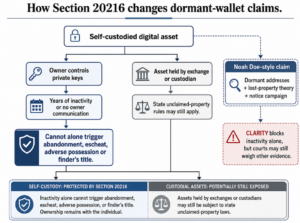
Section 20216 of the latest CLARITY draft states that a self-custodied digital asset cannot become abandoned, unclaimed, or forfeited. It also cannot become subject to adverse possession or finder’s title solely because its owner has not moved it or otherwise shown continued interest.
The language overrides state and local laws that treat years of wallet inactivity alone as grounds for transferring ownership to someone else.
The May 8 and May 20 Senate drafts protected only the ability to hold a self-hosted wallet, and the July 22 version adds scope beyond that, extending into property law and covering whether a person still owns the coins inside that wallet once years of silence go by.
The section defines a self-custodied digital asset as one where the owner keeps exclusive control of the private keys without relying on a custodian, exchange or intermediary.
That definition draws the line the rest of the provision depends on.
| Draft / provision | What it protects | What it does not fully settle |
|---|---|---|
| May 8 / May 20 Senate drafts | The ability to use a self-hosted wallet and hold private keys | Whether dormant self-custodied coins can be treated as abandoned property |
| July 22 Section 20216 | Continued ownership of lawfully self-custodied digital assets | Claims based on more than inactivity, such as fraud, theft, competing ownership evidence, or court-specific facts |
| Custodial assets carveout | Preserves state unclaimed-property rules for exchanges, brokers, and custodians | Dormant assets held by intermediaries may still face state reporting and escheat rules |
From wallet access to property title
Courts would have to draw a line between two categories of digital assets: coins a person controls directly through private keys and coins sitting with an exchange, broker, or custodian. The federal shield from the new CLARITY Act draft goes to the first group.
State unclaimed-property rules keep governing the second, since the draft expressly preserves them for custodial holdings. Recent state amendments already treat exchanges, custodians, and hosted-wallet providers as a distinct category for assets that could belong to missing owners.
A wallet holding its own keys and an exchange account holding the same dollar value in Bitcoin would sit on opposite sides of that line.
In the exchange case, the custodian controls the keys, so state dormancy, reporting, and delivery rules for that custodian keep applying the way they always have.
The case that made this provision urgent
New York’s own lost-property law shows why the provision has real teeth right now. Article 7-B of the state’s Personal Property Law covers property that someone loses and later turns over to police.
Section 257 lets title vest in the finder under specific conditions, including for property under $10 once a year of failed efforts to find the owner has gone by.
Noah Doe and two companies are using that framework to claim title to 39,069 dormant Bitcoin addresses holding roughly 3.799 million BTC, nearly 18% of Bitcoin’s total supply. Their filing points to an OP_RETURN notice campaign, a press release, and a claim window as evidence that the coins count as lost property nobody came forward to reclaim.
The theory leans hard on the wallets’ silence, years of coins sitting untouched with no owner surfacing to contest the claim, and Section 20216 targets that mechanism. A claimant could no longer point to years of inactivity or a lack of communication as the basis for taking title under state abandoned-property law.
Noah Doe’s plaintiffs also cite police reports, the OP_RETURN notices, and their attempts to contact possible owners. That evidence goes beyond pure dormancy, and it could let them argue their claim rests on more than silence alone even if CLARITY becomes law.
The provision closes the legal opening their case is testing without settling the lawsuit itself, since a court still has to weigh whether that additional evidence moves the analysis.
Where the provision goes from here
In the bull case, Section 20216 survives Senate negotiation with its preemption language intact, and courts read the phrase “solely due to inactivity” narrowly enough to give self-custody real protection.
Dormancy-based theories like the one behind Noah Doe become far harder to build, since a claimant would need proof beyond years of silence to get anywhere. Holding your own keys gains a legal backing that self-custody advocates have never quite had before.
In the bear case, Senate negotiators strip or soften Section 20216 before a final vote, and whatever language survives leaves room for courts to weigh inactivity alongside other factors when deciding a claim.
State-law experiments around dormant wallets stay possible, and a future claimant could still build a theory similar to Noah Doe’s around long stretches of silence plus a notice campaign.
| Scenario | What happens to Section 20216 | Effect on dormant-wallet claims | What it means for self-custody |
|---|---|---|---|
| Strong version survives | Federal preemption remains intact, and courts read “solely due to inactivity” narrowly. | Dormancy-only claims become very hard to bring | Self-custody gains a property-law shield, not just a technical right |
| Softened version passes | Language is narrowed, or exceptions expand | Claimants can still combine inactivity with notices or other evidence | Courts decide case by case whether silence supports abandonment |
| Provision removed | CLARITY keeps wallet-use protections but drops title protection | State-law experiments continue | Self-custody remains legal, but dormant-title risk stays unresolved |
| Court rules before law passes | Noah Doe or a similar case creates precedent first | Congress may need to clarify retroactivity and state-law preemption | Dormant Bitcoin becomes a national property-law issue |
Self-custody keeps its protection as an activity; holding your own keys stays legal, and title during years of inactivity stays a live issue courts have to settle case by case.
Section 20216 removes the single easiest argument a claimant could make against a silent Bitcoin address: the idea that years of nothing happening amounts to abandonment on its own. Whether that turns out to be enough depends on what survives Senate negotiation and what a judge eventually decides silence alone can prove.