We provide a layer 1 blockchain performance comparison of 6 major blockchain platforms: Ethereum, Cardano, Solana, Avalanche, Algorand and Internet Computer.
Before we begin with our comparison, it’s important to highlight that scaling on layer 1 is not the only way to improve the scalability of blockchains. Projects such as Ethereum and Cardano are focusing a lot of attention on scaling through layer 2 solutions that can handle a larger number of transactions while leveraging the security of the underlying layer 1.
In this article, we kept comparisons limited to layer 1 performance, but it’s worth keeping in mind that it doesn’t tell the whole story – for example, Ethereum users are already benefiting significantly from layer 2 solutions such as Arbitrum, Optimism and Base, and layer 2 technologies are steadily improving and gaining adoption.
At the bottom of the article, we provide a full list of sources used to make this comparison.
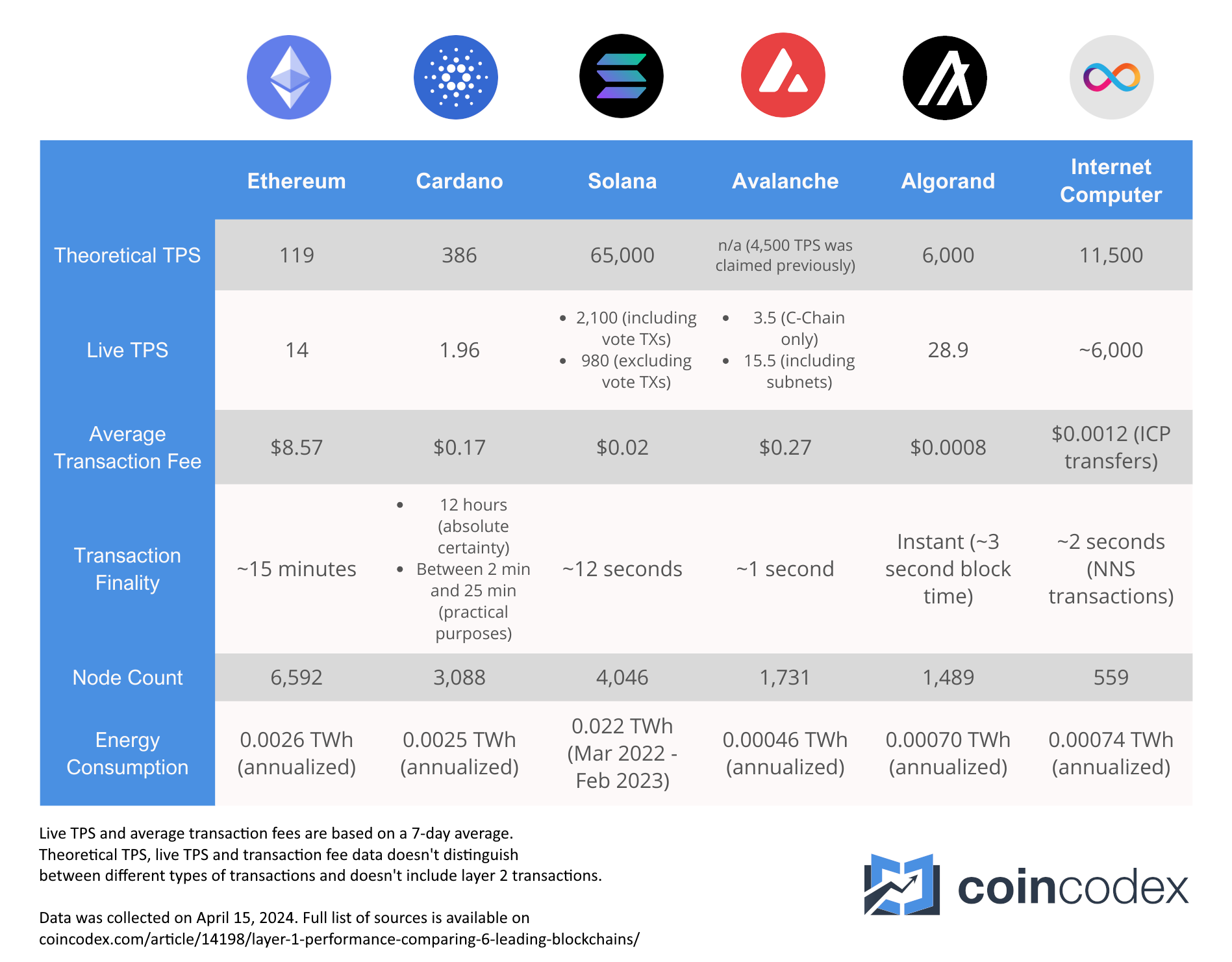
Comparing the layer 1 performance of 6 major blockchains
The most straightforward way to compare the performance of blockchains is to look at how many transactions a blockchain is capable of processing within a given time period. The most common metric used for this purpose is TPS (transactions per second).
Another important aspect to consider is a blockchain’s time to finality. This metric refers to how long it takes for a transaction to be considered irreversibly settled on the blockchain. There is a lot of nuance to the subject of blockchain finality (in many blockchains, what’s considered as “final” is up to interpretation), but we’ve made our best efforts to find commonly accepted time to finality figures for each of the blockchains we’re comparing.
Ethereum
Ethereum can handle 119 TPS in theory on layer 1, although the network is unlikely to ever approach this figure, as it would require a very specific set of conditions (for example, all transactions being standard ETH transfers).
In practice, the Ethereum network is handling about 14 transactions per second on layer 1. The demand for transacting on the Ethereum blockchain is immense – according to cryptofees.info, Ethereum users are currently paying about $9.6 million in total fees every day.
Ethereum transactions are considered final after a period of roughly 15 minutes, which corresponds to 2 epochs (an epoch is a period of 32 slots in which validators propose blocks and attest to blocks). Ethereum’s roadmap includes a concept called Single Slot Finality (SSF), which would reduce the time to finality to mere seconds.
Cardano
Cardano’s current theoretical TPS limit is at around 386 TPS. The Cardano blockchain is processing roughly 2 TPS on average at the time of writing this article, although it does have quite a bit of headroom to handle a spike in demand for transactions.
The Cardano project is also working on various solutions such as sidechains and layer 2s to dramatically improve scalability. Probably the most notable development here is the Hydra layer 2 scalability solution.
When it comes to Cardano’s time to finality, there is quite a bit of nuance. The Ouroboros Proof-of-Stake consensus protocol guarantees finality after 2,160 blocks, which takes roughly 12 hours.
In most practical scenarios, however, this degree of finality is not required before a transaction can be considered as settled. In practical scenarios, Cardano transactions can be considered final in between 2 and 25 minutes. How long to wait before considering a transaction as final ultimately depends on the significance of the transaction to the transacting parties.
Solana
Solana is a blockchain project that is primarily focused on layer 1 improvements to boost scalability. Solana is already very performant when compared to most other blockchains on the market today. In testing conditions, Solana has demonstrated the capability of handling around 65,000 transactions per second.
Currently, the Solana blockchain is processing just over 2,000 transactions per second on average. However, this metric also includes vote transactions, which some don’t consider as “real” transactions. If we exclude these transactions, Solana is processing just under 1,000 transactions per second on average in real-world conditions.
As far as scalability improvements are concerned, the Solana community is looking forward to the upcoming mainnet launch of Firedancer, a highly performant Solana client that’s being developed by Jump Crypto. Due to its efficiency, Firedancer is poised to make Solana even faster and more cost-efficient as a layer 1 blockchain.
On Solana, transactions are considered final after 31 block confirmations, which typically takes about 12 seconds.
Avalanche
We have previously been able to find claims of 4,500 theoretical TPS on various materials on the official Avalanche website, but the project doesn’t appear to be claiming 4,500 theoretical TPS anymore in its official materials. As of April 2024, we were unable to find a good benchmark for how many transactions Avalanche can handle in theory.
Moving on to practice, Avalanche is currently processing roughly 3.5 TPS if we only count the C-Chain, which is the chain in the Avalanche network that’s tasked with handling EVM-compatible smart contracts. If we also include Avalanche’s various subnets into the equation, the Avalanche network is processing roughly 15.5 transactions per second.
Avalanche’s Proof-of-Stake consensus protocol excels in terms of time to finality, as transactions on Avalanche achieve finality in roughly one second.
Algorand
The Algorand blockchain can handle around 6,000 TPS in theory following the 3.9 upgrade, which increased the block size to 5 MiB and reduced block latency to under 4 seconds. The project claims it has a key performance goal of achieving 10,000 TPS, which will primarily be done through reducing round times.
In practice, the Algorand blockchain is handling just under 30 transactions per second, with users only paying about $0.0008 in fees per transaction on average.
The design of the Algorand blockchain allows it to achieve “instant” finality, although this is limited in practice by the block time. Currently, Algorand is adding blocks to the chain about every 3 seconds, which can be considered as the time to finality for a transaction on Algorand.
Similarly to Solana, the Algorand project’s scalability roadmap is primarily focused on improvements to layer 1 instead of relying on layer 2 scalability solutions.
Internet Computer
In its current configuration, the Internet Computer platform can handle about 11,500 TPS in theory. In practice, the Internet Computer is handling roughly 6,000 TPS at the time of writing this article.
Transactions on the Internet Computer platform have fast finality – subnets dedicated to decentralized applications can achieve finality in about 1 seconds, while the finality for NNS (Network Nervous System) transactions is about 2 seconds.
Although fees on the network vary based on the operation the user is trying to perform, sending the network’s native asset ICP only costs about $0.0012 on average.
While Internet Computer provides impressive scalability when compared to most blockchains, it’s important to keep in mind that the Internet Computer makes quite a few tradeoffs between decentralization and performance. For example, joining the network as a validator requires permission. Meanwhile, all the other blockchains we have featured in this article are permissionless.
The bottom line
Our aim was to provide a baseline comparison between leading blockchains and not to determine which blockchain is the “best”. Hopefully, our layer 1 blockchain performance comparison has helped you decide which L1 network is best for your needs. While scaling is a very complex topic, we focused on characteristics like transaction speed, finality, scalability, node count and energy efficiency, which are among the most common metrics used to measure blockchain performance.
It’s important to understand different blockchains are designed with an emphasis on different characteristics, so direct comparisons between chains shouldn’t be done without context.
For example, if a blockchain sacrifices some decentralization in order to increase its transaction throughput, it would be unfair to label it as “better” or “worse” than a blockchain which is more decentralized but not as performant.
Ultimately, it will be interesting to look beyond the performance metrics to see what the future holds in store for each of the blockchain networks discussed above.
In the meantime, you can check our selection of the cheapest cryptocurrency networks for transfers, which allow you to save on transaction costs and engage with DeFi and NFT products and services at an accessible cost.
Sources
Here are the sources we used to arrive at the data points used in our blockchain layer 1 performance comparison.
Ethereum
- Theoretical TPS: https://www.kiln.fi/post/path-to-proto-danksharding-episode-i-ethereum-scalability-limitations
- Live TPS: https://chainspect.app/chain/ethereum?range=7d
- Average transaction fee:
- https://www.theblock.co/data/on-chain-metrics/ethereum/average-transaction-fee-on-ethereum
- Finality: https://ethereum.org/en/roadmap/single-slot-finality/
- Ethernodes: https://www.ethernodes.org/
- Energy efficiency: https://ethereum.org/en/energy-consumption/
Cardano
- Theoretical TPS: https://eutxo.org/stats/records
- Live TPS: https://cexplorer.io/tps
- Average transaction fee: https://messari.io/project/cardano/charts/fees-and-revenue/chart/txn-fee-avg-ntv
- Energy efficiency: https://cexplorer.io/energy
- Transaction finality: https://twitter.com/_KtorZ_/status/1482346836992180224
- https://cexplorer.io/article/understanding-transaction-finality
- Node count: https://adapools.org/
Solana
- Theoretical TPS: https://solana.com/news/network-performance-report-july-2023
- Live TPS: https://chainspect.app/chain/solana?range=7d
- Average transaction fee: https://solanacompass.com/statistics/fees
- Transaction finality: https://www.tbstat.com/wp/uploads/2022/02/20220222_FinalityReport_TheBlockResearch.pdf
- Node count: https://solanacompass.com/statistics/decentralization
- Energy consumption: https://solanaclimate.com/
Avalanche
- Live TPS: https://snowtrace.io/chart/tps
- Average transaction fee: https://dune.com/queries/1389077/2361423
- Transaction finality: https://www.avax.network/blog/time-to-finality-ttf-the-ultimate-metric-for-blockchain-speed
- Node count: https://subnets.avax.network/
- Energy consumption: https://www.avax.network/blog/ccri-report-2023
Algorand
- Theoretical TPS: https://developer.algorand.org/articles/algorand-boosts-performance-5x-in-latest-upgrade/
- Live TPS, Average transaction fee: https://metrics.algorand.org/#/protocol/#transactions
- Transaction finality: https://metrics.algorand.org/#/protocol/#blocks
- Node count: https://metrics.algorand.org/
- Energy consumption: https://twitter.com/JohnAlanWoods/status/1628781089853415424
Internet Computer
- Theoretical TPS: https://medium.com/dfinity/the-internet-computers-transaction-speed-and-finality-outpace-other-l1-blockchains-8e7d25e4b2ef
- Live TPS, average transaction fee: https://dashboard.internetcomputer.org/
- Node count: https://www.icpexplorer.org/#/datacenters
- Transaction finality: https://internetcomputer.org/docs/current/developer-docs/multi-chain/faq/cketh-faq
- Energy consumption: https://medium.com/dfinity/internet-computer-footprint-assessing-ic-energy-consumption-and-sustainability-4a4dcf10707a