
In the ongoing debate over BIP-110, Michael Saylor recently claimed that although BIP-110 was permitted to challenge Bitcoin [BTC], it was widely rejected by the larger Bitcoin community.
For context, proponents of BIP-110 ran modified Bitcoin software with different rules to create a fork, and they were able to do so without obtaining permission thanks to Bitcoin’s design.
However, a fork only gains significance if it is adopted by a sufficient number of miners, users, wallets, exchanges, custodians, investors, and companies. In this case, the expected support was not fulfilled as Saylor claimed,
About 99.85% of Bitcoin’s hashpower stayed with Bitcoin.
During this time, the BIP-110 branch only generated two blocks and, after reaching 961,632, fell more than 80 blocks behind.
Saylor despises BIP-110
According to Saylor, supporters would need to mine about 2,015 more blocks at the current rate before they experience their first difficulty adjustment, which could take about 25 years. The matter is one of economic consensus rather than just the number of blocks mined by BIP-110.
Put simply, anyone can fork or copy the code of Bitcoin, but they cannot make the Bitcoin ecosystem accept their version as the real thing. Therefore, Saylor argues that BIP-110 shows that Bitcoin’s decentralized governance functions as intended.
Nobody controls Bitcoin. Consensus emerges from the network, and the network has spoken.
Well, this isn’t the first time Saylor has criticized BIP-110. Back in mid-July, he pointed out 110 reasons why he believes BIP-110 is a bad idea.
Saylor is not alone
General Partner Dan Held of Asymmetric Financial expressed somewhat similar opinions. He contends that BIP-110 required a substantial amount of developer time and effort without garnering enough support from the larger Bitcoin community.
Held added,
Promoted by puritan maxis who thought emotional urgency and moral panic could override consensus.
In addition, Held claims that some supporters tried to sway miners and companies through public pressure, harassment, personal attacks, and other means rather than through the standard procedure of technical discussion and voluntary adoption.
He claims that “BIP-110 was retarded” as it was “technically defective and game theoretically flawed.”
Bitcoin’s valuation in relation to network activity
This comes as the NVM Ratio stayed high at press time, hovering around 4.378, indicating strong network activity in relation to valuation. This occurred while Bitcoin was trading at $65,163.47 at press time.
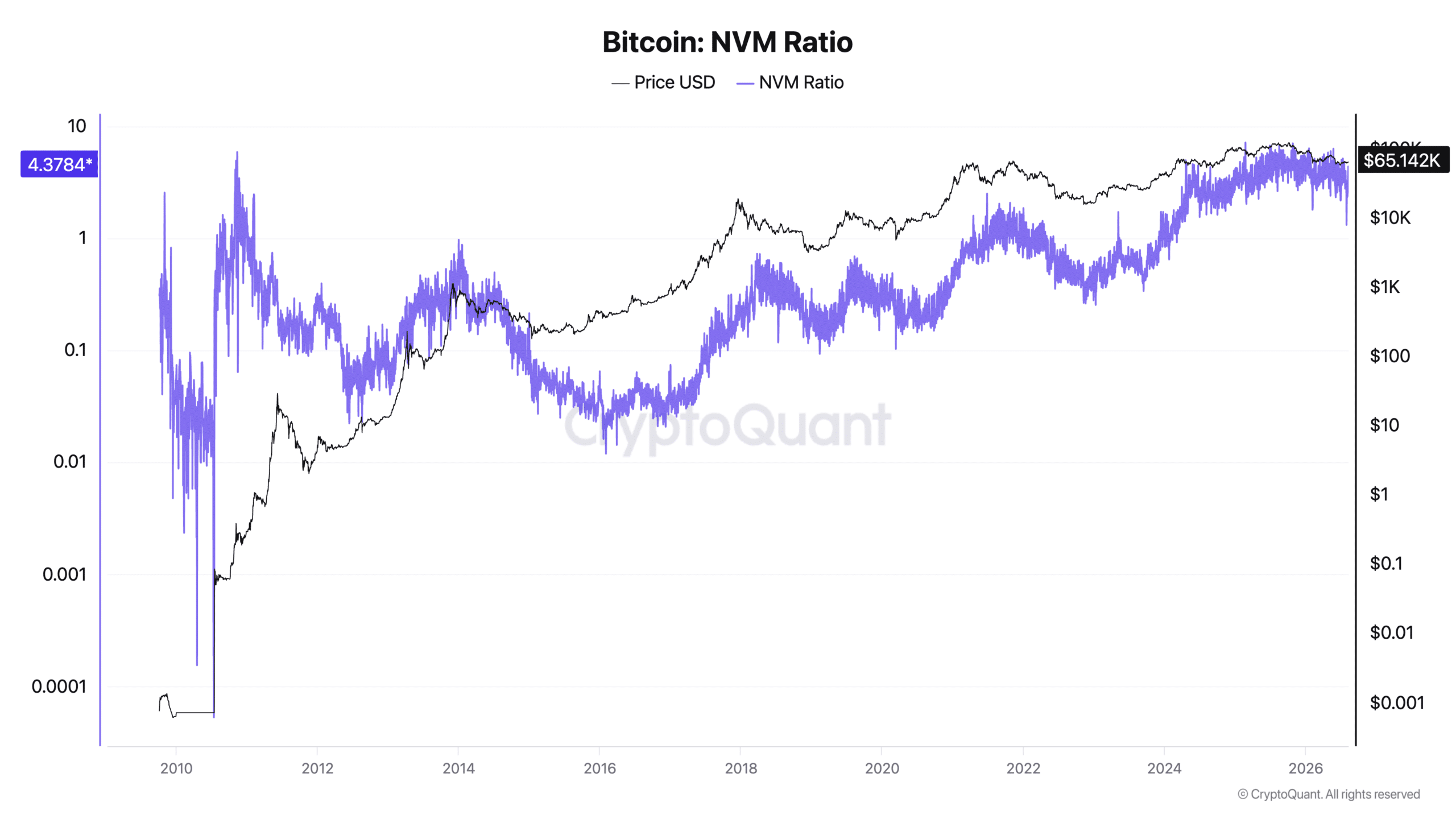
Now, even though the NVM Ratio has declined from its peak values in early 2026 and parts of 2025, the graph indicates that it is still much higher than the lower values observed during earlier market corrections.
In other words, rather than clearly indicating either extreme undervaluation or a significant speculative peak, the reading indicates a healthy but elevated valuation in relation to network activity.
Final Summary
- Saylor claimed that the recent fork couldn’t gain enough significance as about 99.85% of Bitcoin’s hashpower has stayed with Bitcoin.
- Dan Held also criticized BIP-110 for wasting the time and effort of developers.