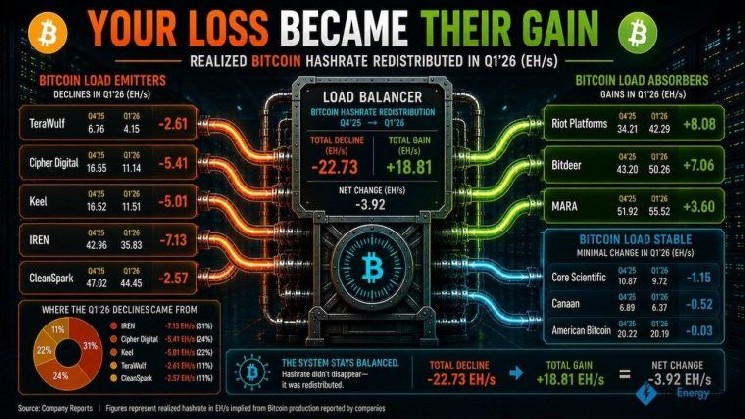
Public Bitcoin miners spent years racing to add more hashrate to the network. In the first quarter of 2026, many of them did the opposite.
This article first appeared in Miner Weekly, a weekly newsletter by Blocksbridge Consulting curating the latest news in energy, compute, infrastructure, and data analysis from The Energy Mag. The original article can be viewed here.
Bitcoin’s average network hashrate, based on public blockchain data, declined from roughly 985 EH/s in Q4 2025 to 873 EH/s in Q1 2026. Separately, TheEnergyMag compiled quarterly production disclosures from major publicly traded miners to calculate their respective realized hashrate implied from Bitcoin production results.
At first glance, the aggregate change among large public miners appeared relatively modest. The combined realized hashrate of 10 major ones tracked by TheEnergyMag declined only slightly from approximately 297 EH/s in Q4 2025 to 291 EH/s in Q1 2026. HIVE and Cango (NYSE: CANG) were excluded from the comparison because their first-quarter production data was incomplete.
But beneath that seemingly stable aggregate figure was a much more notable redistribution of industrial-scale hashing power.
While companies such as Core Scientific (NASDAQ: CORZ), IREN, Cipher Digital (NASDAQ: CIFR), TeraWulf (NASDAQ: WULF) and Keel Infrastructure (NASDAQ: KEEL) sharply reduced realized hashrate as they dismantled or repurposed mining fleets for AI and HPC infrastructure, others, including Bitdeer (NASDAQ: BTDR), MARA (NASDAQ: MARA) and American Bitcoin (NASDAQ: ABTC) expanded aggressively to absorb part of the displaced network share.
Among the biggest decliners, IREN’s realized hashrate fell from 42.96 EH/s to 35.83 EH/s, while Cipher dropped from 16.55 EH/s to 11.14 EH/s after fully decommissioning mining operations at its Black Pearl facility in February to begin retrofitting the site for HPC infrastructure. Keel Infrastructure, formerly Bitfarms, declined from 16.52 EH/s to 11.51 EH/s as it continued winding down legacy mining operations and shifting toward North American AI infrastructure development.
CleanSpark (NASDAQ: CLSK) witnessed a modest drop but similarly signaled it intends to continue monetizing Bitcoin infrastructure while selectively pursuing AI opportunities. Executives said older ASIC fleets may eventually be sold or relocated once AI deployments become fully operational, though the company acknowledged future site conversions could result in additional impairment charges.
By contrast, Riot Platforms (NASDAQ: RIOT) increased realized hashrate from 34.21 EH/s to 42.29 EH/s during the quarter. Bitdeer climbed from 43.20 EH/s to 50.26 EH/s with energization of its SEALMINERs, while MARA rose from 51.92 EH/s to 55.52 EH/s despite simultaneous expansion efforts of their businesses around AI and HPC initiatives.
The divergence highlighted a growing split within the public mining sector and that shift became especially visible in corporate filings and earnings calls, where several miners disclosed large-scale fleet dismantling efforts, asset write-downs and mining infrastructure impairments tied directly to AI conversions.
Core Scientific said mining operations will continue winding down throughout 2026, with management expecting only one or two sites to remain operational for Bitcoin mining by year-end as the company prioritizes high-density colocation infrastructure for CoreWeave (NASDAQ: CRWV). The company recorded a $266.5 million impairment charge during Q1 2026, including $151.6 million related to mining equipment and $114.9 million tied to mining infrastructure.
Cipher Digital separately disclosed $30.8 million worth of mining rigs classified as held for sale after shutting down Black Pearl mining operations. TeraWulf owned approximately 54,100 Bitcoin miners as of March 31, but only around 35,500 were operational at its Lake Mariner campus. The remaining roughly 18,600 miners were categorized as undergoing maintenance, awaiting disposal, or held on standby to replace units under repair.
Instead of merely idling rigs during periods of weak economics, operators are permanently repurposing substations, cooling systems and data center layouts for AI deployments. Once infrastructure is converted for GPU workloads, it is unlikely to quickly return to Bitcoin mining.
American Bitcoin, one of the few companies still expanding its mining fleet, argued the transition could create a long-term opportunity for dedicated Bitcoin miners willing to continue scaling while competitors unplug fleets.
The company increased its owned fleet capacity from 25 EH/s to 28.1 EH/s in April following the reenergization of its Drumheller site, which had remained offline since 2024. Much of that growth, similar to its 2025 ramp-up, was financed through an unconventional structure that used pledged bitcoin rather than cash to acquire new-generation ASIC miners from Bitmain.
As of March 31, 2026, ABTC had pledged a total of 3,090 bitcoin to Bitmain for the purchase of 18 EH/s computing power, which alone represented nearly 64% of ABTC’s 28.1 EH/s proprietary mining fleet. ABTC mined 817 bitcoin during Q1 2026, up 505% from a year earlier. At the current production pace, and assuming Bitcoin network hashrate remains roughly stable, the company could theoretically mine back the equivalent of its originally pledged bitcoin collateral in about six quarters.
If network hashrate continues declining as industrial miners unplug more hashrate to pivot toward AI infrastructure, ABTC’s payback period in bitcoin terms could accelerate even further as remaining miners capture a larger share of block rewards.
All in all, the ongoing migration has altered the financial logic of industrial mining. During previous downcycles, miners typically unplugged rigs because falling Bitcoin prices or rising energy costs rendered operations uneconomic. In 2026, however, miners are increasingly shutting down fleets because AI infrastructure offers more stable long-duration cash flows, stronger financing conditions and higher expected returns on power capacity.
It will be worth watching how the dynamics play out in the quarters to come. But for now, the system remains balanced.