Key Takeaways
- Monero’s network hashrate reached an estimated 7.12 GH/s on Oct. 26.
- SupportXMR, Nanopool and Kryptex collectively accounted for approximately 60% of Monero’s computing power.
- Monero’s RandomX mining model faces concentration concerns following Qubic’s 2025 offensive.
Monero’s Mining Power Climbs as Three Pools Dominate the Hashrate Race
Monero’s mining network is going great guns, with hashrate estimates approaching historic highs while a handful of mining pools command most of the computational firepower. On Oct. 26, 2026, mining distribution data showed around 7.12 gigahash per second (GH/s) securing the privacy-focused blockchain.
The figures paint an intriguing picture of a cryptocurrency deliberately engineered for accessible CPU mining, yet increasingly shaped by industrial-scale competition, concentrated pool participation, and specialized hardware.
Three Mining Pools Command Nearly 60% of Monero’s Hashpower
Mining distribution figures from Miningpoolstats show SupportXMR leading the pack with approximately 1.87 GH/s, followed by Nanopool at 1.23 GH/s and Kryptex at 1.17 GH/s. Together, those three pools represent approximately 4.27 GH/s, or 60% of the estimated network total. SupportXMR alone accounts for roughly 26.3%, while Nanopool and Kryptex represent approximately 17.3% and 16.4%, respectively.
Hashvault follows with 730.76 megahash per second (MH/s), while C3Pool contributes 481.17 MH/s. P2Pool’s largest listed segment supplies another 473 MH/s, offering miners a decentralized alternative to conventional pool operators. The figures don’t establish that three entities own 60% of Monero’s mining equipment. Pool operators coordinate computing power contributed by independent miners, who can redirect their machines elsewhere.
Nevertheless, the distribution shows how mining coordination can become concentrated even when participation remains technically accessible.
Monero Mining Pool Distribution, Oct. 26, 2026
| Mining Pool | Hashrate | Network Share |
|---|---|---|
| SupportXMR | 1.87 GH/s | 26.3% |
| Nanopool | 1.23 GH/s | 17.3% |
| Kryptex | 1.17 GH/s | 16.4% |
| Hashvault | 730.76 MH/s | 10.3% |
| C3Pool | 481.17 MH/s | 6.8% |
| P2Pool | 473.00 MH/s | 6.6% |
| Skypool | 349.47 MH/s | 4.9% |
| Monero Ocean | 225.24 MH/s | 3.2% |
Source: Miningpoolstats, Oct. 26, 2026, at 6 p.m. ET. Network hashrate estimated at 7.12 GH/s. Percentages are approximate, and P2Pool figures reflect its largest listed segment.
Qubic’s 2025 Mining Offensive Still Looms Large
Monero’s elevated hashrate follows a contentious 2025 campaign in which Qubic directed substantial outside computing resources toward the network. Qubic claimed it temporarily controlled more than 51% of Monero’s hashrate, equivalent to approximately 2.7 to 3 GH/s at the time. Short blockchain reorganizations and orphaned blocks accompanied the episode, although the network continued operating.
The confrontation rocked discussions about Monero’s security model, particularly whether CPU-friendly mining alone could prevent coordinated entities from amassing considerable computing power. While the network is humming along at 7.12 GH/s, it is still below the all-time high logged earlier this year. Coinwarz data shows that the Monero network reached 7.54 GH/s at block height 3589072.
RandomX Keeps CPUs Competitive, but Bitmain Enters the Picture
Monero relies on RandomX, a proof-of-work (PoW) algorithm introduced in November 2019 to favor general-purpose CPUs over conventional application-specific integrated circuits (ASICs). RandomX combines random program execution, memory-intensive operations and complex calculations to discourage the extreme hardware specialization associated with bitcoin mining. Bitcoin’s pool distribution concentration is no better, as the top three mining pools command 59.51% at the time of writing.
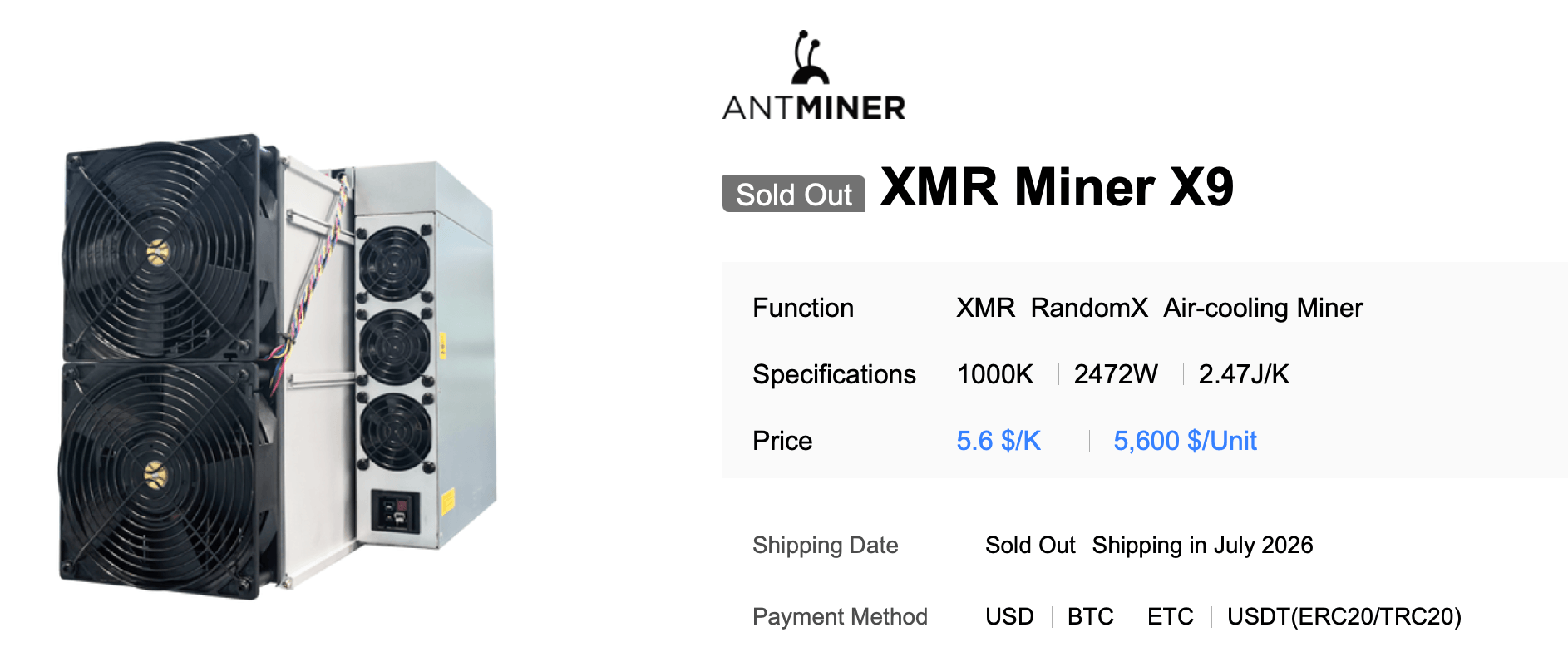
As far as XMR, Bitmain has challenged the decentralized mining premise with dedicated RandomX equipment. Its Antminer X5, released in 2023, delivers approximately 212 kilohash per second (KH/s) while consuming 1,350 watts. The X5 unit was sold for $2,999. A Bitmain X9, which delivers 1 megahash per second (MH/s) of hashpower, was sold for $5,599, and gets an estimated $28.27 per day according to current XMR prices. This makes RandomX the second most profitable PoW mining algorithm today, just under Zcash’s Equihash. According to Bitmain’s shop, both the X5 and X9 units are sold out.
Monero’s Growing Security Budget Faces a Decentralization Test
The privacy coin Monero produces blocks approximately every two minutes, awarding miners a permanent base reward of 0.6 XMR plus transaction fees. That tail emission creates roughly 432 new XMR daily, providing continuing incentives for miners regardless of transaction activity. Higher network hashrate generally raises the computing resources required to challenge Monero’s consensus, but distribution matters as much as raw computational strength.
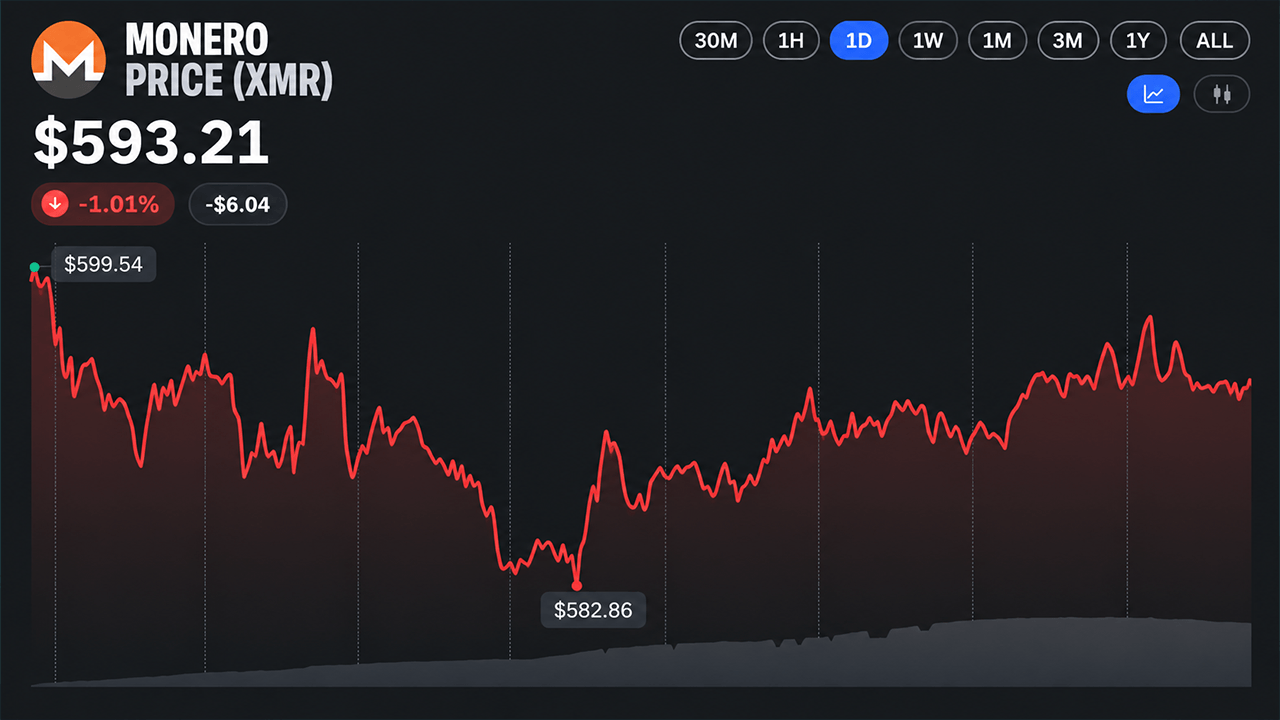
A great deal of that strength derived from XMR’s price jump this past year. Over the last 12 months, monero has climbed 70% against the U.S. dollar while year-to-date stats show a 37% gain. XMR’s price nearly doubling in value in a year has clearly attracted mining interest across a myriad of mining pools, not just the top three. Today, the latest figures show the five largest listed pools collectively directing roughly 77% of the estimated network hashrate.
That’s a substantial concentration of coordinated mining activity, even though the underlying hardware may belong to thousands of independent participants. For Monero, the pressing question isn’t whether its miners can produce more hashes. It’s whether the network can keep that expanding computing power sufficiently dispersed to resist the next coordinated challenge.