Asset manager Ark Invest has dismissed claims made by venture firm a16z that “TradFi does want DeFi, only blockchain.” According to Lorenzo Valente, Director of crypto research at Ark Invest, the VC firm’s arguments are “overly bearish.”
I think a16z Crypto is top-notch out there, but this is overly bearish and simplistic in my opinion.

For a16z, the vision of DeFi and traditional finance (TradFi) convergence is a “comforting story” which is “mostly wrong.” The firm argued that businesses will embrace DeFi not for decentralization, but for cost reduction and improved efficiency where applicable.
Here’s the more honest version: where TradFi can use a blockchain to make its existing business better, it will. Not because it has embraced decentralization, but because it’s a compelling COGS story.
The venture firm cited Circle’s push for Arc Chain for institutional stablecoin payments. Additionally, it mentioned Canton, which advances privacy for institutional players dealing with tokenization. SWIFT is also advancing its blockchain for tokenization and payments. It concluded by stating,
TradFi isn’t adopting DeFi. It’s selectively adopting parts that fit its model.
For the a16z analysts, TradFi will pick viable innovations from DeFi and public chains and adopt it within its controlled environment.
DeFi vs TradFi: Will they converge or diverge?
However, this is not the whole picture, according to Ark Invest’s Valente. He also mentioned the success of BlackRock’s BUIDL and other tokenized treasury money markets that are live on public chains.
Additionally, Valente argued that the success of stablecoins like USDT and USDC shows that the market “keeps voting for open access.”
For him, private chains will continue to die in isolation unless they join permissionless public chains. Carlos Domingo, CEO of tokenization issuer Securitize, echoed Valente’s sentiment.
Private chains or pseudo ones are the intranet and private clouds of this era, a transitional step into a truly open and permissionless innovation model.
Here, it’s worth pointing out that several private chains have since debuted or are in the pipeline, like Stripe’s Tempo or Google Cloud Universal Ledger (GCUL). They are all eyeing payments and tokenization.
In fact, even Mastercard, Stripe, Visa, and PayPal have adopted stablecoins, which validates some part of a16z’s claim.
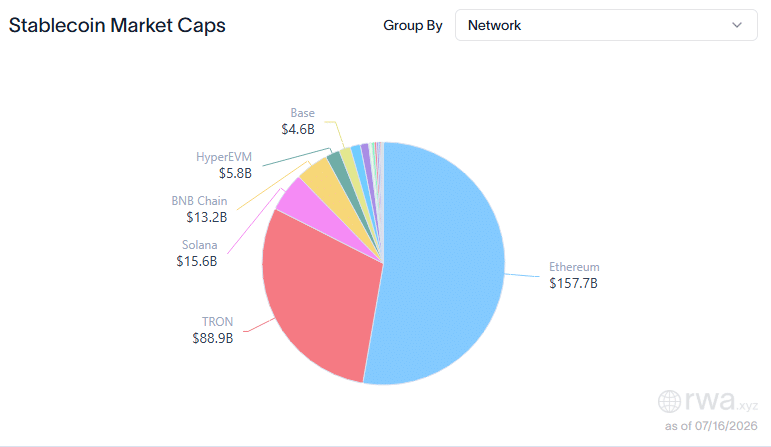
Still, the dominance of public chains in the stablecoin and tokenization settlement market segment also validates Ark Invest’s argument. Notably, Ethereum and Tron control nearly 75% of the stablecoin sector.
For tokenization, corporate chains Canton and Provenance control 85% market share while Ethereum comes in third at about 4%.
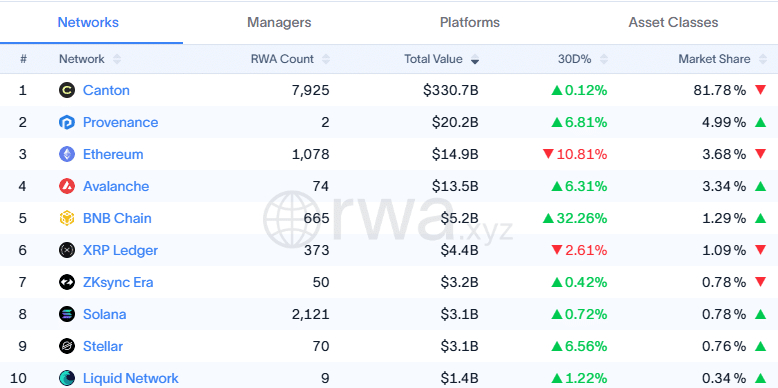
As it stands, based on the aforementioned data, public chains dominate stablecoin payments.
However, corporate chains still have a massive moat in the tokenized assets segment. This means that both sides are right. Meaning, TradFi is selective in its DeFi push, but that does not overwrite the importance of public chains.
Final Summary
- Ark Invest believes public chains and DeFi will emerge winners in the long run.
- Ethereum dominated stablecoins, but ‘corporate chains’ locked the tokenization segment.