
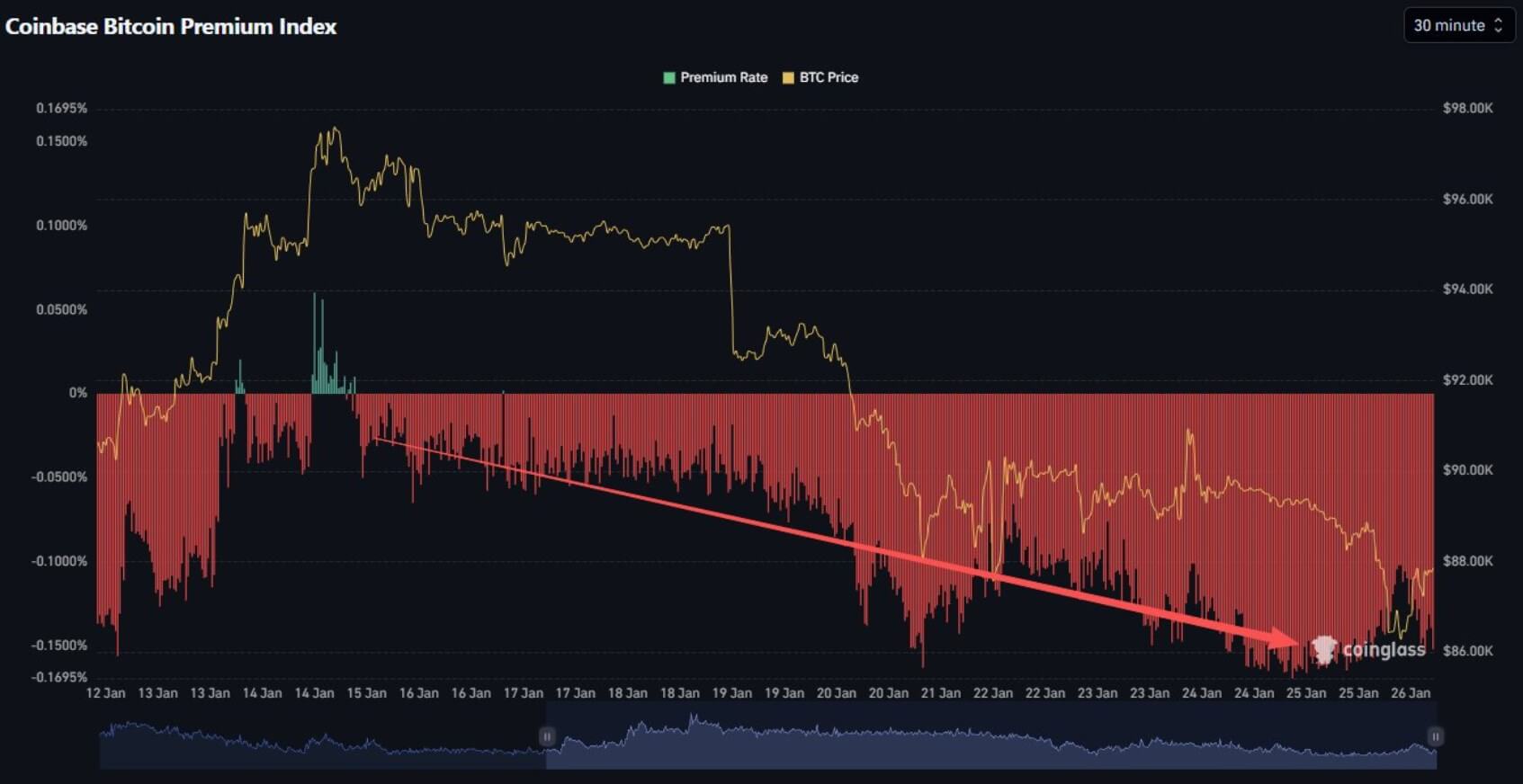
Coinbase’s Bitcoin (BTC) price dropped below competing exchanges this week, and the gap continues to widen.
CoinGlass reported on Jan. 26 that its Coinbase Bitcoin Premium Index, which tracks the price difference between Coinbase’s BTC/USD and Binance’s BTC/USDT, turned sharply negative, indicating Bitcoin trades at a discount on the largest US venue compared to offshore competitors.
The move arrives as US spot Bitcoin ETFs recorded $1.1 billion in outflows last week and broader risk appetite weakened, raising questions about whether American institutional demand is cracking or whether something messier is happening in crypto market plumbing.
The answer is likely both, and the distinction matters because a persistent discount reveals more than sentiment, exposing constraints in how liquidity moves between venues, how ETF flows translate to spot execution, and whether arbitrage infrastructure can keep markets connected during stress.
Defining the signal
CoinGlass documents its premium index as the price difference between Coinbase Pro and Binance, with a negative reading meaning Bitcoin is cheaper on Coinbase than on Binance.
The index is not purely a demand gauge, as it measures the spread between a USD-denominated venue and a USDT-denominated venue, which introduces mechanical effects from stablecoin deviations, funding conditions, and offshore leverage dynamics.
The baseline interpretation treats widening negative premiums as evidence of relatively stronger sell pressure or weaker bid depth on US-linked venues compared to offshore markets.
However, cross-exchange price deviations can persist for days or weeks even in liquid markets, reflecting genuine segmentation rather than pure supply-demand shifts.
Research on crypto price formation documents large recurring gaps driven by transfer frictions, compliance barriers, credit limits, and inventory constraints that prevent arbitrage from closing dislocations instantly.
The question is not whether selling exists, as it always does, but why cross-venue arbitrage failed to compress the gap and what that reveals about stress in financing, settlement infrastructure, or risk appetite.
ETF plumbing channel
When US spot Bitcoin ETFs record net outflows, authorized participants and market makers adjust hedges and liquidity provision, which can translate into net spot selling or reduced bid depth.
Coinbase serves as a primary liquidity venue for US institutional crypto infrastructure, handling custody for over 80% of Bitcoin ETF issuers, and BlackRock materials reference Coinbase Prime as an affiliate of the iShares Bitcoin Trust custodian.
That embedded role means ETF redemption activity can route through Coinbase-linked execution pathways more directly than through offshore venues.
Farside Investors data shows multiple days of sizable outflows from US-traded Bitcoin ETFs over the past week, totaling over $1.3 billion.

The timing correlation is suggestive but not definitive, as most US spot Bitcoin ETFs use cash creations and redemptions rather than pure in-kind transfers, which introduces latency between ETF share flow and spot execution.
The pattern resembles a symptom of balance sheet tightening.
When ETF flows wobble and macro risk appetite weakens, US-linked liquidity providers pull bids faster than offshore leverage unwinds, creating transient but persistent discounts.
The premium becomes a real-time gauge of whether institutional appetite is keeping pace with supply. And, right now, it suggests US bids are stepping back.
USD-USDT plumbing channel
The index structure introduces a second mechanical driver: because Coinbase trades against USD and Binance against USDT, any deviation in the USDT/USD rate affects the calculated premium even if spot demand is identical across venues.
Kaiko has documented episodes in which USDT rapidly flips between discount and premium during market stress, driven by stablecoin supply constraints, offshore funding conditions, or perp market basis dynamics.
If USDT trades above parity, then BTC/USDT prices appear optically higher, mechanically worsening Coinbase’s discount even if no additional selling occurs on Coinbase itself.
Perpetual swap markets compound this effect. Funding rates are mechanically linked to spot-perp basis calculations. When funding turns negative or compresses, the relationship between USD and USDT venues can dislocate as traders adjust hedges venue-by-venue based on margin requirements and collateral preferences.
This channel doesn’t invalidate the demand interpretation, complicating it instead. A widening discount can simultaneously reflect US spot selling pressure and offshore stablecoin microstructure stress.

Derivatives stress and arbitrage constraints
When the CME Bitcoin futures basis compresses, and perpetual swap funding turns negative or flat, spot becomes the fastest hedge leg for traders unwinding positions.
CF Benchmarks notes that the CME basis is strongly tied to sentiment shifts and momentum regimes, and that basis compression often coincides with risk-off moves.
If basis and premium both deteriorate simultaneously, that alignment points to a broader de-risk environment rather than an isolated US weakness.
In frictionless markets, a Coinbase discount should attract buy-on-Coinbase, sell-offshore arbitrage until the gap closes.
Persistent widening implies something is constraining that flow: balance sheet limits, compliance frictions, transfer costs, volatility risk, or simply that arbitrage capital is deployed elsewhere.
Academic work on crypto arbitrage documents large recurring deviations and meaningful market segmentation, with price gaps persisting longer during sell-offs when liquidity deteriorates, and risk limits tighten.
Kaiko research discusses fragmentation-driven dislocations that flare during stress periods, noting order book depth can thin asymmetrically across venues.
If Coinbase’s bid depth shrinks relative to Binance’s, discounts persist even if arbitrageurs recognize the opportunity, because executing large size becomes prohibitively expensive or risky.
The most actionable signal is not that selling exists but that market connectivity is degrading.
When institutional flow turns negative, financing signals deteriorate, and arbitrage can’t close gaps, the combination indicates genuine stress rather than routine volatility.

Three forward scenarios
The first foreseeable scenario is a reversion, in which ETF flows stabilize or turn positive, risk appetite recovers, and the premium mean-reverts to zero.
This path depends on macro stabilization and renewed institutional appetite, which aggregators’ data can confirm day to day. If outflows stop and inflows resume, arbitrage capital returns, and discounts naturally compress.
The second scenario involves persistence, with the premium remaining negative as ETFs continue bleeding and macro conditions remain risk-off.
Rallies become fragile because the US bid depth never fully recovers, creating resistance at higher price levels. This regime favors patient sellers over momentum buyers and keeps volatility elevated.
Microstructure shock scenario: USDT/USD dislocates sharply, funding regimes shift abruptly, or a venue-specific event introduces new frictions.
The premium becomes noisy and less interpretable as a pure demand signal, with larger intraday swings driven by offshore stablecoin dynamics rather than spot flows.
Broader implication
Coinbase’s widening discount functions as a symptom dashboard rather than a single diagnosis.
It reflects US-linked net selling and weak bids when ETF flows are negative, but it also reflects USD-versus-USDT plumbing stress and constrained arbitrage capacity.
All three dynamics intensify during risk-off regimes, making the premium a composite signal of institutional appetite, stablecoin microstructure health, and market connectivity.
The forward-looking question is whether arbitrage infrastructure can keep pace with institutional flow shifts. If ETFs continue bleeding while arbitrage remains constrained and financing conditions tighten, the discount becomes a leading indicator of liquidity fragmentation rather than a lagging indicator of sentiment.
The difference matters because fragmentation persists longer and resolves less predictably than simple supply-demand imbalances.
For now, the widening gap suggests US balance sheets are tightening faster than offshore leverage is unwinding, and that market plumbing is struggling to keep prices in sync.
That combination doesn’t guarantee further downside, but it does indicate the infrastructure needed to absorb selling pressure or sustain rallies is operating under stress. And stress, once embedded in market microstructure, tends to linger even after headlines improve.






1 Comment
Join our affiliate community and maximize your profits!