The SEC’s proposed Regulation Crypto Assets offers a $75 million fundraising ceiling. A Senate market-structure framework starts with a greater-of-$50-million-or-10% formula. Those numbers look comparable, but they attach to different legal mechanisms.
The SEC proposal would create exemptions by rule for certain crypto-asset offerings. Section 103 of the Senate’s version of the CLARITY Act would create a statutory exemption for certain transactions involving ancillary assets sold pursuant to an investment contract. The distinction changes which issuers and instruments qualify, what buyers receive, and how the two paths could interact.
Neither route is currently available. The SEC proposal remains subject to public comment through Oct. 20, 2026, while the congressional framework remains unfinished legislation.
Different legal objects create different fundraising paths
The SEC proposal describes two routes. A limited “startup” exemption would allow up to $5 million over a four-year period. A separate offering-and-reporting exemption would permit up to $75 million in a 12-month period, paired with disclosure and continuing-reporting duties.
The Senate text takes a different approach. Its Section 103 would exempt qualifying transactions in “ancillary assets” sold under an investment contract. The annual amount would be the greater of $50 million or 10% of the total dollar value of the issuer’s outstanding ancillary assets, measured during a four-year period. An issuer could not exceed $200 million in aggregate sales under the exemption.
That 10% alternative means the congressional route is not necessarily a $50 million ceiling. For an issuer whose outstanding ancillary assets are valued above $500 million, 10% would exceed $50 million, although the separate $200 million aggregate limit would still matter. The calculation also depends on a category, ancillary assets, that is not identical to the covered assets and transactions contemplated by the SEC proposal.
| Issue | SEC proposal | Senate Section 103 |
|---|---|---|
| Current status | Proposed agency rules | Pending statutory text |
| Covered object | Qualifying crypto-asset offerings under proposed exemptions | Qualifying ancillary-asset transactions under an investment contract |
| Main limits | $5 million over four years; or $75 million in 12 months | Greater of $50 million annually or 10% of outstanding ancillary-asset value during four years; $200 million aggregate |
| Issuer access | Depends on the conditions of the chosen SEC exemption | Depends on the statutory ancillary-asset and transaction conditions |
| Retail rule | Proposed purchaser limits apply under the larger SEC route | No matching purchaser-cap structure appears in Section 103 |
| Resale | No general holding period in the larger proposed SEC route | Special conditions apply to specified related persons and coordinated-control holders |
| Timing | Would apply only after adoption and effectiveness | Would apply only after enactment and the statutory implementation period |
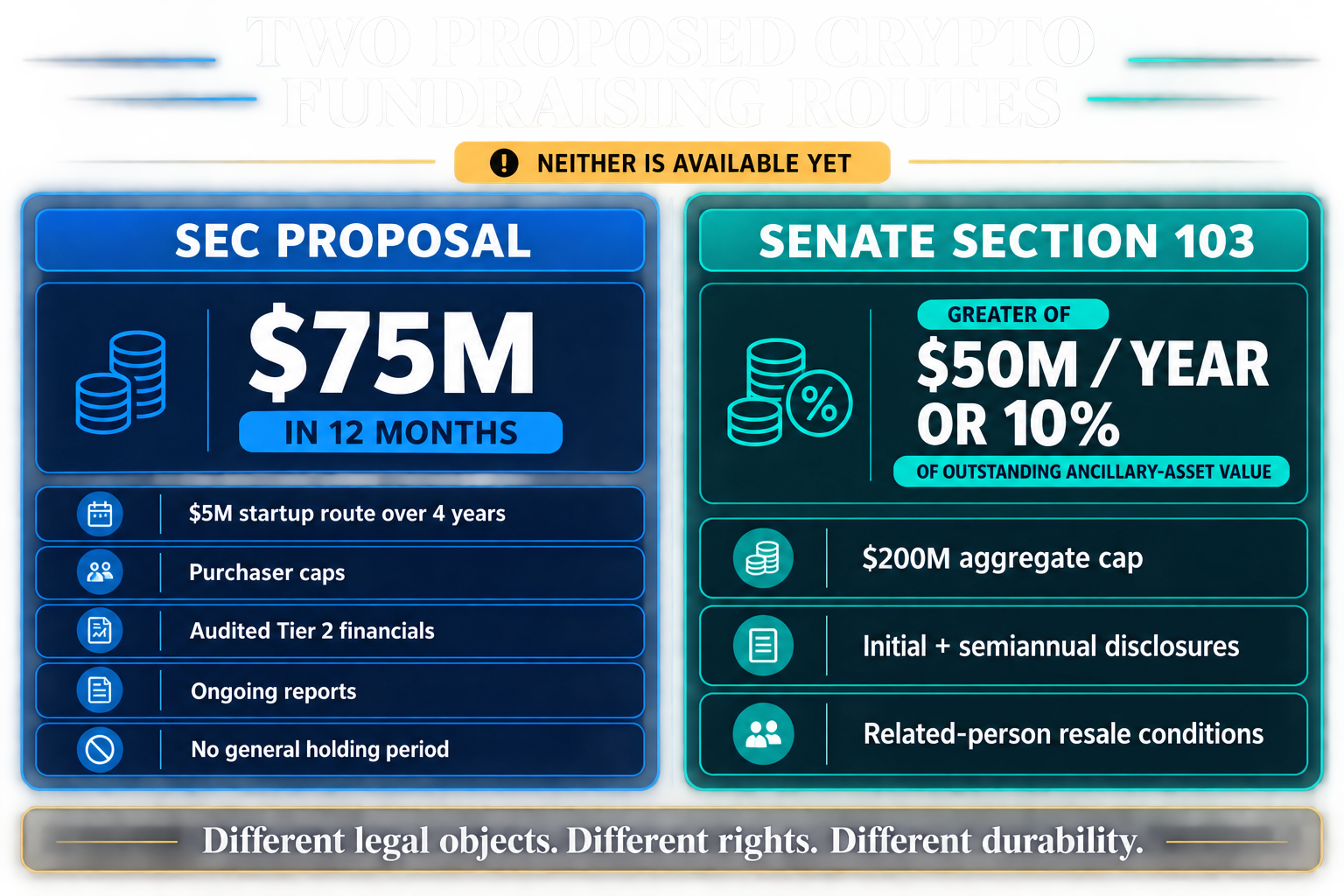
The practical choice would therefore turn on more than the amount an issuer wants to raise. Counsel would first need to identify the asset, the transaction, the issuer’s eligibility and any affiliate or control relationships. A token sale that fits one route might not fit the other.
Investor rights depend on the mechanism
Under the SEC’s proposed $75 million route, purchaser limits would generally restrict how much an investor could buy, using a 10% financial-capacity formula. The proposal would require offering disclosures, audited financial statements for the larger tier, and annual, semiannual and current reports. It also says there would be no general resale restriction under that route and proposes federal preemption of state registration and qualification requirements for covered offerings.
The SEC proposal would not erase federal anti-fraud law. Its release also presents the exemptions as nonexclusive, meaning an issuer could rely on another available exemption if the facts and conditions support it.
The Senate framework offers a different package. Section 103 requires an initial filing after the first sale and semiannual disclosures while the conditions apply. The bill text preserves specified federal liability provisions, including Securities Act Section 12(a)(2), Exchange Act Section 10(b) and Rule 10b-5. It also preserves private rights of action rather than replacing them with a bespoke remedy.
At the same time, the Senate text says that failure to satisfy the exemption does not, by itself, determine whether the ancillary asset is a security. That clause separates compliance with the transaction exemption from the broader legal classification of the asset.
Resale treatment also differs. The SEC’s larger proposed route does not impose a general holding period. The Senate text instead places conditions on sales by related persons and holders acting as a coordinated group to control the network. Those rules could matter most for founders, insiders and concentrated holders, even when ordinary downstream trading looks less constrained.
Federal preemption is another fault line. The SEC proposal expressly addresses state registration and qualification for its covered offerings. The Senate text would operate through a federal statutory exemption and related market-structure provisions, but its preemption consequences must be read from the enacted text as a whole.
Overlap would require reconciliation, not an automatic wipeout
If Congress enacted provisions that directly conflicted with an SEC rule, the agency would have to administer its rules consistently with the later statute.
The current texts leave room for coexistence. The SEC proposal says its exemptions would be nonexclusive, while the Senate bill creates a targeted statutory route for transactions in ancillary assets. An issuer could potentially assess both, provided it independently met every condition of the route used. A final law could also direct, narrow or supersede portions of the SEC framework, and later SEC rulemaking could modify the proposal before adoption.
Timing reinforces the uncertainty. The SEC must first complete notice-and-comment rulemaking. The Senate text contains its own effective and implementation provisions, including a period tied to enactment and required rulemaking. Transition provisions address some offerings and reporting obligations, but they do not make an unfinished bill operative now.
Congressional versions also remain a moving target. The Senate Banking Committee advanced one text in May, a reported Senate version appeared in June, and an updated discussion text was released in July. Any legal conclusions will need to be checked against the version that ultimately advances, not treated as fixed by an earlier draft.
The headline $25 million difference is therefore the least reliable guide. The SEC route pairs a fixed 12-month ceiling with purchaser caps, audited financials and continuing reports. The Senate route uses an asset-value alternative, a four-year framework and a $200 million aggregate ceiling, while preserving a different liability and disclosure structure. For issuers and investors, the operative divide is the legal object and the attached rights, not the first number in each proposal.