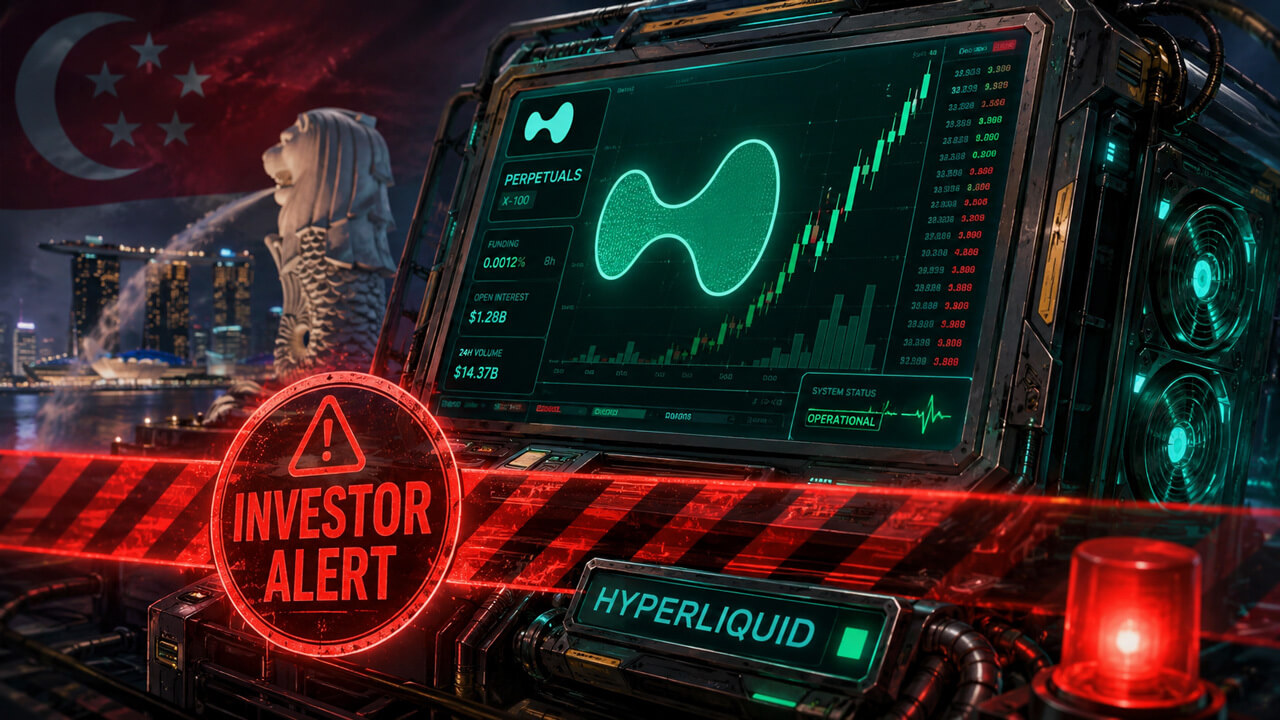
Hyperliquid has been added to Singapore’s Investor Alert List, putting DeFi’s permissionless pitch to a consumer-protection test: the network can keep settling trades, while the interface and public messaging around it draw regulatory scrutiny.
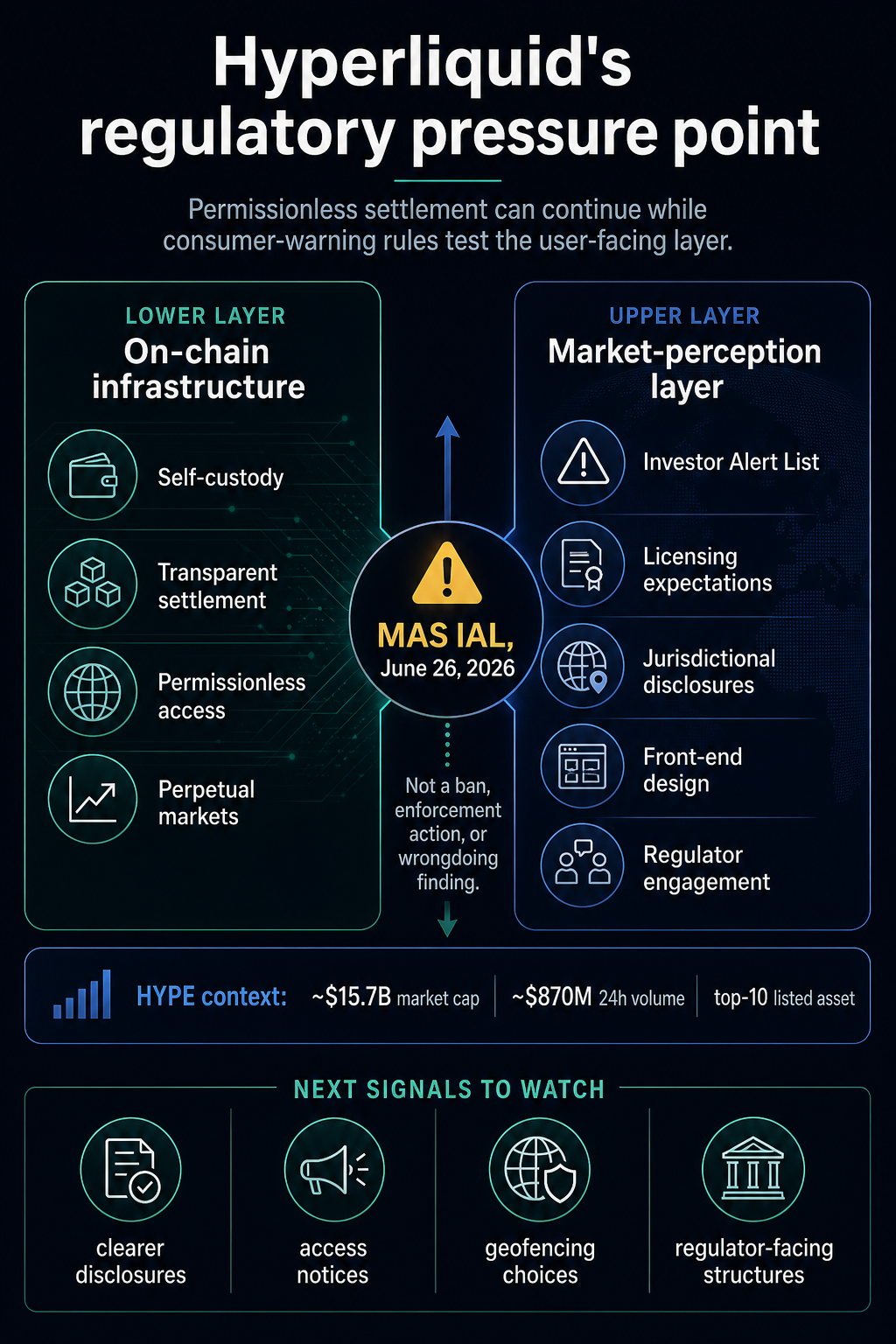
Hyperliquid said in a June 26 statement that its appearance on the Monetary Authority of Singapore’s list was a warning-list event rather than a ban, enforcement action, or finding of wrongdoing.
The project also said it had not claimed to be licensed by MAS, described itself as permissionless infrastructure, and said users retain self-custody while transactions settle transparently on-chain.
The resulting pressure is applied to the user-facing layer. A high-performance on-chain derivatives venue can keep processing trades and still face questions about whether its interface, documentation, and public messaging lead retail users to believe they are accessing a regulated market.
Singapore’s alert, therefore, now moves the regulatory test toward consumer perception.
The warning list tests the market-facing edge
MAS’s Investor Alert List is a public warning tool. Singapore’s public materials frame the list around unregulated persons or entities that may be wrongly perceived as licensed or authorized by MAS.
MoneySense, Singapore’s national financial education program, warns that consumers who deal with unregulated persons may forgo the protections available under MAS regulations, and that the list is not exhaustive.
That consumer-protection framing sits apart from any finding that Hyperliquid broke Singapore law. MAS said when it launched the IAL in 2004 that publishing a name on the list did not mean the authority had concluded that the person had contravened the law.
Hyperliquid’s own response leans on the same boundary. The venue’s statement says the listing does not amount to a ban or enforcement finding, while also stressing that users do not give up custody to the protocol and that trades settle on-chain.
Those points can all be true at the same time. A regulator can avoid saying a protocol is banned, and the protocol can continue operating as designed, while the warning still changes the public frame around who should use it, what protections users have, and whether the interface creates the impression of regulated access.
Hyperliquid’s documentation describes high-performance on-chain derivatives infrastructure and broad coverage of perpetual markets. That is central to its appeal: it gives users an expansive derivatives venue while routing the core settlement story through on-chain infrastructure.
The MAS listing tests the part of that model that technical architecture leaves open. A protocol can be permissionless at the settlement layer, while most users still meet it through a website, a user interface, documentation, social posts, market pages, and third-party discussions.
Those layers create expectations before a trade ever settles.
Singapore’s public materials focus on whether consumers may think an entity is licensed or authorized, and MoneySense emphasizes what users lose when dealing outside the regulated perimeter. For on-chain derivatives venues, that puts pressure on the presentation of access as much as the availability of code.
The practical questions are straightforward. Does the interface tell users which jurisdictions it is aimed at? Does it state what protections users do not have? Does it prevent or discourage access where the operator sees clear regulatory risk? Does the venue engage with regulators as its user base and market footprint grow?
Scale turns disclosure into a live test
The market context makes the alert more than a niche compliance footnote. HYPE is currently a top-10 asset as of June 26, with roughly $15.7 billion in market capitalization, about $870 million in 24-hour trading volume, and strong 90-day performance.
Regulator warnings hit differently when the subject is a large, liquid venue rather than a small experimental app. A retail user who sees a major token, visible volume, active markets, and a polished trading experience may infer a level of market acceptance that differs from local authorization.
That is the gap Singapore’s warning framework is built to address. The framework asks whether consumers might wrongly understand the status of the entity they are dealing with and whether they understand that MAS protections may not apply.
For Hyperliquid, the consequences are reputational and operational before they are technical. The network can continue settling trades, but the project’s public posture may now face a higher bar.
Clearer jurisdictional disclosures, access messaging, and regulator-facing communications become more important as the venue’s scale makes it harder to argue that consumer perception sits outside the operator’s responsibility.
The pressure also lands at a moment when Hyperliquid’s access model has already been under discussion. A June 24 CryptoSlate article reported that Changpeng Zhao praised Hyperliquid’s no-KYC model before noting lawyer involvement as a practical constraint.

Earlier in June, another CryptoSlate article covered a UK warning that raised concerns about unauthorized firms around Hyperliquid.

Hyperliquid’s case previews how large on-chain derivatives venues may be judged as they become easier for retail users to find and use.
The technical claim of permissionless infrastructure remains important. Regulators can also focus on what users are led to believe about licensing, local protections, and who stands behind the interface when an app begins to resemble regulated market access.
Possible next signals
Singapore has shown this distinction before. In its 2022 statement after FTX’s collapse, MAS said Binance had not been banned in Singapore, while also pointing to licensing and solicitation concerns.
That precedent involves a different fact pattern, but it shows that MAS can separate a technical or practical access question from a licensing and warning-list question.
For DeFi derivatives, that separation is likely to become more important. A venue can defend self-custody and on-chain settlement while still needing a more mature answer on jurisdictional availability, consumer warnings, front-end design, and regulator engagement.
The signals to watch now are changes in how Hyperliquid and other large on-chain trading venues speak to users in specific markets. Possible responses could include clearer Singapore-facing disclosures, revised terms, access notices, geofencing decisions, or direct regulator-facing structures.
Any of those would show that the pressure point has moved from the chain itself to the user-facing layer around it.
Until then, the MAS alert leaves DeFi with a more uncomfortable message than a formal prohibition would have. Permissionless infrastructure can keep working, while consumer-protection systems can still shape how that infrastructure is presented, understood, and trusted.