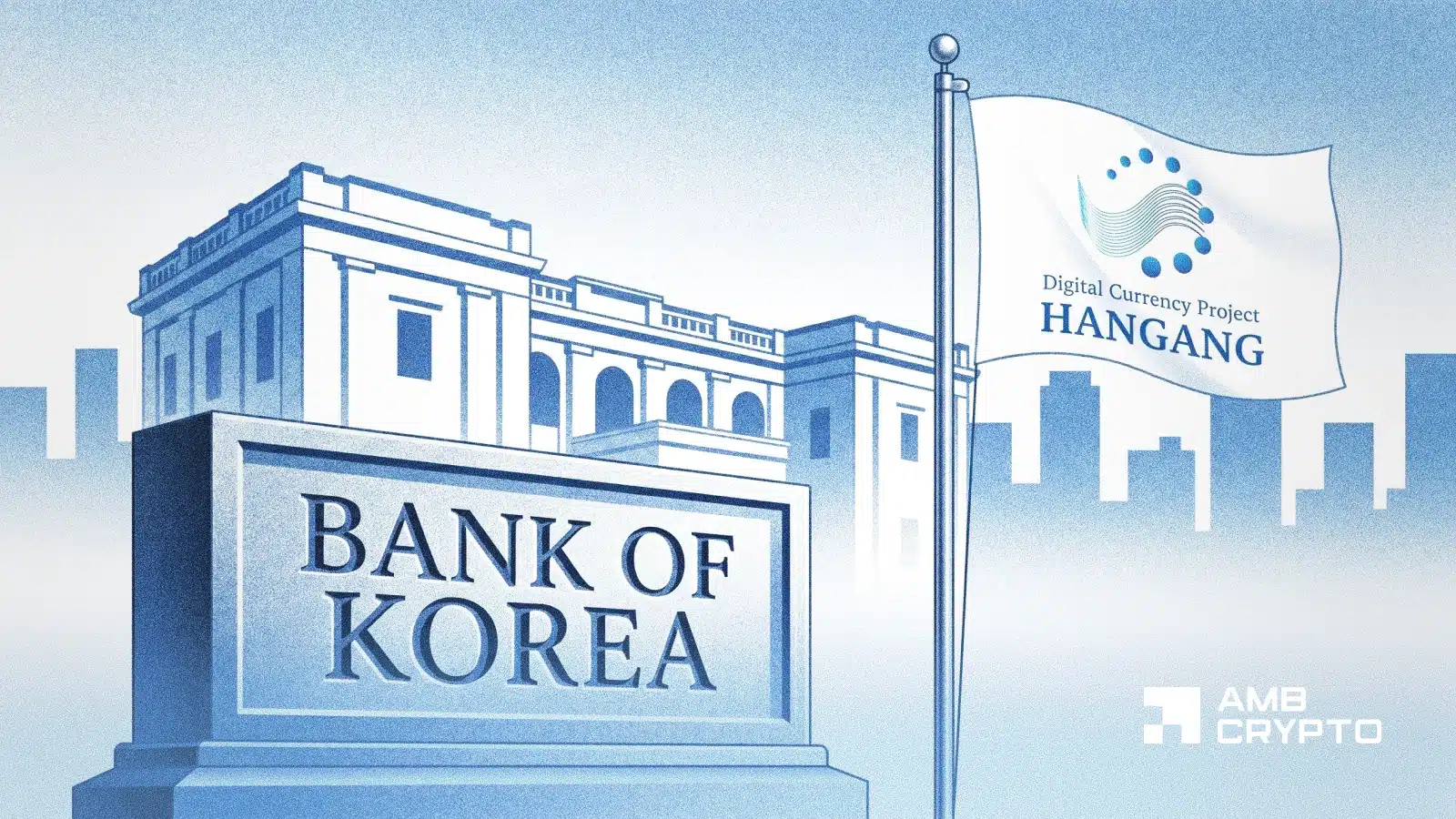
South Korea’s CBDC initiative, Project Hangang, is set to advance to a more advanced stage. According to a recent report from ETNews Korean Edition, the country’s existing mobile banking and account infrastructure is being integrated with the digital currency system.
The plan calls for participating banks to issue deposit tokens that are secured by a Bank of Korea’s wholesale CBDC.
Instead of directly holding the digital currency issued by the central bank, customers will use these deposit tokens through e-wallets integrated into their banking applications.
Details of South Korea’s new CBDC phase
In the new phase of the South Korean CBDC project, commercial banks will build the infrastructure required to integrate digital currency into their existing banking systems, moving beyond simple payment trials.
This includes developing digital voucher systems, e-wallets, and blockchain-based platforms that can be directly integrated with accounting, interest calculations, transfers, withdrawals, and other crucial banking functions.
Nevertheless, the program does not yet represent a national CBDC rollout. Instead, it is still a limited real-world experiment in which commercial banks test the use of deposit tokens backed by the central bank’s CBDC.
This is usually done among particular participants and locations, laying the groundwork for broader adoption in the future.
Phase 2 of Project Hangang
For those unaware, during the first phase, the Bank of Korea provided wholesale CBDCs to participating banks. During that period, these banks issued deposit tokens to clients through e-wallets they supplied for limited payment trials.
Therefore, by allowing those tokenized deposits to work with traditional banking operations, the new phase expands on this. Additionally, it also creates a framework for digital currency to behave more like traditional bank money while remaining in a regulated pilot environment.
Remarking on the same, a financial industry official said,
Phase 2 of Project Hangang is a stage that connects digital currency with bank account systems, mobile banking, electronic wallets, and treasury operations.
This came as South Korea was considering excluding USD-based stablecoins from its upcoming corporate crypto regulations, particularly Tether’s USDT and Circle’s USDC.
Meanwhile, through the KIPRIS database in South Korea, Tether has submitted seven trademark applications.
Final Summary
- South Korea’s Project Hangang will expand CBDC integration into bank accounts, mobile banking, and broader financial infrastructure.
- The Bank of Korea’s approach signals a push toward real-world usability, moving beyond pilot tests into practical applications.