What is opBNB?
opBNB relies on OP Stack’s bedrock technology, which boosts node performance and makes it EVM compatible. The objective is to attract more users to the Binance ecosystem by improving the overall experience and performance of the BNB Smart Chain.
The opBNB network serves as the Layer 2 scaling solution for the BNB Smart Chain, powered by the Optimism OP Stack’s bedrock version. It operates by offloading transaction processing and resource usage from the BNB Smart Chain while still maintaining data integrity on the underlying mainnet. Users can seamlessly interact with the opBNB network by depositing funds from BSC and leveraging various applications and contracts offered by opBNB.
By harnessing the power of Layer 2 technology, opBNB breaks free from the limitations of the BNB Smart Chain, offering an elevated experience for users. The implementation of this Layer 2 scaling solution marks a significant milestone for the Binance ecosystem and the broader blockchain community.
The opBNB mainnet officially launched on August 16, 2023, initially opening its doors to infrastructure providers. As of September 13, 2023, the network is now accessible to the general public. This move has generated considerable excitement within the crypto community, as opBNB’s Layer 2 solution promises to reshape the landscape of the Binance Smart Chain, making it even more attractive for users and developers alike.
How Does opBNB Work?
OpBNB, unlike other platforms, extends its capabilities beyond the realm of Optimistic Rollups. As of the latest update, the system does not implement a foolproof mechanism for validating the accuracy of challenges through a contract. This article aims to provide an overview of opBNB’s current architectural features.
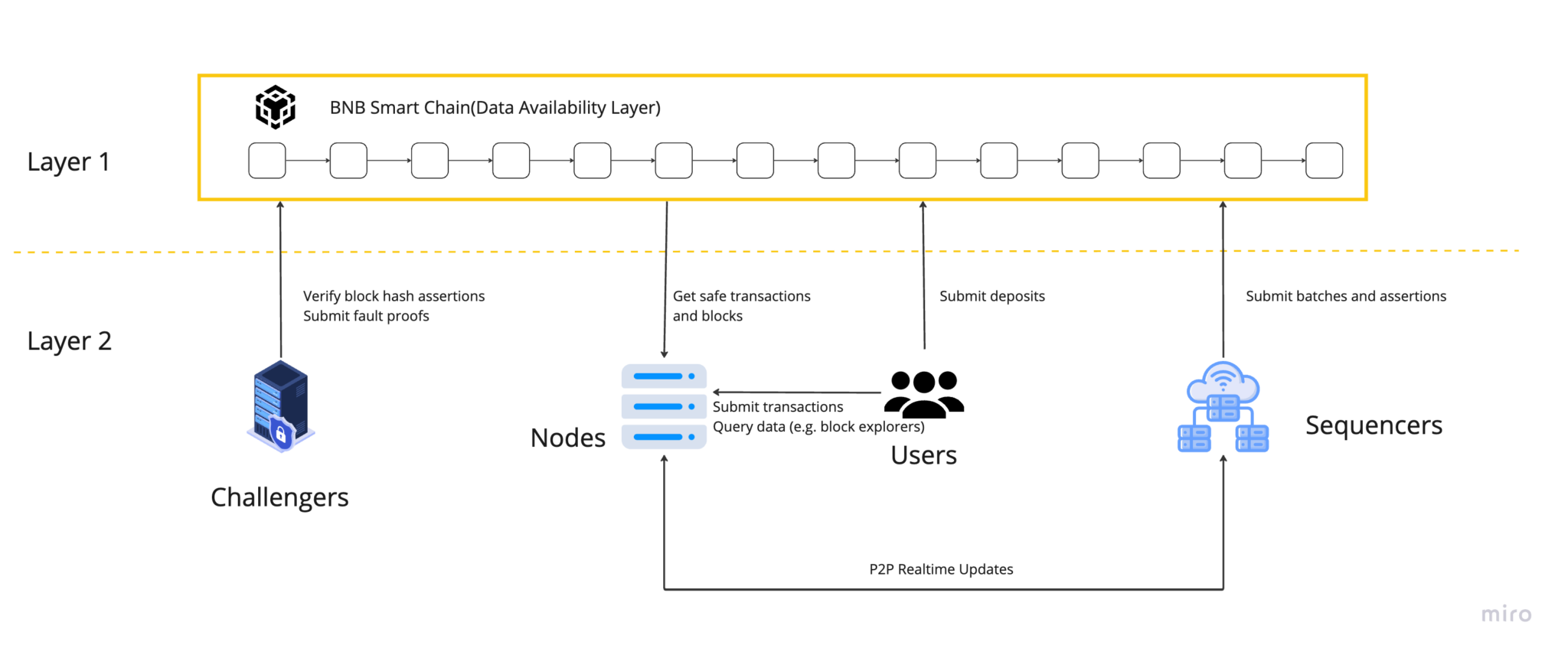
One of opBNB’s most remarkable attributes lies in its inherent modularity. As a modular network, each component within the opBNB ecosystem operates independently, yet they seamlessly synchronize to form a dynamic and cohesive system. One key architectural distinction is the separation of the Data Availability (DA) layer from the execution layer. This separation empowers users to choose from different DA options and switch between DA schemes based on their specific needs and circumstances.
Here’s a more detailed breakdown of how opBNB operates:
However, in cases where disputes arise concerning the validity of a transaction, a probationary period comes into play. During this challenge period, any party can raise objections to the transaction’s authenticity. If the challenge proves successful, the transaction is reversed, and the state of the Optimistic Rollups contract is promptly restored, ensuring the integrity and trustworthiness of the system.
Structure
Sequencer
At the heart of opBNB’s structure lies the Sequencer, a pivotal component tasked with calculating and transforming the state of transactions. The Sequencer’s role is multifaceted; it takes the diverse transactions within the network and converts them into a coherent format. This converted transaction data is then transmitted to the Roll-Up Contract, a critical element responsible for processing and affirming transactions on Layer 2.
Prover (Node)
The Prover, often referred to as a Node, assumes a pivotal role in opBNB’s infrastructure by constructing the evidence required to verify the validity of state transitions in transactions. This component operates with a singular focus on ensuring the accuracy and reliability of each transaction that traverses the opBNB network. In essence, the Prover functions as the guardian of transaction integrity, actively working to prevent third-party intrusion and fraudulent activities.
Verifier (Challenger)
Completing the trio is the Verifier, often referred to as the Challenger, which takes on the critical role of scrutinizing the evidence presented by the Prover. The Verifier’s primary responsibility is to independently assess the validity of transactions within the opBNB network. By rigorously examining the evidence provided by the Prover, the Verifier ensures that transactions adhere to the network’s established standards of validity and are free from any fraudulent or unauthorized alterations.
Highlights
- High interoperability: Using the OP Stack allows opBNB to communicate with other Layer 2 integrated OP Stack.
- Quick transactions: The project team claims that opBNB is built to be able to increase the network’s transaction speed to 4,500 TPS (Arbitrum is 4,000 TPS). These statements are not genuine; they are only the team’s words.
- EVM compatible: Since opBNB is Layer 2 EVM compatible, developers may create dApps with ease on the opBNB ecosystem.
- Low transaction costs: While Ethereum is a network with high transaction fees ($10/transaction), the majority of Layer 2 networks have transaction fees of about 0.2–0.3 USD. BNB Chain, a network with low transaction costs (under $1/transaction), is where opBNB was built. As a result, opBNB charges customers minimal transaction fees—on average, 0.005 USD per transaction.
- opBNB is a product of Binance; therefore, the network is highly compatible with BNB Greenfield, BNB Chain, BNB Beacon Chain, and zkBNB. This helps to expand the Binance ecosystem.
- Security: To provide safe state transitions and transactions, opBNB uses sequencers, provers, and verifiers. Its settlement chain, which benefits from the consensus and data availability solutions of the BNB Smart Chain, secures its rollup, providing reliable security.
- Flexibility: The OP Stack foundation offers a modular and interchangeable execution architecture, enabling opBNB to interact in a variety of ways with the blockchain network while remaining independent of a particular client implementation. This increases platform decentralization and flexibility.
- Interoperability: Since opBNB is built on the OP Stack, it can interact with other Layer 2 security platforms like Optimism, which supports EVM and Solidity. This promotes an open and collaborative environment that fosters network effects and innovation.
Products
opBNB Bridge
Users may transfer assets from the BNB Chain testnet to opBNB and vice versa via the opBNB Bridge, a bridge on the opBNB ecosystem. Nevertheless, the ecosystem also has the zkBridge of Polyhedra Network in addition to the opBNB Bridge (which supports the BNB Chain Testnet and Combo Network).
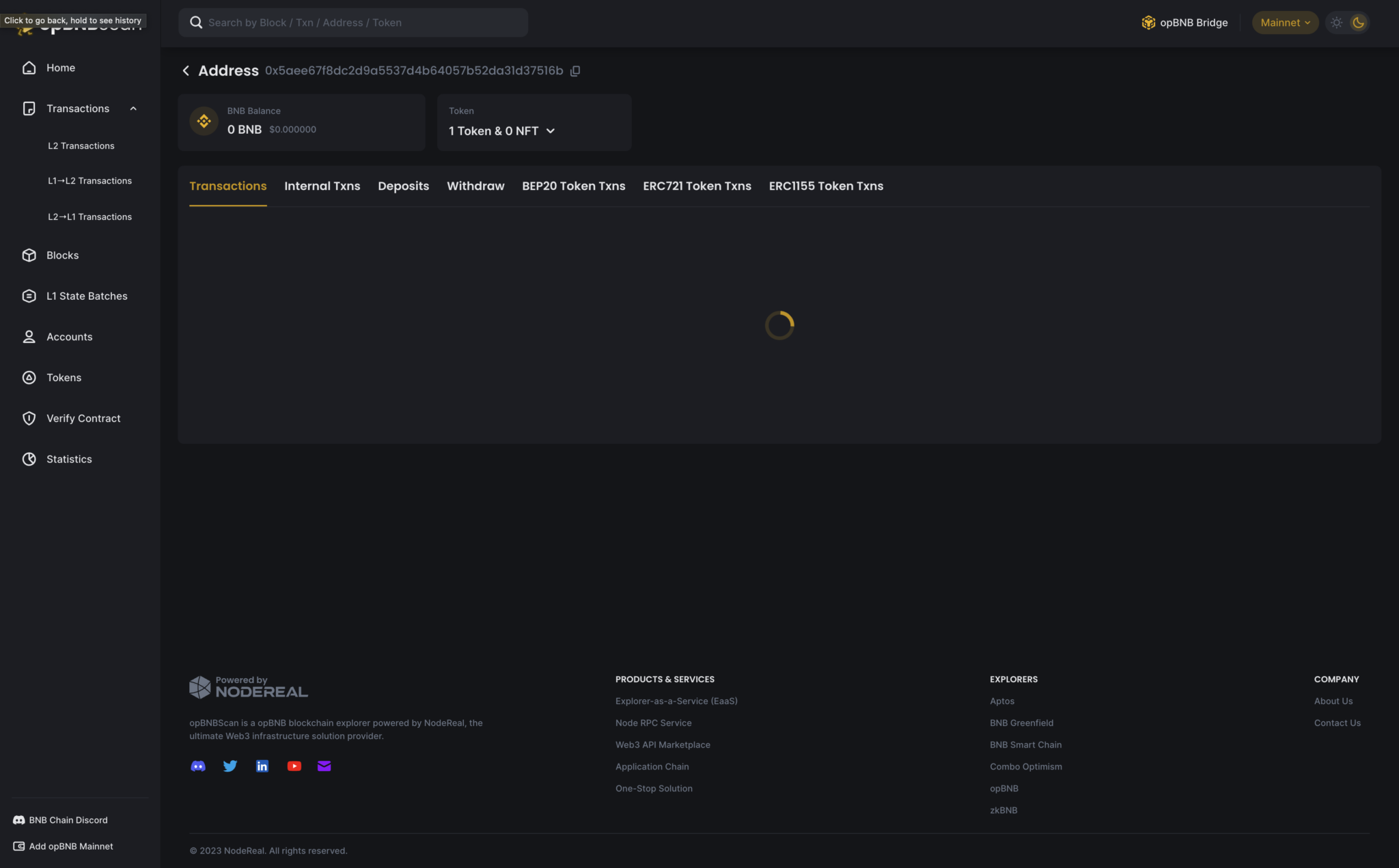
opBNBScan
Users may inspect on-chain data on the opBNB network using the opBNBScan browser, which includes the block number, transaction history, and Txn hash. At the time of writing, there were 450,000 separate wallet addresses being used in 150,000 daily transactions.
Roadmap
The following is the opBNB roadmap:
Q2, 2023
- Launch testnet
- Integrates with dApps
- Marketing and outreach campaigns.
Q3, 2023
- Launch mainnet
- Increased dApps and user adoption
- Expand to other blockchains.
Q4 2023 and futures
- Continue to develop and improve
- Expand into new markets
- General user acceptance.
The opBNB staff is dedicated to offering top-notch Layer 2 solutions that can satisfy the requirements of dApps and users. This dedication is reflected in the roadmap, which also defines the team’s goals for opBNB’s future.
The opBNB roadmap includes the following particular milestones:
- Launch of the testnet: The opBNB testnet is expected to be live in Q2 2023. This will enable testers and users to evaluate the opBNB platform and provide the team with feedback.
Integrating with well-known dApps: On the BNB Smart Chain, the opBNB team is working to integrate with well-known dApps. Users will find it simpler to utilize these dApps as a result, and they will get access to opBNB’s cheaper costs and quicker transaction times. - Marketing and outreach initiatives: To raise awareness of the project and draw in new users, the opBNB team plans to start a number of marketing and outreach initiatives.
- Launch of the opBNB Mainnet: The opBNB Mainnet is expected to become live in Q3 2023. This will serve as the opBNB platform’s formal debut and open it up to a larger audience.
- Increasing dApp and user adoption: The opBNB team is optimistic about the platform’s ability to attract more dApps and users. The BNB Smart Chain ecosystem’s scalability and effectiveness will benefit from this.
- Other blockchain expansion: The opBNB team has plans to make the platform available on more blockchains. Users will be able to take advantage of opBNB’s benefits across a larger variety of networks thanks to this.
- The strategy for opBNB is challenging yet doable. The team is certain that they can make opBNB a success since they have a good track record of accomplishing their objectives.
Team
Since opBNB is a product of Binance, the project team is made up of Binance employees. The platform is being constantly developed by the opBNB team, and new features are being added. This demonstrates their dedication to and confidence in the project’s future.
Conclusion
Since it is built on the BNB Smart Chain’s security, opBNB is a secure solution. There is no chance of fraud or duplicate spending since the main chain verifies every transaction that Optimistic Rollups sends. The probationary period also offers a means of settling disagreements over a transaction’s legality.
For the BNB Smart Chain, opBNB is a viable layer 2 solution overall. For dApps that need to grow and save expenses, it provides fast throughput, reasonable rates, and EVM compatibility.
There are not many dApps that now use opBNB since it has not yet gained widespread acclaim. But, the team is aiming to boost use and improve opBNB’s appeal to consumers and developers.
DISCLAIMER: The information on this website is provided as general market commentary and does not constitute investment advice. We encourage you to do your own research before investing.