Beginning in early September, TRON’s [TRX] activity levels have stabilized into what would appear to be a long-term trend of increasing network usage instead of short bursts of increased use.
That being said, the platform held over 4 million in total active accounts, with the monthly averages totaling approximately 4.41 million users.
As time progressed, user activity increased up to 4.84 million users by mid-September but then declined down to below 4 million users by the end of the month.
Importantly, it is significant for participation to remain consistent over time since it creates a solid base for transactions, stablecoin transfers, and payment processing.
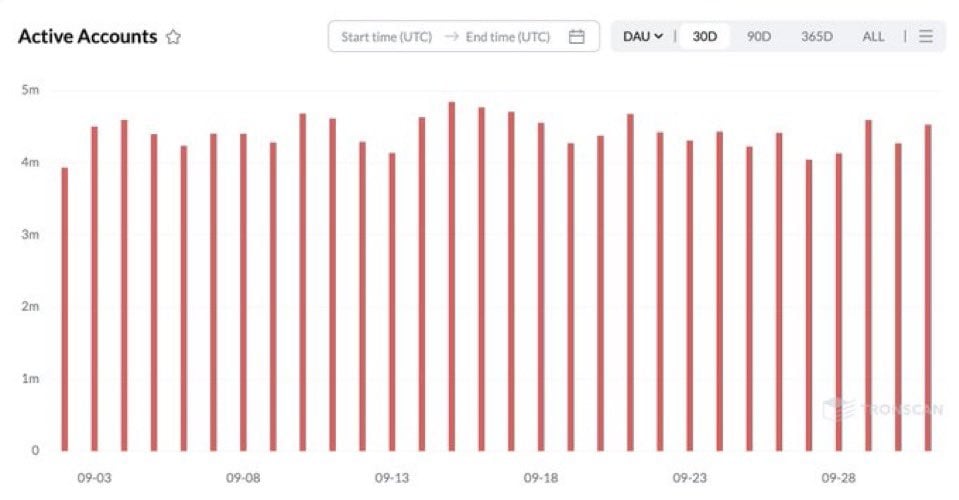
TRONSCAN also reported over 407 million accounts on its platform with over 15.7 billion cumulative transactions. Therefore, if the activity baseline increases as adoption grows, it may provide additional support to TRX’s utility narrative.
Therefore, the activity baseline could strengthen TRX’s utility narrative as adoption expands. However, maintaining growth beyond 4.4 million accounts will determine whether this momentum becomes a larger adoption trend.
TRX ETF demand remains weak
Meanwhile, that on-chain momentum is yet to translate into institutional demand. Despite the launch of the Canary Staked TRX ETF on Cboe, institutional demand has remained limited.
TRON and Canary recently rang the Cboe closing bell to mark the ETF’s launch under the ticker TRXS, yet flows have barely felt the impact.
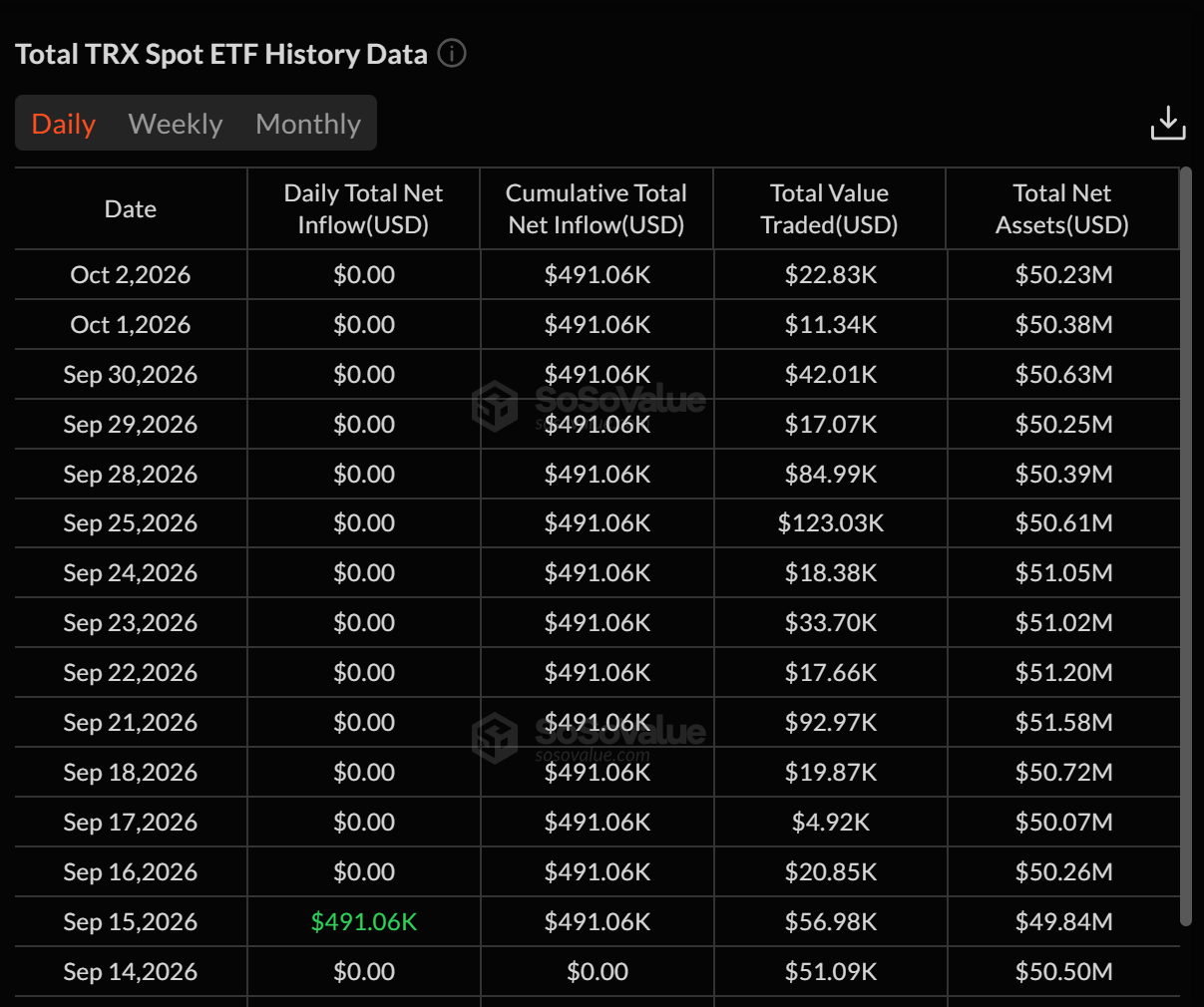
After launching in September, Canary’s ETF recorded its only net inflow on the 15th of September, when investors added $491,060.
Since then, every session through the 2nd of October recorded zero net flows. As a result, this left cumulative inflows unchanged, with total net assets standing at $50.23 million.
That gap becomes more notable given Canary Capital founder and CEO Steven McClurg’s rationale for choosing TRX. During a discussion on X space, he cited TRON’s growing footprint throughout Asia and developing regions as the basis for his decision.
He stated that these regions are supported by both their large Tether [USDT] activity and overall wallet base.
All in all, TRXS allows institutional participants to gain exposure to a well-established use case in their region, but so far investor interest has not followed suit.
Ultimately, unless inflows accelerate, the listing could raise TRON’s visibility without materially increasing TRX demand.
TRX exchange inflows surge
While Canary’s ETF shows weak institutional demand, Binance data suggests a change in TRX flow into the exchange. Net inflows rose to $79.8 million in a single session on the 1st of October.
Notably, this was the largest daily net inflow since the 20th of August, when deposits hit $136.9 million.
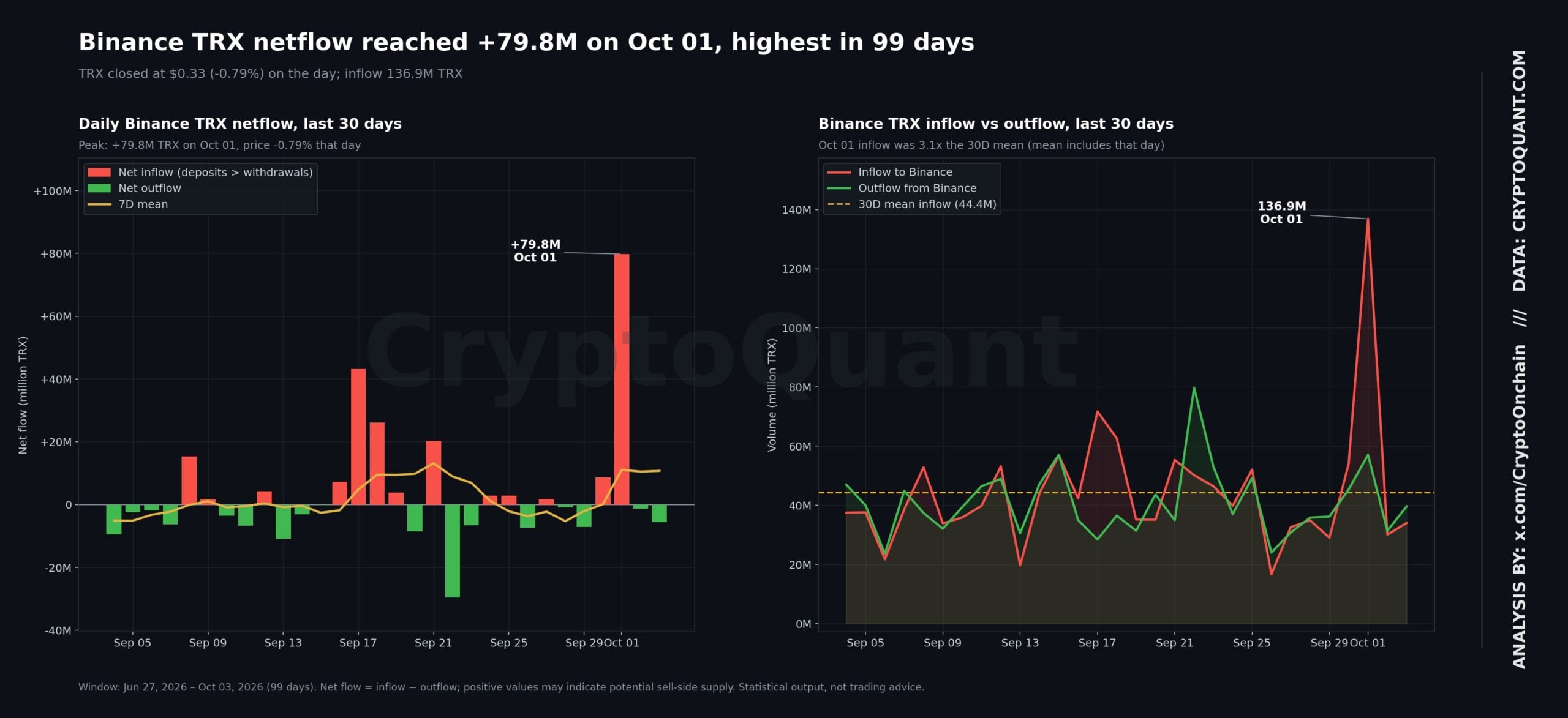
At the same time, total cumulative net flow decreased from $37.7 million on the 1st of October to $35.4 million by the 3rd of October. TRX fell 0.79% that day, while later returns showed little predictive connection.
Thus, exchange supply has risen, but persistence remains unconfirmed.
Final Summary
- TRON sustains over 4.4 million daily active accounts, signaling strong network demand.
- TRX faces weak ETF demand and rising Binance inflows, increasing supply risks.