Bitcoin (BTC) is often praised as the most decentralized cryptocurrency by its supporters, but the truth could be something else. Onchain data shows that only two Bitcoin mining pools mined over 51% of all BTC in the last three years. Here is why it matters and could raise a centralization alert for the leading blockchain network.
Finbold retrieved this information from mempool.space, a Bitcoin data aggregator and block explorer, gathered directly from an observer node. Essentially, this data ranks Bitcoin mining pools per their mined blocks against the total blocks mined in a certain period.
In the last three years from March 28, 2025, the Bitcoin mined blocks were highly dominated by two mining pools.
Precisely, Foundry USA published 46,076 blocks (28.72%) and AntPool 34,365 blocks (21.42%), out of 160,432. Together, these mining pools have mined 90,441 blocks, or 56.37% of the total, in the last three years.
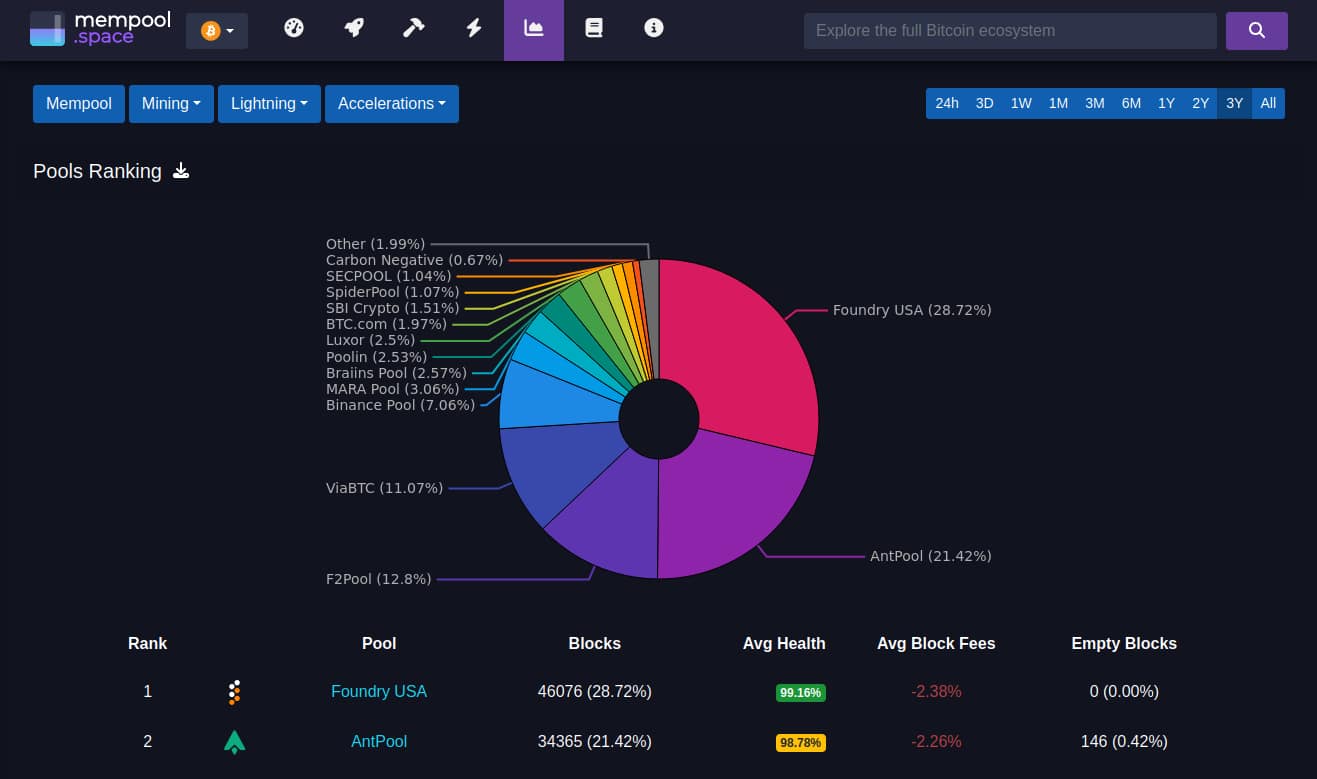
Why does it matter to have only two mining pools above the 51% threshold
According to the whitepaper written by Satoshi Nakamoto, Bitcoin’s value proposition lies in achieving consensus over the blockchain state in a decentralized manner. This is achieved via Bitcoin mining, when special nodes (the miners) use computational power to crack cryptographic hashes, discovering blocks.
Once the blocks are discovered, the miner gains the right to collect the coinbase, which are newly created BTC units. Besides the coinbase, miners can also add transactions to the blocks, collecting their respective fees.
For that, the miner needs to broadcast the discovered block with both their coinbase transaction and all the third-party transactions. Other nodes, as designed by Satoshi, will follow the longer chain, which means the chain with more proof-o-work attached to it, or more added blocks.
There is a theoretical attack called the 51% attack, which, theoretically, could allow a bad actor to make double spends. Moreover, Bitcoin mining pools could deliberately censor transactions from being broadcasted, if they control enough of the mined blocks.
Finbold reported a case where F2Pool, the third-largest Bitcoin mining pool, was caught – and later admitted – filtering transactions.
At its current state, the Bitcoin network has a Nakamoto Coefficient of two. The Nakamoto coefficient is a metric that measures the decentralization of a blockchain network by determining the minimum number of independent entities (like miners) needed to control or disrupt the network.
Bitcoin mining pools and not individual miners or nodes
While each pool is supposedly made of different miners, it’s the pool coordinator, a single entity, responsible for setting the block, broadcasting it to the network, collecting the rewards, and then, if they want, distribute it to their miners.
Therefore, the mining pools are the relevant entities when measuring the current blockchain consensus decentralization state. Not the individual miners or nodes, that can migrate only once it is too late, under a hypothetical attack.
We have also seen cases where transaction fees were not distributed to AntPool miners, as expected, but sent back to the sender.
Furthermore, AntPool was also the protagonist of another discovery by the renowned pseudonym analyst b10c. According to the researcher, data suggests the second-largest mining pool could have strong influence over five other Bitcoin mining pools.
Looking at the merkle branches that mining pools send to miners as part of stratum jobs, it’s clear that the BTCcom pool, Binance pool, Poolin, EMCD, Rawpool, and possibly Braiins* have exactly the same template and custom transaction prioritization as AntPool. https://t.co/KTjFWtTXEP pic.twitter.com/xhCrdvkOH8
— b10c (@0xB10C) April 17, 2024
In conclusion, Bitcoin decentralization could be in check as economies of scale dynamics play out, increasing big miners’ dominance. The more blocks a mining pool discovers, the more rewards it collects from newly issued BTC and transaction fees. This allows for larger investments in infrastructure, easier access to capital, and even more dominance over future block mining.
Featured image from Shutterstock.