
The issuance of new stablecoins has surged since the GENIUS Act was signed into law last year. At the moment, there are over 17 million new stablecoins active across various blockchains.
However, this growth has been accompanied by a sizable rise in fraudulent tokens masquerading as legitimate coins like $USDT and $USDC and fake dApps.
Stablecoin clones skyrocket since July 2025
According to Blockaid’s research, there are over 54,000 bogus tokens impersonating known stablecoins. A total of 2.1 million fake stablecoin instances have been detected across 17 million total token deployments since the GENIUS Act was instituted in July 2025.
Most of these clones target $USDT, with over 34,000 fake tokens detected, followed by $USDC with around 12,000. PayPal’s PYUSD has an impersonation count of 1,600 while DAI follows with 400 tokens.
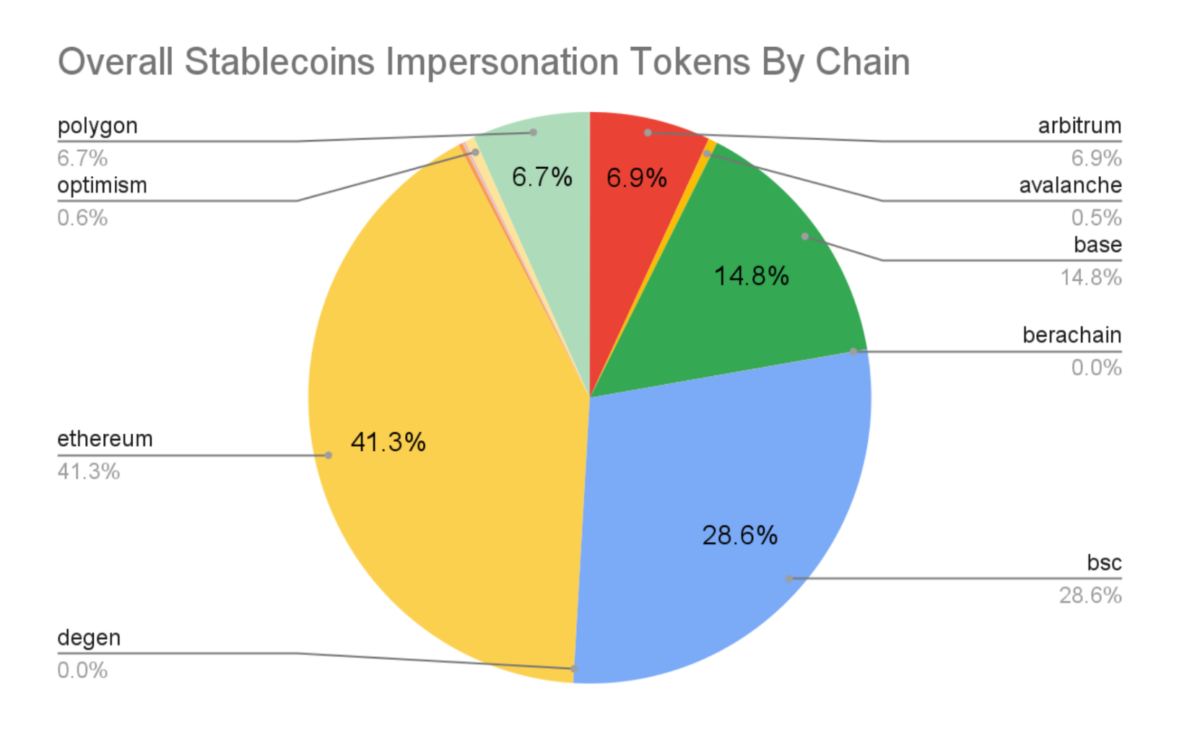
Cloned stablecoins are distributed across various networks. Around 41.3% of fake stablecoin tokens were found on Ethereum, followed by 28.6% on $BNB Smart Chain, and 14.8% on Base. More clones were found on layer-2 networks. Arbitrum recorded 6.9% of fake stablecoins, Polygon had 6.7%, and Optimism had 0.6%. Avalanche had the lowest share with 0.5% of fake stablecoin tokens.
Dusting and memo injection were the most common techniques used to distribute these fake tokens. In dusting, scammers send small amounts of fake tokens to active wallets, hoping users will attempt to swap them on DEXs and discover they have no value.
Memo injection involves inserting fake token symbols or malicious contract addresses into a transaction’s memo field. This attack is common on networks like Solana and Hedera. In this attack, the victim may copy-paste this information and unawarely interact with a malicious contract.
Rogue stablecoin dApps spread across several chains
In addition to cloning stablecoins, hackers have also been deploying rogue dApps.
Over 4,200 malicious dApps have exploited stablecoin branding within their URLs and page titles. Around 80 new malicious dApps using stablecoin branding were detected per week throughout 2025, with a sharp spike in Q4.
A total of 661 new malicious dApps were deployed in a single month between October and November of 2025. 2,100 unique victim addresses have interacted with these malicious dApps according to Blockaid.
The research found that 87% of dApp impersonation cases targeted Ethereum, followed by 10% on $BNB Smart Chain and 1% on Polygon. Ethereum is targeted the most due to its high volume of DeFi activity and the maturity of its stablecoin ecosystem.
After creating websites that mimic legitimate stablecoin platforms, attackers run social media campaigns.
They exploit trending topics on platforms like X and Telegram. They also try to phish people through direct messages and emails. They exploit YouTube and create deepfake celebrity endorsements and fake tutorials.
Once a victim interacts with a malicious dApp, the attack can take several forms, including seed harvesting and compromised transaction approvals.
President Donald Trump signed the GENIUS Act into law in July 2025. The bill faced opposition from bankers and lawmakers.
Bankers feared that the legislation could mark the end of banking as people know it. They also warned that it would create a “Wild West” of unregulated stablecoins and threaten financial stability.
Senator Elizabeth Warren warned that the GENIUS Act could enable tech giants and wealthy financiers to create crypto-based currencies capable of tracking user behavior.
“If Congress doesn’t fix the GENIUS Act, billionaires like Elon Musk and Jeff Bezos could launch stablecoins that track your purchases, exploit your data, and squeeze out competitors,” Warren said on X (formerly Twitter) in June 2025.
However, the GENIUS Act created new opportunities for scammers to exploit the market.
The stablecoin market cap is standing at over $309 billion according to data from CoinGecko. Tether’s $USDT leads with a market cap of $184 billion, followed by Circle’s $USDC with $77 billion.