Blockchain infrastructure developer zkLink has revealed Nexus, a layer-3 network built to connect multiple popular Ethereum rollup solutions, including zkSync, StarkNet and Polygon zkEVM.
zkLink’s app-specific rollups inherit security from Ethereum using zk-SNARKs, and can connect to various general-purpose zero-knowledge (zk) rollups.
By enabling tokens to be easily transferred between one zkLink rollup to another, DeFi applications — including decentralized exchanges and NFT marketplaces — will be able to minimize liquidity fragmentation when sending transactions between different blockchains.
Co-founder of zkLink Vince Yang told Blockworks that Nexus will select just one of the layer-2 networks to execute the zk-SNARK verification process, reducing costs compared to performing verifications directly on Ethereum mainnet.
“Nexus establishes a communication mechanism through Ethereum to coordinate and synchronize the state across different zk-based layer-2 networks, representing the status of the Nexus network on each layer-2,” Yang explained.
Ethereum is the “host” for various zk layer-2 solutions, and each layer-2 solution is able to communicate with Ethereum mainnet through its canonical bridge, Yang said. ZkLink Nexus has deployed a smart contract on Ethereum and connected it with smart contracts that are connected to zk layer-2s.
“Nexus layer-3 is posting proofs and off-chain layer-3 states to the contracts on the layer-2s,” which then post state roots to Ethereum. “This communication is the fundamental guarantee to ensure the state security of Nexus,” he said.
Yang notes that it is through this synchronization mechanism that Nexus is able to achieve Ethereum-equivalent security across various rollup aggregators without compromising security or introducing additional trust assumptions.
This synchronization mechanism is also a key factor in preventing deposit fraud, as it ensures that all deposit information remains accurate across multiple networks, preventing validators from double-signing on a transaction.
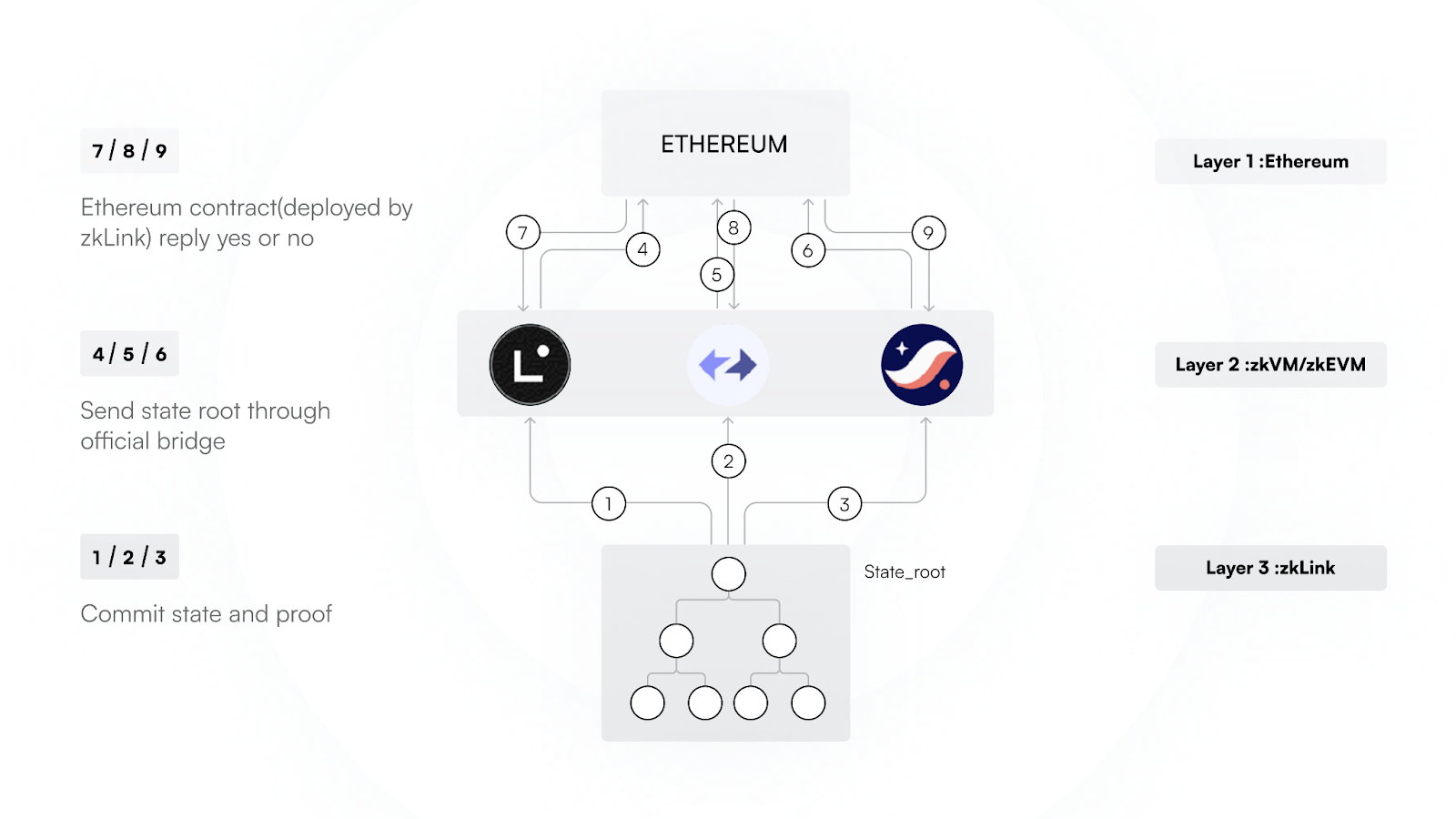
Cross-zkRollup layer-2 states synchronization process | Source: zkLink
A key feature of this architecture is that it also enables customizable data availability, offering multiple ways to store data, including options such as using Ethereum to store data via calldata. It also offers data availability storage through validiums using on-chain layer-2 networks such as Celestia and EigenLayer or off-chain through a data availability committee (DAC).
The Nexus team is also working on a new technology called ‘Multiple Application Recursive Proof Verification’ or MARPV.
MARPV is the ability for recursive ZKPs to consolidate various on-chain verifications into one single verification that is then submitted.
It refers to the further recursive aggregation of proofs from different layer-3 rollups, thereby reducing the number of on-chain verifications and consequently lowering costs, Yang noted. As zkLink Nexus is an app-specific layer-3 rollup solution, more than one Nexus layer-3 rollup will be deployed by different apps.
Kalman Lajko, a senior software engineer at Matter Labs — the team behind zkSync — told Blockworks that zkLink, and applications that connect across multiple rollup ecosystems, solves the crucial issue of fragmentation for the wider Ethereum community.
“This will give developers the ability to achieve greater scale, provide lower gas costs, and offer more app-specific customizability for their projects. The focus now needs to be on not creating additional trust assumptions,” Lajko said.
Native token transfers across chains
Unlike some cross-chain interoperability protocols that send wrapped versions of tokens from one chain to another, Nexus is designed to send native tokens across different zero-knowledge ecosystems.
Yang said tokens minted by the same application on different networks should be recognized as one. The design would allow for users to trade on the zkLink layer, instead of just for cross-chain transactions.
“Both mainstream and emerging coins [will] find their trading pairs on zkLink Nexus, meaning users can achieve better trading depth and a wider range of trading pair selections through zkLink Nexus,” Yang said.
Upcoming work
Nexus currently uses Plonk, a category of zk-SNARKS, as its main zero-knowledge proof (ZKP) system. It is working to develop its own system based on the recent progress of other proof systems, specifically SuperNova and HyperNova, Yang notes.
According to Yang, no other projects are using SuperNova or HyperNova, but there are many teams following the progress of the implementation of these systems. This is largely due to the fact that SuperNova and HyperNova have not yet deployed production-ready engineering states.
“On our roadmap, the zkLink team is working on the implementation of folding schemes and will implement it into the Nexus platform once it gets production ready,” Yang said.